Wind-hardening young trees
Stake only the lowest 1/3 of the trunk in the first 1–2 years and allow the canopy to move in the wind so the tree develops a stronger trunk and root system.

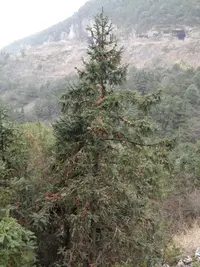
Chinese fir, Cunninghamia lanceolata, is an evergreen coniferous tree valued for its narrow, pyramidal shape and dense whorled branches. It carries stiff, lance-shaped needles that give the canopy a textured, architectural look.
This species is native to China and neighboring parts of East Asia, where it is widely grown for timber and ornamental planting. In gardens and larger properties, it works as a specimen tree or a tall screen.
Cunninghamia lanceolata grows relatively fast but can be sensitive to extreme cold, poor drainage, and prolonged drought, so site choice is important. Those learning how to care for Chinese fir should focus on a sunny position, evenly moist but well-drained soil, and shelter from harsh winds.

Care Difficulty
Moderate Care

Light Preference
Full Sun

Water Requirements
Moderate Water

Temperature Preference
Warm Climate

Hardiness Zone
7–10

Soil Texture
Sandy, Loamy, Organic-rich

Soil pH
Strongly acidic (4.5–5.5), Acidic (5.5–6.5)

Soil Drainage
Moist but well-drained

Fertilization
Minimal (feed rarely)
Scan your plant to receive care tips personalized for your specific plant
Available on iOS and Android
This species prefers bright outdoor conditions with some protection from intense midday sun.
This conifer prefers evenly moist, well-drained soil rather than extremes of wet or dry.
This tree grows best in mild to warm climates with moderate seasonal variation.
This conifer prefers moderate, steady humidity but adapts to a range of household and outdoor conditions.
This species performs best in deep, well-structured, free-draining soil that still holds consistent moisture.
This tree can be grown in containers for several years, but only with careful attention to stability and root space.
Cunninghamia lanceolata benefits from modest, controlled feeding rather than heavy fertilization.
Pruning Cunninghamia lanceolata is mainly corrective, aimed at maintaining a strong structure and safe size.
Chinese fir is typically a landscape tree, so management focuses on careful transplanting rather than frequent repotting.
Propagation of Cunninghamia lanceolata is usually done by seed or semi-hardwood cuttings under controlled conditions.
Cunninghamia lanceolata is moderately cold hardy but benefits from some winter protection in colder regions.

Plant Health Check
Not sure what's wrong with your plant? Check your plant's health inside the app.
This species has been cultivated in China for timber for more than 1,000 years and is one of the country’s classic plantation conifers, valued for its straight trunk and workable, decay-resistant wood.
Although it is a conifer, its needles are relatively soft and flat, arranged in spirals that often twist into comb-like rows along the shoot, giving the crown a somewhat feathery appearance.
In the wild it occurs mainly in warm, humid, hilly regions of southern China at low to mid elevations, where it tolerates high rainfall and acidic, often nutrient-poor soils.

Genetic and fossil evidence indicates that this tree belongs to one of the more ancient lineages of conifers, and some botanists consider it a living relict that has survived since the time when many now-extinct conifer groups were more widespread.
This species is generally fast-growing, especially in its first 10–20 years. In suitable conditions, it can add about 30–90 cm per year, slowing as it matures and if soil, moisture, or climate are suboptimal.
Keep your plants happy and healthy with plant identification, disease detection, and easy care guidance.