Pinch For Bushiness
Pinch back soft shoot tips in late spring and early summer to encourage denser branching and more flower spikes, rather than allowing stems to run long and sparse.

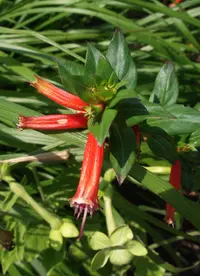
Candy corn plant, Cuphea micropetala, is a sun-loving perennial shrub grown mainly for its tubular orange and yellow flowers that resemble candy corn. It forms a bushy clump with many upright stems and narrow green leaves. In its native range of Mexico, it grows in warm, bright conditions and attracts hummingbirds and other pollinators. In cooler climates, it is often grown as a seasonal accent or kept in containers and protected from frost. The plant is considered relatively easy to grow when given plenty of light, moderate moisture, and well-drained soil, which helps simplify how to care for Candy corn plant.

Care Difficulty
Moderate Care

Light Preference
Full Sun

Water Requirements
Moderate Water

Temperature Preference
Tropical / Frost Sensitive

Hardiness Zone
9–11

Soil Texture
Sandy, Loamy, Organic-rich

Soil pH
Acidic (5.5–6.5), Slightly acidic (6.5–7.0)

Soil Drainage
Moist but well-drained

Fertilization
Light (every 4–6 weeks)
Scan your plant to receive care tips personalized for your specific plant
Available on iOS and Android
This species prefers bright outdoor conditions with strong but not extreme sun exposure.
Cuphea micropetala grows best in evenly moist, well-drained soil that never stays soggy for long.
This plant performs best in warm, frost-free conditions with mild seasonal variation.
This species grows best in moderate, not extreme, humidity.
Cuphea micropetala performs best in loose, well-drained, slightly fertile ground.
This species is well suited to container growing outdoors in warm seasons.
Cuphea micropetala responds well to light, consistent feeding during its active growing season.
Cuphea micropetala benefits from periodic pruning to maintain a compact, floriferous shape.
Cuphea micropetala is most often grown in the ground, with container plants needing occasional repotting or transplanting.
Cuphea micropetala is commonly propagated from softwood cuttings and sometimes from seed.
Cuphea micropetala is only lightly frost tolerant and needs attention in colder climates.

Plant Health Check
Not sure what's wrong with your plant? Check your plant's health inside the app.
This species is native to montane regions of eastern and central Mexico, where it grows on rocky, well-drained slopes and open scrub rather than humid tropical forest.
In its native range and in mild climates, it often reaches peak bloom in late summer to fall and can continue flowering into winter, responding strongly to shortening day length and cooler night temperatures.
The long, tubular, bicolored orange and yellow flowers are adapted to hummingbird pollination, offering abundant nectar and a shape that matches the bill length and feeding behavior of these birds.

Genetic and morphological studies place this species within a group of Cuphea that are considered important model taxa for understanding the evolutionary transition from bee- to bird-pollinated flowers in the Lythraceae family.
This species is a tender perennial shrub in warm climates. In USDA zones 9–11 it can live for many years. In colder regions it is often treated as an annual or overwintered indoors.
Keep your plants happy and healthy with plant identification, disease detection, and easy care guidance.