Use host trees
Establish this mycorrhizal fungus near compatible broadleaf hosts such as oak or beech seedlings, planting spawn or colonized plugs directly into the root zone where fine feeder roots are most dense.

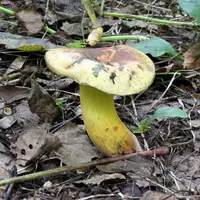
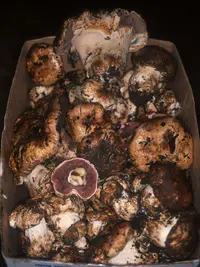
The ink stain bolete, Cyanoboletus pulverulentus, is a wild mycorrhizal fungus that partners with tree roots rather than a typical houseplant or potted specimen. It forms stout, soft-fleshed mushrooms with yellow pores that quickly bruise dark blue to almost black when touched, giving it the ink-stained look.
This species appears in mixed woodlands, often with oak or beech, across parts of North America, Europe, and Asia. It can be challenging to grow intentionally, because it depends on a stable, living tree partner and undisturbed soil. For anyone exploring how to care for ink stain bolete, it is usually more about protecting its woodland habitat than cultivating it indoors or in containers.

Care Difficulty
Hard Care

Light Preference
Partial Shade

Water Requirements
Keep Soil Moist

Temperature Preference
Cool Climate

Hardiness Zone
Unknown

Soil Texture
Loamy, Silty, Organic-rich

Soil pH
Strongly acidic (4.5–5.5), Acidic (5.5–6.5)

Soil Drainage
Moist but well-drained

Fertilization
Minimal (feed rarely)
Scan your plant to receive care tips personalized for your specific plant
Available on iOS and Android
This woodland fungus prefers dappled, forest-like light rather than direct, open sun.
Moist, not saturated, soil is essential for stable Cyanoboletus pulverulentus mycelium development.
This species thrives in mild, temperate conditions similar to a shaded woodland floor.
Humidity is not a primary factor for this outdoor ectomycorrhizal fungus, which associates with tree roots rather than growing as a typical houseplant.
This ectomycorrhizal fungus relies on suitable tree partners and specific forest soil conditions rather than conventional potting substrates.
This species is not suitable for conventional container growing, as it depends on stable, long-term associations with the roots of mature trees in natural soil.
This ectomycorrhizal fungus depends mainly on its tree host and soil conditions, so it needs little direct fertilization.
Pruning is not applicable to Cyanoboletus pulverulentus because it is a wild ectomycorrhizal mushroom, not a woody or leafy plant.
This fungus is rarely container-grown; management focuses on transplanting or establishing suitable host trees and soil rather than moving the organism itself.
Propagation of this ectomycorrhizal mushroom is specialized and not straightforward for typical home growers.
This species is naturally cold hardy in its native temperate range and generally needs no special winter care when growing with suitable host trees.

Plant Health Check
Not sure what's wrong with your plant? Check your plant's health inside the app.
The pores and flesh of this bolete turn an intense inky blue almost immediately when handled or cut, due to rapid oxidation of pigment compounds in the tissue.
It forms ectomycorrhizal associations with broadleaf trees, especially oaks and beeches, exchanging mineral nutrients from the soil for sugars produced by the host tree.
Studies have shown that this species can accumulate relatively high levels of certain heavy metals, such as arsenic, from contaminated soils, which is important for biomonitoring environmental pollution.
This species is considered edible when properly cooked, though opinions on taste vary. Always confirm identification with an expert, avoid polluted areas, cook thoroughly, and never eat specimens that are old, infested, or badly discolored.
Keep your plants happy and healthy with plant identification, disease detection, and easy care guidance.