Use modular trays
Grow this crust fungus on small, removable bark or wood sections placed in shallow trays so individual pieces can be rotated, inspected, or discarded if contamination or heavy pest activity appears.

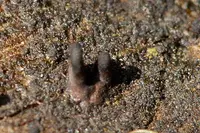
Glyphium elatum is not a typical ornamental plant but a microscopic fungus, usually found on decaying plant material and bark. It forms small, dark, elongated fruiting bodies that are only visible with magnification.
This species occurs mainly in temperate regions, where it lives as a saprobe, helping break down dead plant tissue. Because it is not cultivated as a houseplant or garden feature, there is almost no practical guidance on how to care for Glyphium elatum.
Its growth depends mainly on the presence of suitable dead organic material and adequate ambient moisture, rather than on directed human cultivation or standard potting conditions.

Care Difficulty
Moderate Care

Light Preference
Partial Shade

Water Requirements
Moderate Water

Temperature Preference
Warm Climate

Hardiness Zone
Unknown

Soil Texture
Loamy

Soil pH
Slightly acidic (6.5–7.0)

Soil Drainage
Well-drained

Fertilization
Minimal (feed rarely)
Scan your plant to receive care tips personalized for your specific plant
Available on iOS and Android
This species prefers bright, indirect light with some protection from intense midday sun.
This plant prefers evenly moist but not saturated soil that dries slightly between waterings.
Stable, moderate temperatures support strong growth and reduce stress for this species.
This species prefers moderate, stable humidity to prevent tissue stress and distorted growth.
Glyphium elatum grows best in a loose, evenly moist, and well-aerated substrate.
This species can be grown in containers if moisture and stability are carefully managed.
This species generally grows well in natural or low-input settings, so only light feeding is needed in cultivation.
Pruning needs for Glyphium elatum are modest and mainly focus on plant health and structure.
This species is usually grown in the ground, so transplanting young plants is more common than container repotting.
Propagation of Glyphium elatum is usually done by seed and tends to be slow but reliable under stable conditions.
This species is generally cold hardy in its suitable climate range and usually needs only basic winter care outdoors.

Plant Health Check
Not sure what's wrong with your plant? Check your plant's health inside the app.
Glyphium elatum is a microscopic ascomycete fungus that forms elongated, dark lesions mainly on the leaves of certain grasses, showing a strong preference for specific host species rather than infecting a wide range of plants.
This species produces narrow, elongated ascospores inside flask-shaped fruiting bodies (perithecia), a combination of traits that helps mycologists distinguish it from closely related foliar fungi.
Reports from different continents indicate that this fungus occurs in temperate regions worldwide wherever suitable grass hosts and moist leaf surfaces allow its spores to germinate and infect.
This fungus shows slow, localized growth on its substrate, expanding gradually over weeks to months rather than days. Growth rate depends on temperature, moisture stability, and nutrient availability, and is typically modest even under favorable culture conditions.
Keep your plants happy and healthy with plant identification, disease detection, and easy care guidance.