Cyathea bicrenata Care

Cyathea bicrenata

About Cyathea bicrenata

Cyathea bicrenata is a tree fern, a primitive fern with a trunk-like stem and a crown of large, finely divided fronds. It forms an upright, architectural shape that gives a lush, forest-like look.

This species is naturally found in moist, shaded forests in tropical to subtropical regions, often along slopes or near streams. It prefers consistently damp conditions, high humidity, and sheltered, filtered light.

In cultivation it can be more demanding than common houseplants because it dislikes drying out, low humidity, and harsh sun. Gardeners who learn how to care for Cyathea bicrenata usually grow it in protected outdoor sites or specialized indoor spaces that mimic its cool, moist habitat.

Main Plant Requirements

Care Difficulty

Hard Care

Light Preference

Partial Shade

Water Requirements

Keep Soil Moist

Temperature Preference

Tropical / Frost Sensitive

Hardiness Zone

10–12

Soil Texture

Loamy, Peaty, Organic-rich

Soil pH

Acidic (5.5–6.5)

Soil Drainage

Moist but well-drained

Fertilization

Light (every 4–6 weeks)

Get Personalized Care Plan

Scan your plant to receive care tips personalized for your specific plant

Available on iOS and Android

How to Care for the Cyathea bicrenata

This tree fern prefers bright, gentle light that mimics a forest understory.

  • Provide 2–4 hours of soft morning sun with bright dappled or filtered light for the rest of the day; avoid direct midday and afternoon sun that can scorch fronds.
  • Plant where nearby trees or shade cloth provide 40–70% shade, especially in summer, while still allowing a bright environment to support steady frond growth.
  • Watch fronds: pale, crisping edges indicate too much sun, while elongated, sparse fronds suggest too little light and the need for a slightly brighter position.

This species requires consistently moist, never waterlogged soil around its fibrous root zone.

  • Keep soil evenly moist, allowing only the top 1–2 cm to start feeling slightly dry before watering again, especially during warm, active growth periods.
  • Use deep, slow watering so moisture reaches the full root area, and ensure soil is rich, humus-based, and drains freely to prevent standing water and root rot.
  • Reduce watering frequency in cooler months but do not allow complete drying; drooping, crisp fronds signal underwatering, while yellowing, mushy bases indicate excess moisture.

This fern grows best in mild, consistently cool-to-warm conditions without extremes.

  • Aim for 60–75°F (16–24°C) for active growth, which suits most temperate outdoor, shaded garden conditions in many regions.
  • Protect the crown and trunk from cold below about 40°F (4°C); brief dips to 35°F (2°C) may be tolerated, but freezing conditions can damage new fronds or kill the growing point.
  • In hot spells above 85°F (29°C), increase shade and humidity and ensure soil does not dry out, since high heat combined with low moisture stresses the plant.

This tree fern needs consistently high humidity to maintain healthy fronds.

  • Aim for 60–80% humidity; prolonged levels below 50% lead to browning frond tips and crisping edges.
  • Cyathea bicrenata tolerates brief drier spells but declines in heated, forced-air rooms without added moisture.
  • Increase humidity with room or ultrasonic humidifiers, grouped plants, and pebble trays, avoiding direct misting of new fronds.

This species prefers a loose, moisture-retentive yet well-drained, organic-rich substrate.

  • Use a mix of 50% fine pine bark, 30% peat or coco coir, and 20% perlite to create a fibrous, airy medium.
  • Maintain constant, even moisture; water should drain freely without leaving the mix waterlogged or compacted.
  • Target slightly acidic pH around 5.5–6.5, avoiding limy or strongly alkaline substrates that impair nutrient uptake.
  • Improve aeration by avoiding heavy garden soil and by incorporating coarse bark chips rather than sand, which can cause compaction.

This fern can be grown in containers if given a deep, stable setup that supports its eventual size.

  • Choose a tall, heavy pot to counterbalance the developing trunk and prevent tipping in wind or accidental knocks.
  • Select thicker-walled clay or ceramic to moderate moisture swings and protect surface roots from overheating.
  • Use a wide base container so new fronds have room to arch without crowding hard edges or walkways.

Feeding supports steady frond production but should remain light for this tree fern.

  • Apply a balanced liquid fertilizer at 1/4–1/2 strength every 4–6 weeks during spring–summer to moist soil.
  • Use a gentle, balanced NPK or organic seaweed / fish emulsion rather than strong synthetic lawn products.
  • In ground sites with rich, compost-amended soil, additional feeding for Cyathea bicrenata can be minimal.
  • Stop or greatly reduce feeding in fall–winter when growth slows, to avoid salt buildup and weak, soft tissue.

Pruning is mainly cosmetic and health-focused for this species rather than structural.

  • Best timing is late winter or early spring before strong new frond flush begins.
  • Remove only dead, diseased, or severely damaged fronds at the base with clean, sharp pruners or a folding saw.
  • Thin very crowded, shading lower fronds to improve air movement and reduce fungal problems.
  • Avoid cutting into the central crown of Cyathea bicrenata, as this can permanently damage the growing point.

Transplanting and any container shifting should be infrequent and done with care due to the sensitive root system.

  • Look for roots circling the pot, emerging from drainage holes, or persistent slow growth as signs to move up 1 pot size.
  • Carry out repotting or transplanting in spring–early summer, aiming for 2–4 year intervals at most.
  • Lift with a solid root ball, disturbing roots as little as possible, and set at the same depth in a moist, humus-rich, free-draining mix.
  • Shade Cyathea bicrenata after moving, keep soil evenly moist, and avoid strong wind until new fronds resume normal growth.

Propagation of this fern is possible from spores but is slow and technically demanding for most home growers.

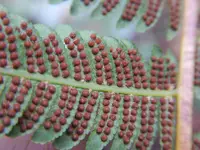
  • Collect ripe spores from the underside of mature fronds in late summer when sori turn brown.
  • Sow spores on sterilized, fine, moist peat-based or fern-specific medium, then cover to maintain 90–100% humidity.
  • Provide stable warmth around 70–75°F with low to medium light and avoid direct sun on the covered container.
  • Gametophytes and tiny sporophytes of Cyathea bicrenata develop slowly; keep conditions sterile and moist for many months.

This tree fern is frost-sensitive and benefits from targeted winter protection in most temperate climates.

  • Avoid exposure below about 30°F; in colder regions, grow in containers that can be moved to a cool, bright, frost-free space.
  • Mulch the root zone with 5–10 cm of leaf mold or bark to moderate soil temperature and conserve moisture.
  • Wrap the crown and upper trunk loosely with breathable frost cloth or burlap during freezing nights, then remove during mild spells.

Care Tips

Protect Soft Trunk

Wrap the trunk loosely with breathable horticultural fleece or shade cloth during cold snaps or strong winds to prevent mechanical damage and desiccation of the soft tissues.

Stage Frond Unfurling

Keep the crown area free of debris and avoid overhead obstructions so new croziers (coiled fronds) can extend fully without kinking, which reduces breakage and deformation.

Mulch For Root Zone

Apply a 5–8 cm layer of fine bark or leaf mold around, but not against, the trunk to keep surface roots cool and moist and to mimic the constant litter layer of a forest floor.

Build Wind Shelter

Install a low, open lattice or use tall companion shrubs on the windward side to diffuse strong winds, which helps maintain intact fronds and reduces water loss through transpiration.

Monitor Crown Health

Inspect the crown regularly for rot or pests and irrigate so that water drains away instead of pooling, since the plant’s growing point is in the crown and is critical when caring for Cyathea bicrenata.

Common Pests and Diseases

Scale insects

This pest feeds on plant sap, often settling along the stipe bases and undersides of fronds, causing yellowing and a general decline in vigor. Symptoms include sticky honeydew on nearby surfaces and sooty mold growth on fronds.

Solution

Physically remove colonies with a soft cloth or cotton swab dipped in diluted alcohol, then rinse fronds with lukewarm water to clear honeydew. For ongoing Cyathea bicrenata care in shaded, humid sites, improve air movement without lowering humidity too much and use repeated applications of a light horticultural oil, making sure to coat the stipe bases and frond undersides.

Fern aphids

These insects cluster on soft, new croziers and young fronds, causing deformation and pale, distorted growth. Symptoms include sticky honeydew and increased attraction of ants on and around the plant.

Solution

Dislodge colonies by spraying the plant thoroughly with a firm stream of water, focusing on unfurling fronds and sheltered crown areas. If populations persist, use a mild insecticidal soap or soft soap solution applied in the early morning, repeating weekly until new growth emerges clean and undistorted.

Rhizoctonia crown rot

This disease attacks the central crown and upper rhizome, especially in warm, poorly drained conditions, leading to browning and collapse of emerging fronds. Symptoms include a foul smell at the crown and dark, sunken tissue where fronds join the trunk or rhizome.

Solution

Remove and discard all affected fronds and soft, discolored crown tissue, then improve drainage and reduce watering so the crown is never left waterlogged. In outdoor plantings, lift and replant in a raised, free-draining site, and in pots, repot into fresh, sterile, well-aerated mix and avoid overhead watering that keeps the crown constantly wet.

Bacterial leaf blight

This disease causes water-soaked, translucent spots on pinnae that turn brown and irregular, sometimes with yellow halos, starting on older fronds in dense, stagnant humidity. Symptoms include rapid spread across neighboring pinnae under warm, wet conditions with frequent frond wetting.

Solution

Promptly remove and discard affected fronds, sterilizing tools between cuts, and avoid wetting foliage when watering. Increase spacing and airflow around the plant, and in very valuable specimens consider using a copper-based bactericide labeled for ferns, applied strictly according to label directions while monitoring for phytotoxicity on test fronds first.

Fern mites

This pest thrives in consistently humid, sheltered crowns, where microscopic mites feed on delicate tissues and cause bronzing, fine speckling, and gradual thinning of fronds without obvious webbing. Symptoms include poor new frond expansion and a dusty, rough texture on affected pinnae under magnification.

Solution

Increase gentle air movement and regularly hose down the plant, directing lukewarm water into the crown and under fronds to disrupt mite populations. For continued problems, apply a miticide or insecticidal soap specifically safe for ferns, treating both upper and lower leaf surfaces and repeating according to product guidance to cover the full mite life cycle.

Interesting Facts

Tree fern trunk structure

This species develops a woody, vertically elongated trunk made of persistent leaf bases and roots rather than true wood, allowing it to reach several meters in height while remaining flexible in strong mountain winds.

Habitat in Asian cloud forests

Cyathea bicrenata is naturally found in moist, shaded montane forests of parts of East and Southeast Asia, where it grows along stream banks and ravines exposed to constant mist and high air humidity.

Frond and spore features

Its large, twice- or thrice-pinnate fronds carry sori (spore clusters) arranged in rows beneath the leaf segments, a reproductive pattern that helps botanists distinguish it from similar tree fern species when studying wild populations.

FAQs about Cyathea bicrenata

This tree fern is generally slow to moderate growing. In suitable outdoor conditions, it may add around 10–30 cm of trunk per year, with faster growth in consistently warm, humid, sheltered sites with rich, moist soil.

Grow Healthy Plants with Botan Care

Keep your plants happy and healthy with plant identification, disease detection, and easy care guidance.

Botan plant care app — identify plants on mobile

Explore More Plants