Rotate host wood
Periodically turn or replace small logs or branches used as substrate so that colonization stays even and fruiting bodies receive balanced air exposure, which reduces localized decay and desiccation issues.

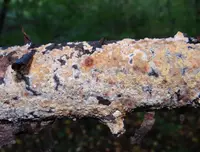
Cylindrobasidium evolvens is not a traditional houseplant but a wood-decay fungus that forms thin, crust-like patches on dead or weakened woody material. It often appears as whitish to pale brown, smooth to slightly wrinkled layers that spread across bark or cut wood surfaces.
This species is found mainly in temperate regions, especially in forests and landscaped areas where pruned branches, stumps, or stressed trees are present. It plays a role in breaking down dead wood, which can be useful in natural ecosystems but undesirable on valuable ornamental trees.
Because it is a fungus associated with wood decay, how to care for Cylindrobasidium evolvens is usually not a concern for indoor growers, and management focuses more on tree health and sanitation than active cultivation.

Care Difficulty
Moderate Care

Light Preference
Partial Shade

Water Requirements
Moderate Water

Temperature Preference
Warm Climate

Hardiness Zone
Unknown

Soil Texture
Loamy

Soil pH
Slightly acidic (6.5–7.0)

Soil Drainage
Well-drained

Fertilization
Minimal (feed rarely)
Scan your plant to receive care tips personalized for your specific plant
Available on iOS and Android
This wood-decaying fungus thrives in shaded forest conditions rather than direct sun.
This species depends on consistently moist but not waterlogged wood or organic debris.
This fungus prefers cool to mild conditions and declines in extreme heat or hard frost.
This wood-decay fungus has low humidity demands but reacts to very dry air over time.
This species is a wood-decaying fungus and does not use potting soil in the usual sense, but substrate conditions still matter.
This species is not well suited to decorative container growing, but it can be maintained in tubs or boxes for decay studies or controlled culture.
This saprophytic fungus usually does not need additional fertilizer when growing on naturally decaying wood or organic debris.
Cylindrobasidium evolvens does not benefit from horticultural pruning, since it functions as a wood-decaying fungus rather than an ornamental plant.
Transplanting is rarely relevant, as this fungus establishes directly on wood or plant debris rather than in containers.
Propagation of this species is normally left to natural spore spread and is not a standard part of Cylindrobasidium evolvens care.
This fungus is cold hardy in its natural range and generally does not require special winter care.

Plant Health Check
Not sure what's wrong with your plant? Check your plant's health inside the app.
This fungus forms thin, crust-like fruiting bodies on dead wood that often peel away from the substrate at the margin as they age, giving a characteristically rolled or lifting edge visible with the naked eye.
It is a white-rot basidiomycete that breaks down both lignin and cellulose in hardwoods, playing a key role in nutrient cycling and structural decomposition of fallen branches in forests and managed landscapes.
The species occurs across temperate regions in both hemispheres and is most frequently recorded on broadleaf hosts such as beech and apple, including in orchards and ornamental plantings where it colonizes pruned or dead wood.
This fungus spreads locally along dead or weakened wood and bark but is not considered aggressively invasive in managed gardens. It colonizes suitable substrates gradually, especially in damp, shaded sites with abundant woody debris.
Keep your plants happy and healthy with plant identification, disease detection, and easy care guidance.