Support And Training
Provide a thin trellis, wire frame, or horizontal rail and loosely tie young stems with soft ties so the plant can climb and form a tidy, easily managed structure instead of a tangled mass.


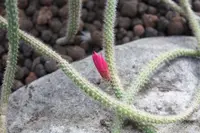
Cynanchum viminale, commonly called caustic vine or rubber vine, is a succulent, leafless climber with narrow, green, pencil-like stems. It often forms intricate, twining mounds or cascades.
This species is native to arid and coastal regions of Africa, the Middle East, India, and parts of Asia, where it copes with heat, drought, and poor soils. Its tolerance of dryness and high light can make it appealing for low-maintenance collections.
However, rapid stem growth and a tendency to sprawl mean it needs firm support and regular shaping in cultivation. Understanding how to care for Caustic Vine starts with respecting its need for bright light, very free-draining soil, and careful watering to avoid rot.

Care Difficulty
Easy Care

Light Preference
Full Sun

Water Requirements
Low Water

Temperature Preference
Tropical / Frost Sensitive

Hardiness Zone
10–12

Soil Texture
Sandy, Loamy, Rocky

Soil pH
Slightly acidic (6.5–7.0), Neutral (7.0)

Soil Drainage
Well-drained

Fertilization
Minimal (feed rarely)
Scan your plant to receive care tips personalized for your specific plant
Available on iOS and Android
This succulent vine thrives in bright, warm conditions that mimic its native arid habitats.
This drought-adapted plant prefers infrequent, deep watering and fast-drying soil.
This species prefers warm, dry conditions and has low tolerance for frost.
This drought-adapted succulent vine tolerates typical indoor humidity and does not need special humidity management.
This species needs a very free-draining, mineral-rich mix that dries quickly between waterings.
This vine grows well in containers when drainage and stability are carefully managed.
This drought-adapted species needs only light feeding when grown in containers or poor substrates.
Pruning Cynanchum viminale is mainly for size control and to keep the vine tidy in cultivation.
Container-grown plants need infrequent repotting because this species grows from a relatively tough, drought-tolerant root system.
This species is most often propagated from stem cuttings taken during the warm growing season.
In mild, frost-free climates this plant needs little winter attention, but container plants in colder regions require some protection.

Plant Health Check
Not sure what's wrong with your plant? Check your plant's health inside the app.
This species often lacks true leaves and instead performs most of its photosynthesis in its green, pencil‑like succulent stems, an adaptation to very dry and high‑light habitats in Africa, Arabia, India, and parts of Asia–Pacific.
The vine exudes a white, milky latex when cut or damaged; this latex is typical of the Apocynaceae family and deters many herbivores because of its sticky texture and chemically active compounds.
It naturally occurs from eastern Africa across the Arabian Peninsula and into South and Southeast Asia and northern Australia, often in coastal scrub and rocky habitats, showing a strong tolerance to salt spray and intense sun.

In parts of its range, this species can grow as a leafless, tangled mass over shrubs and small trees, where its dense, cylindrical stems form a living, three‑dimensional lattice that provides shelter and perching sites for small animals and invertebrates in otherwise exposed coastal and arid landscapes.
This species is a twining, leafless succulent vine. Stems coil around nearby supports, forming long, trailing or climbing strands. Without something to climb, it tends to sprawl along the ground or over pot edges.
Keep your plants happy and healthy with plant identification, disease detection, and easy care guidance.