Staggered sowing
Sow seeds in 2–3 small batches spaced 2 weeks apart to spread out flowering time and reduce the risk of losing the whole crop to a single heatwave or pest outbreak.

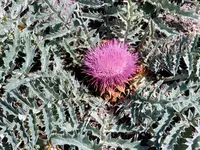
Cynara tournefortii is a thistle-like perennial from the Mediterranean region, related to the artichoke. It forms dense rosettes of deeply lobed, spiny leaves and tall flowering stems. Purple flower heads appear above the foliage and attract many pollinators. The plant has a coarse, architectural look, so it suits wild, dry, or low-maintenance garden areas rather than small containers.
This species is adapted to hot, dry summers and poor, well-drained soils, which can make it relatively undemanding once established. Understanding how to care for Cynara tournefortii starts with providing strong sun, sharp drainage, and avoiding prolonged wet conditions around the roots.

Care Difficulty
Moderate Care

Light Preference
Full Sun

Water Requirements
Moderate Water

Temperature Preference
Warm Climate

Hardiness Zone
8–10

Soil Texture
Sandy, Loamy, Organic-rich

Soil pH
Slightly acidic (6.5–7.0), Neutral (7.0)

Soil Drainage
Well-drained

Fertilization
Minimal (feed rarely)
Scan your plant to receive care tips personalized for your specific plant
Available on iOS and Android
This Mediterranean perennial needs strong outdoor light to form compact rosettes and sturdy flowering stems.
Watering should support deep root development while avoiding persistent soil saturation.
This species prefers mild, dry climates and struggles with hard frost or extreme humidity.
This Mediterranean perennial handles relatively dry air and rarely needs special humidity control.
Cynara tournefortii prefers deep, well-drained, moderately fertile soil that does not stay wet.
This species can be grown in large containers, but only when specific structural needs are met.
This Mediterranean perennial benefits from moderate feeding to support leafy growth and flowering.
Thoughtful pruning keeps this thistle-like perennial tidy and encourages strong flowering.
This deep-rooting perennial is best grown in open ground, with transplanting done sparingly and at the right stage.
New plants are most reliably raised from seed under warm, bright conditions.
This species is adapted to mild, dry winters and has limited tolerance of hard freezing.

Plant Health Check
Not sure what's wrong with your plant? Check your plant's health inside the app.
This thistle is naturally restricted to the Iberian Peninsula, with populations mainly in central and southern Spain and parts of Portugal, where it grows in dry, open habitats and disturbed fields.
Unlike the better-known perennial globe artichoke, this species is an annual that completes its entire life cycle in a single growing season, relying on large seed production for population persistence.
Its leaves and large involucral bracts bear strong, stiff spines that provide an effective mechanical defense against grazing herbivores in Mediterranean grassland environments.

Taxonomic and field studies have shown that this species is closely related to the cultivated artichoke group yet remains a distinct wild lineage, making it useful in research on the evolution and domestication of edible Cynara crops.
Parts of this species are related to edible artichokes, but this wild taxon is not commonly cultivated or standardized for food. Identification mistakes are easy, so it is safer to treat it as ornamental, not as a vegetable.
Keep your plants happy and healthy with plant identification, disease detection, and easy care guidance.