Golden Cyrtochilum Care (Cyrtochilum aureum)

Golden Cyrtochilum

About Golden Cyrtochilum

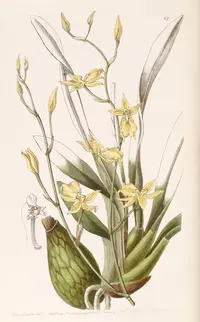
Golden Cyrtochilum, botanically known as Cyrtochilum aureum, is an epiphytic orchid that typically grows on trees in cool, humid mountain forests of South America. It produces arching or pendulous sprays of golden-yellow flowers that stand out against narrow, often slightly leathery leaves.

This species prefers good air movement, consistent moisture, and a loose, airy orchid substrate rather than dense soil. Its need for stable humidity and cooler conditions makes it more suitable for growers with some orchid experience. Understanding how to care for Golden Cyrtochilum helps reduce stress on the plant and maintain reliable flowering over time.

Main Plant Requirements

Care Difficulty

Hard Care

Light Preference

Partial Shade

Water Requirements

Keep Soil Moist

Temperature Preference

Tropical / Frost Sensitive

Hardiness Zone

Unknown

Soil Texture

Peaty, Organic-rich, Loamy

Soil pH

Acidic (5.5–6.5)

Soil Drainage

Moist but well-drained

Fertilization

Moderate (every 2–4 weeks)

Get Personalized Care Plan

Scan your plant to receive care tips personalized for your specific plant

Available on iOS and Android

How to Care for the Golden Cyrtochilum

This orchid prefers bright, filtered light that mimics high-elevation forest conditions.

  • Provide 4–6 hours of bright, indirect light daily, with gentle morning sun and protection from harsh midday and afternoon rays.
  • Grow Cyrtochilum aureum under a shade cloth or dappled canopy outdoors, aiming for about 50–70% shade to prevent leaf scorch.
  • Insufficient light leads to dark, soft foliage and weak flowering; gradually increase light in late winter–spring and reduce exposure during the strongest summer sun.

This species prefers evenly moist conditions with excellent drainage and brief drying at the surface between waterings.

  • Water when the top 1–2 cm of the medium feels just dry, using thorough soakings that allow excess water to drain completely.
  • In active growth and flowering, expect to water more often, while in cooler months extend intervals but never let the root zone dry out completely.
  • Watch for yellowing, limp leaves or blackened roots as signs of overwatering, and wrinkled pseudobulbs or folded leaves as signs of underwatering; use a loose, fast-draining orchid mix.

This cloud-forest orchid prefers cool to intermediate temperatures with limited extremes.

  • Aim for daytime temperatures of 65–75°F (18–24°C) and nights of 50–60°F (10–16°C) to support steady growth and flowering.
  • Protect the plant from frost; growth slows sharply below about 45°F (7°C), and repeated exposure near freezing can damage leaves and roots.
  • It tolerates brief heat up to 80–85°F (27–29°C) if shaded and well ventilated, but sustained heat above this range can cause leaf stress and reduced flowering.

This orchid prefers consistently moist air to avoid leaf and root stress.

  • Aim for 60–80% humidity; prolonged levels below 40% cause wrinkled pseudobulbs and dry leaf tips in Golden Cyrtochilum.
  • Use a humidity tray, grouped plants, or a room humidifier rather than frequent misting, which encourages fungal spots.
  • Increase air movement with a small fan so high humidity does not lead to rot around roots and leaf bases.

Cyrtochilum aureum grows best in a loose, airy epiphytic mix rather than dense potting soil.

  • Use a medium-grade orchid bark base with added perlite and a little sphagnum moss to hold moderate moisture without staying wet.
  • Ensure very fast drainage; water should run through freely and the mix should feel barely damp, not compact or sticky, within a day.
  • Keep pH slightly acidic to neutral (pH 5.5–7.0), which suits most orchid fertilizers and supports nutrient uptake.
  • Avoid peat-heavy, garden, or clay-based mixes that pack down, reduce aeration, and suffocate fine orchid roots.

This species is suitable for container culture when the pot and support system match its epiphytic growth habit.

  • Choose a relatively narrow but deep orchid pot or basket that allows roots to grip bark while staying well aerated.
  • Use slotted or net pots set inside a cache pot so roots get airflow yet the container remains stable and easy to handle.
  • Secure a stake or small trellis directly in the potting mix to support arching spikes and prevent the container from tipping over.

This orchid benefits from light, consistent feeding during active growth but is sensitive to excess salts.

  • Use a balanced orchid fertilizer (roughly 20-20-20) at 1/4–1/2 strength for caring for Golden Cyrtochilum in containers or mounted culture.
  • Feed every 2–3 weeks during spring–early fall when new roots and pseudobulbs develop.
  • Leach the medium with plain water once a month to flush accumulated salts and prevent root burn.
  • Reduce feeding to once every 4–6 weeks in winter or when growth pauses, always on moist, not dry, roots.

Cyrtochilum aureum needs only light, maintenance-style pruning focused on spent and unhealthy growth.

  • Trim spent flower spikes back to the base after blooming using clean, sharp scissors or pruners.
  • Remove dead, shriveled, or blackened pseudobulbs and leaves to limit fungal problems and improve airflow.
  • Cut only clearly damaged or diseased tissue, avoiding green pseudobulbs that still store water and nutrients.
  • Disinfect tools with alcohol between plants to reduce the spread of viruses and other pathogens.

This orchid prefers infrequent disturbance and should be repotted only when the medium breaks down or the root system outgrows its space.

  • Check for crowded roots, pseudobulbs pressed against the pot edge, or decomposed mix as signs it needs repotting every 2–3 years.
  • Plan repotting for late winter–early spring, just as new root tips appear, to help the plant reestablish quickly.
  • Gently tease roots free, trim rotted portions, and shift into a slightly larger pot with fresh, airy orchid bark-based medium.
  • Keep the plant shaded and humidity higher for 1–2 weeks after repotting, with slightly reduced watering to limit root stress.

Propagation of Cyrtochilum aureum is typically done by careful division rather than seed in home settings.

  • Divide mature plants in late winter–early spring when new growth starts and repotting is already planned.
  • Ensure each division carries at least 3–4 healthy pseudobulbs and active roots to maintain vigor.
  • Use sterile tools to cut the clump, dust cut surfaces with fungicidal powder if available, and pot divisions in fresh medium.
  • Provide bright, indirect light, high humidity, and gentle air movement to support rooting and establishment.

This orchid is not frost tolerant and needs protected, cool to intermediate indoor conditions during winter in most climates.

  • Maintain indoor temperatures near 55–65°F at night and 65–75°F by day, avoiding drafts and cold windowsills.
  • Keep humidity around 50–70% with trays or humidifiers while ensuring good air movement to prevent fungal issues.
  • Reduce watering slightly in shorter days, allowing the medium to nearly dry between waterings but not remain dry for long.

Care Tips

Mounting Technique

Grow this orchid on a cork slab or tree fern mount with a thin layer of sphagnum only around the roots, which improves air movement and reduces the risk of rot in humid conditions.

Cool-Night Cycling

Provide a regular night temperature drop of 10–15°F by placing plants near a slightly open window or in a cooler room at night to support flowering and overall vigor.

Airflow Management

Use a small oscillating fan on a low setting near, but not directly on, the plant to keep leaves and roots dry between waterings and discourage fungal spots.

Inflorescence Support

Once spikes appear, guide them early with slim, tall stakes and soft clips so the long, often arching inflorescences develop without kinking or snapping under their own weight.

Seasonal Light Shift

In winter, move plants a little closer to bright windows or use a timer-controlled grow light to maintain consistent day length, which helps when growing Golden Cyrtochilum in dimmer indoor environments.

Common Pests and Diseases

Scale insects

These insects feed on sap along pseudobulbs and leaf bases, often appearing as small brown or tan bumps and causing yellowing and weakened growth. This pest favors the sheltered crevices typical of clustered Cyrtochilum pseudobulbs.

Solution

Isolate the plant, then remove visible scale with a cotton swab dipped in 70% isopropyl alcohol and gently wipe affected areas, including under leaf sheaths. Improve air movement around the plant and repeat alcohol swabs weekly; for heavier infestations, use a systematic insecticide labeled for orchids according to directions.

Spider mites

These insects thrive on thin orchid leaves in warm, dry air, causing stippling, fine webbing, and a dull or silvery leaf surface. This pest is more common when Cyrtochilum is kept too dry or in stagnant conditions.

Solution

Rinse foliage thoroughly with lukewarm water, including leaf undersides, to physically remove mites, then increase humidity and airflow to make conditions less favorable. For persistent infestations, apply a miticide or insecticidal soap labeled for orchids, repeating at 7–10 day intervals to target new hatchlings.

Bacterial brown spot

This disease produces water-soaked, translucent patches on leaves that turn brown and sunken, often starting near leaf tips or mechanical injuries. Symptoms include a rapid spread in warm, humid, low-airflow conditions typical of tight orchid growing spaces.

Solution

Remove and discard affected leaf areas with a sterile blade, cutting well into healthy tissue, then keep the plant drier on the foliage and improve air circulation. Avoid overhead watering, disinfect tools between plants, and, if spread continues, apply a copper-based bactericide labeled for orchids according to package directions.

Leaf tip blight

This disease shows as browning and dying-back of the long, narrow leaf tips, sometimes with a distinct line between healthy and damaged tissue. Symptoms include progression from the tip downward when humidity is high but air movement and fertilizer management are poor.

Solution

Trim off affected tips with sterile scissors, cutting into firm, green tissue, and reduce any fertilizer buildup by flushing the medium thoroughly with clean water. Maintain steady but not excessive humidity with good airflow and avoid leaving water droplets on leaf tips for extended periods.

Fungal leaf spots

This disease causes small, dark or yellow-rimmed spots on leaves that may enlarge and merge, especially when water sits on foliage in cool or humid conditions. Symptoms include more pronounced spotting on older leaves and areas shaded by overlapping foliage or pseudobulbs.

Solution

Remove badly spotted leaves or sections, then adjust watering to keep foliage dry, especially in the evening, and space plants to improve airflow. Apply a broad-spectrum fungicide suitable for orchids if new spots keep appearing, following label instructions and alternating products if used repeatedly to reduce resistance risk.

Interesting Facts

High-altitude specialist

This orchid is native to high-elevation cloud forests of the northern Andes, where it grows in cool, very humid, and often misty conditions along mountain slopes and ridges.

Long, wiry inflorescences

It produces slender, branching flower spikes that can extend well beyond the foliage, carrying numerous yellow flowers spaced along the length rather than clustered.

Showy golden flowers

The species name aureum refers to its rich yellow to golden flowers, which often display contrasting darker markings on the lip and segments, making the blooms stand out in dim, foggy forest light.

FAQs about Golden Cyrtochilum

This species usually blooms once a year, often in cooler, drier seasons after a period of steady growth. Healthy, mature plants may occasionally produce a second flush if light, nutrition, and humidity remain stable.

Grow Healthy Plants with Botan Care

Keep your plants happy and healthy with plant identification, disease detection, and easy care guidance.

Botan plant care app — identify plants on mobile

Explore More Plants