Use clean substrates
Collect leaf litter or woody debris only from unpolluted, pesticide-free areas and avoid substrates from roadside verges or heavily managed lawns to reduce chemical and heavy metal exposure for the mycelium.

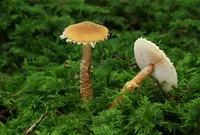
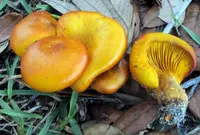
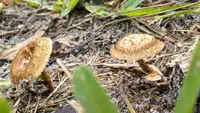
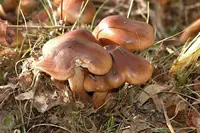
Earthy powdercap, Cystoderma amianthinum, is a small woodland mushroom rather than a leafy houseplant. It forms low clusters of yellow to ochre caps dusted with a fine, powdery surface and a slender, pale stem.
This species occurs widely in temperate regions, especially in mossy conifer forests and heathland, often appearing in autumn on soil rich in decaying organic matter. It is not commonly cultivated, and attempts to care for Earthy Powdercap at home are challenging because it depends on complex natural soil fungi communities.
In nature it favors cool, moist, well-drained, slightly acidic habitats with stable humidity and undisturbed ground cover.

Care Difficulty
Hard Care

Light Preference
Partial Shade

Water Requirements
Keep Soil Moist

Temperature Preference
Cool Climate

Hardiness Zone
Unknown

Soil Texture
Loamy, Peaty, Organic-rich

Soil pH
Strongly acidic (4.5–5.5), Acidic (5.5–6.5)

Soil Drainage
Moist but well-drained

Fertilization
Minimal (feed rarely)
Scan your plant to receive care tips personalized for your specific plant
Available on iOS and Android
This woodland fungus prefers cool, subdued light that mimics the forest floor.
This species thrives in consistently moist, well-drained, organic-rich substrates.
This fungus prefers cool to mild conditions typical of temperate woodlands.
Humidity is not a major factor for Cystoderma amianthinum, which naturally fruits in open, outdoor conditions.
This woodland mushroom prefers moist, aerated, organic-rich ground rather than compacted or heavily amended garden soil.
This species is generally unsuitable for container growing because it relies on complex soil fungal networks in the ground.
Cystoderma amianthinum, a woodland fungus, does not require routine fertilization when growing in natural soil rich in organic matter.
Cystoderma amianthinum does not need conventional pruning, but fruiting bodies can be tidied for appearance or spore management.
This fungus is rarely grown in containers; management focuses on careful transplanting or relocation of its substrate rather than true repotting.
Propagation of Cystoderma amianthinum is specialized and usually handled by experienced growers or researchers rather than casual gardeners.
In most temperate climates, Cystoderma amianthinum requires minimal winter care because the mycelium persists quietly in the soil or substrate.

Plant Health Check
Not sure what's wrong with your plant? Check your plant's health inside the app.
This species is named for its finely granular, powdery cap surface, which often looks dusted with ochre to rusty particles that can be easily rubbed off when touched.
In the field it can be confused with some small amanitas and galerinas, including deadly species, so mycologists strongly advise against collecting it for consumption despite its small size and modest appearance.
It is especially frequent in cool, acidic grasslands, heathlands, and mossy conifer woods across northern and montane regions, often fruiting among mosses on nutrient-poor soils where many larger fungi are sparse.

Molecular and microscopic studies show this mushroom has a distinctive ornamented ring zone made of granular veil remnants on the stem, which is a key diagnostic feature that helps separate it from several closely related Cystoderma species in mixed-species collections.
This species is considered inedible and is often treated as potentially poisonous due to possible confusion with dangerous look-alikes. It should not be eaten, and foraging should only be done with expert mycological identification.
Keep your plants happy and healthy with plant identification, disease detection, and easy care guidance.