

Use sacrificial host
Maintain a steady supply of small, healthy boletes or similar fleshy mushrooms as sacrificial hosts, as the fungus only develops fully when parasitizing suitable fruiting bodies.

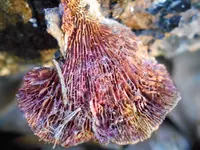
Orange polypore mould, Hypomyces aurantius, is a parasitic fungus rather than a traditional plant. It usually grows as a bright orange crust or powdery layer over host polypore mushrooms, often distorting their shape and texture. In nature, it is found on dead or decaying wood where polypore fungi are already established.
This species depends on suitable host fungi and stable moisture, so it is not as straightforward to cultivate as common houseplants or decorative mushrooms. For those who want to learn how to care for orange polypore mould, it generally prefers cool, shaded, consistently humid environments with decaying wood as the base substrate.

Care Difficulty
Moderate Care

Light Preference
Partial Shade

Water Requirements
Keep Soil Moist

Temperature Preference
Warm Climate

Hardiness Zone
Unknown

Soil Texture
Organic-rich, Loamy

Soil pH
Acidic (5.5–6.5)

Soil Drainage
Moist but well-drained

Fertilization
Minimal (feed rarely)
Scan your plant to receive care tips personalized for your specific plant
Available on iOS and Android
This fungus needs shaded forest light conditions rather than direct sun exposure.
Moisture availability in the host wood is more important than direct watering for this parasitic fungus.
This species prefers cool to mild woodland temperatures with moderate seasonal variation.
This fungus favors consistently moist, humid air rather than dry indoor conditions.
Hypomyces aurantius develops on other fungi, so it is managed on a substrate rather than conventional soil.
This species is suitable for experimental container culture when the focus is on maintaining its host fungus.
Hypomyces aurantius is a fungus that usually does not need added nutrients when growing on suitable host tissue.
Pruning is not a standard practice for Hypomyces aurantius, since it is a parasitic fungus rather than a typical garden plant.
Transplanting is rarely relevant because this fungus naturally colonizes host mushrooms rather than growing as a standalone plant.
Propagation of Hypomyces aurantius is generally left to natural spore spread and is not a typical horticultural activity.
This fungus follows the seasonal cycle of its host mushrooms and does not require dedicated winter care in gardens or containers.

Plant Health Check
Not sure what's wrong with your plant? Check your plant's health inside the app.
This fungus forms a vivid orange crust over other fungi in the genus Lactarius, completely covering the host’s gills and cap surface as it matures.
It is highly specialized and typically parasitizes only milkcap mushrooms, rather than living on wood, soil, or plant debris like many other fungi.
By overgrowing the host mushroom’s fertile surfaces, it replaces the host’s spore-producing tissue with its own, effectively hijacking the host’s reproductive structures.

Within its host range, this species can severely distort the shape and texture of infected milkcap mushrooms, turning them into thick, cushion-like or lobed masses that are difficult to recognize as Lactarius at all.
Growth is relatively fast once it colonizes a suitable host bracket fungus. Under favorable moisture and temperature, it can cover small fruiting bodies in days to weeks, forming a dense orange crust that gradually deforms the host.
Keep your plants happy and healthy with plant identification, disease detection, and easy care guidance.

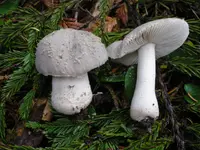
American Floury Amanita
Amanita farinosa
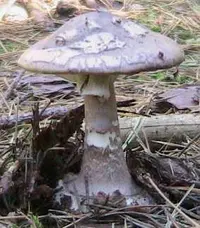
Grey-veiled Amanita
Amanita porphyria
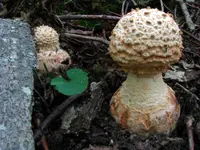
Carrot-Footed Lepidella
Amanita daucipes
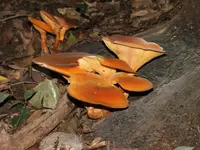
Jack o'Lantern mushroom
Omphalotus olearius

lobster mushroom
Hypomyces lactifluorum
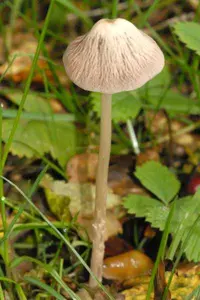
Turf Mottlegill
Panaeolus fimicola
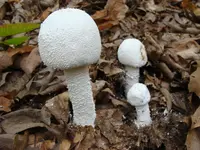
Plateful of Pyramids Lepidella
Amanita polypyramis
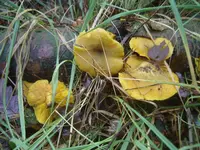
Decorated Mop
Tricholomopsis decora