


Use manure trays
Establish shallow trays or beds filled with well-composted, pasteurized manure so the mycelium can colonize a consistent substrate depth and produce more uniform flushes.

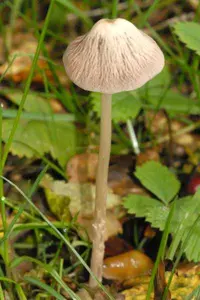
Turf mottlegill, Panaeolus fimicola, is a small saprobic mushroom that decomposes organic matter rather than growing like a typical leafy houseplant. It produces slender, dark stems topped with gray‑brown caps that often show mottled or patchy dark spores as they mature.
This fungus appears naturally in nutrient‑rich lawns, pastures, and disturbed grassy areas, especially where soil contains animal manure. It tends to fruit in clusters after rain and can appear and disappear quickly.
Because it depends on specific organic substrates and moisture cycles, it is not easy to cultivate intentionally at home. Those curious about how to care for Turf Mottlegill should understand it behaves more like a wild lawn fungus than a manageable potted plant.

Care Difficulty
Hard Care

Light Preference
Partial Shade

Water Requirements
Keep Soil Moist

Temperature Preference
Cool Climate

Hardiness Zone
Unknown

Soil Texture
Loamy, Silty, Organic-rich

Soil pH
Slightly acidic (6.5–7.0)

Soil Drainage
Moist but well-drained

Fertilization
Minimal (feed rarely)
Scan your plant to receive care tips personalized for your specific plant
Available on iOS and Android
This small dung-loving mushroom prefers cool, indirect light rather than full exposure to strong sun.
This species depends on consistently moist, but not waterlogged, organic substrate to form mushrooms.
This mushroom fruits best in cool to mild conditions rather than in extreme heat or hard frost.
This fungus does not require managed air humidity in typical outdoor cultivation.
This decomposer fungus thrives in moist, well-aerated, organic-rich substrates rather than standard potting mixes.
This species can be grown in shallow containers mainly to control substrate moisture and cleanliness outdoors.
Panaeolus fimicola gains nutrients mainly from decomposing organic matter and usually needs no deliberate fertilization in gardens or containers.
Panaeolus fimicola is not pruned in the usual horticultural sense, as its fruiting bodies are short-lived and naturally replaced.
This fungus is seldom grown in pots; management focuses on moving or renewing its organic substrate rather than classic repotting.
Panaeolus fimicola is usually propagated by spores or by transferring colonized substrate rather than through vegetative plant techniques.
In most temperate climates, Panaeolus fimicola requires minimal winter care because the mycelium can persist quietly in the substrate.

Plant Health Check
Not sure what's wrong with your plant? Check your plant's health inside the app.
This species is strongly coprophilous, meaning it typically fruits on old cattle or horse dung in grasslands, parks, and lawns rather than directly on soil or wood.
Its gills show a characteristic mottled pattern as the black spores mature in irregular patches, a feature that helps separate it from some look-alike lawn mushrooms.
Although closely related to some psychoactive Panaeolus species, this mushroom has not shown reliable psilocybin content in chemical analyses and is not considered hallucinogenic.

Molecular studies using DNA sequencing have helped confirm that this widespread lawn and pasture mushroom is a single, broadly distributed species across temperate regions, despite its rather variable cap color and size in the field.
This mushroom is not recommended for eating. It is easily confused with toxic look-alike species, and its own edibility and chemical profile are poorly studied. For safety, it should always be treated as non-edible.
Keep your plants happy and healthy with plant identification, disease detection, and easy care guidance.

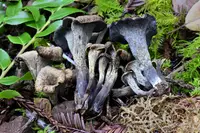
California Black Trumpet
Craterellus calicornucopioides
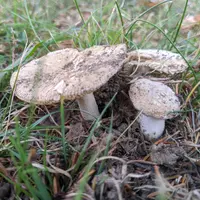
Poison Champagne Amanita
Amanita crenulata
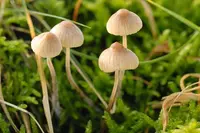
Ivory Bonnet
Atheniella flavoalba
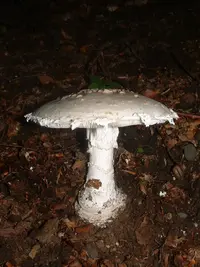
European Pine Cone Lepidella
Amanita strobiliformis
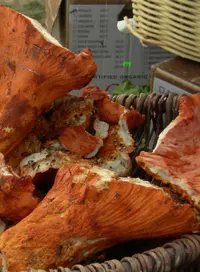
lobster mushroom
Hypomyces lactifluorum
Bresadolia craterella
Bresadolia craterella
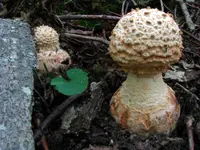
Carrot-Footed Lepidella
Amanita daucipes
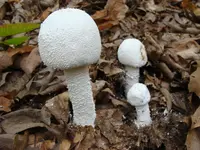
Plateful of Pyramids Lepidella
Amanita polypyramis