Sterile Substrate Handling
Prepare and handle the substrate and wooden debris with clean tools and containers, as Cystoderma carcharias establishes more reliably when competing fungi and bacteria are minimized at the start.

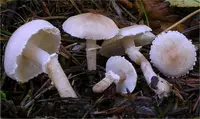
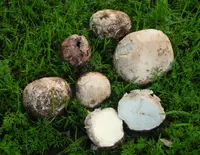
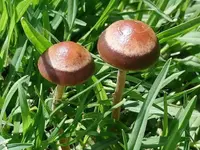
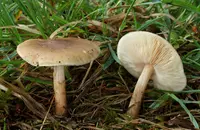
Pearly powdercap, Cystoderma carcharias, is a small gilled mushroom rather than a true plant. It forms delicate caps with a fine powdery surface, usually in pale pinkish or buff tones. The stem is slender and often shows a faint ring zone.
This species typically appears on soil in coniferous and mixed woodlands, especially in cooler temperate regions. It often grows scattered or in small groups among moss, leaf litter, or decaying wood.
Cystoderma carcharias is not considered a beginner-friendly species to collect or use, because its edibility is uncertain and it can be confused with toxic lookalikes. Those interested in how to care for Pearly Powdercap in cultivation should know it requires cool, moist, shaded conditions and access to decomposing organic material rather than typical potting soil.

Care Difficulty
Hard Care

Light Preference
Shade

Water Requirements
Keep Soil Moist

Temperature Preference
Cool Climate

Hardiness Zone
Unknown

Soil Texture
Loamy, Peaty, Organic-rich

Soil pH
Acidic (5.5–6.5)

Soil Drainage
Moist but well-drained

Fertilization
Minimal (feed rarely)
Scan your plant to receive care tips personalized for your specific plant
Available on iOS and Android
This woodland fungus prefers low, filtered light similar to a shaded forest floor.
This fungus needs consistently moist, not waterlogged, conditions around its growing substrate.
This species prefers cool, mild conditions typical of shaded forest floors in temperate climates.
This forest-floor fungus prefers moderately moist air rather than very dry conditions.
This species fruits best in loose, humus-rich substrates that mimic decomposing forest litter.
This species can be grown in containers when the pot environment closely mimics a moist, stable forest floor.
Cystoderma carcharias, a woodland mushroom, does not require fertilization when grown in suitable, organically rich substrate.
Pruning is not applicable to Cystoderma carcharias, as it is a small, short-lived mushroom rather than a woody or leafy plant.
This fungus is not suited to conventional repotting but may be moved only by carefully transplanting colonized substrate.
Propagation of this woodland fungus is specialized and usually handled by experienced mycologists rather than home growers.
Pearly Powdercap is naturally cold hardy in its native woodland range and usually needs no special winter care outdoors.

Plant Health Check
Not sure what's wrong with your plant? Check your plant's health inside the app.
The stem is covered with a persistent pinkish to whitish granular or powdery coating, which often breaks into tiny warts and helps distinguish this species from similar small brown mushrooms in the field.
Fresh fruiting bodies commonly emit a raw, farinaceous smell, often described as similar to damp flour or meal, which mycologists use as a diagnostic character when identifying this species.
This fungus typically fruits in coniferous or mixed forests on acidic, often mossy soils or litter, indicating a preference for low-pH substrates in temperate regions of Europe, North America, and parts of Asia.
This mushroom is considered inedible and potentially harmful. It should not be foraged for food. Identification can be difficult, and confusion with dangerous species is possible, so it is safest to avoid consumption entirely.
Keep your plants happy and healthy with plant identification, disease detection, and easy care guidance.