Select proper host
Attach collected wood only from conifers such as fir or spruce, since this jelly fungus is host-specific and will not fruit well on random hardwood logs.

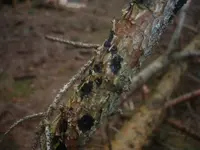
Exidia pithya is a jelly fungus, not a traditional green plant. It typically appears as irregular, dark, gelatinous patches on dead conifer wood, especially spruce and fir. The fruiting bodies often form in clusters, becoming harder and more crust-like as they dry. It plays an ecological role in breaking down dead wood in cool, moist forests. This species is naturally found in northern and montane regions of Europe, Asia, and North America, where conifer forests are common. It is not usually grown intentionally, and how to care for Exidia pithya mainly comes down to providing consistently damp, shaded, woody habitats with good air circulation.

Care Difficulty
Moderate Care

Light Preference
Shade

Water Requirements
Keep Soil Moist

Temperature Preference
Cool Climate

Hardiness Zone
Unknown

Soil Texture
Loamy, Organic-rich

Soil pH
Acidic (5.5–6.5)

Soil Drainage
Waterlogged tolerant

Fertilization
Minimal (feed rarely)
Scan your plant to receive care tips personalized for your specific plant
Available on iOS and Android
This jelly fungus prefers shaded forest conditions with very limited direct sun exposure.
Moist, decaying wood is essential for stable hydration and healthy fruiting of this fungus.
This species is adapted to cool to cold woodland climates and tolerates significant seasonal variation.
This wood-inhabiting jelly fungus has low direct humidity needs but still responds to ambient moisture levels.
This saprophytic fungus grows on conifer wood, so a soil-like substrate is only relevant when simulating decaying wood conditions.
This species is not well suited to conventional container growing and is better maintained on outdoor conifer logs or branches.
This jelly fungus lives on decaying conifer wood and does not require fertilization in natural or garden conditions.
Pruning is not applicable to Exidia pithya, which is a saprophytic fungus rather than a leafy ornamental plant.
This species is not conventionally repotted or transplanted, since it develops directly on dead conifer branches or logs rather than in soil-filled containers.
Exidia pithya spreads naturally by spores on suitable dead conifer wood, and deliberate propagation is rarely attempted in home settings.
This wood-inhabiting fungus is cold hardy in its native range and generally needs no intentional winter care from the gardener.

Plant Health Check
Not sure what's wrong with your plant? Check your plant's health inside the app.
This jelly fungus produces its dark, cushion-like fruiting bodies mainly in winter and early spring, often emerging through or beside snow on conifer stumps and logs. The contrast between the blackish jelly and white snow makes it easier to spot than many other wood-decay fungi.
It is strongly associated with dead conifer wood, especially spruce and fir, and rarely appears on broadleaf trees. The fungus contributes to nutrient recycling in boreal and montane forests by breaking down the lignin and cellulose in these conifer logs.
The gelatinous fruiting bodies can dry out and appear shrunken and crusty in warm or windy weather. After rainfall or snowmelt, they rehydrate and regain their jelly-like texture, a common adaptation among many jelly fungi but particularly noticeable in this species.

Molecular studies have led to taxonomic revisions within the genus Exidia, and Exidia pithya has been an important reference species in clarifying species boundaries among visually similar dark, gelatinous wood-inhabiting fungi.
This jelly fungus is generally regarded as inedible or of no culinary value. It is not known to be dangerously toxic, but texture and poor flavor make it unsuitable for regular consumption or foraging for food.
Keep your plants happy and healthy with plant identification, disease detection, and easy care guidance.