Use hardwood debris
Incorporate small chips and well-aged sawdust from untreated hardwoods into the substrate to mimic natural forest litter and support more reliable fruiting bodies.

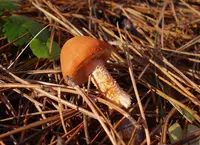
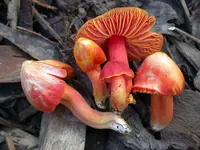
Cystodermella cinnabarina, commonly called cinnabar powdercap, is a small, bright red mushroom rather than a true plant. It forms compact caps with a granular, powdery surface and slender stems. In nature it usually appears on soil or decaying leaf litter in coniferous and mixed forests, often in cool, moist conditions. It is mainly observed in temperate regions of Europe, North America, and parts of Asia. This species is not commonly cultivated and is considered challenging to maintain outside its natural woodland habitat. For anyone curious about how to care for cinnabar powdercap, conditions that mimic a cool, shaded, consistently moist forest floor are generally required.

Care Difficulty
Hard Care

Light Preference
Shade

Water Requirements
Keep Soil Moist

Temperature Preference
Cool Climate

Hardiness Zone
Unknown

Soil Texture
Loamy, Peaty, Organic-rich

Soil pH
Acidic (5.5–6.5)

Soil Drainage
Moist but well-drained

Fertilization
Minimal (feed rarely)
Scan your plant to receive care tips personalized for your specific plant
Available on iOS and Android
This woodland fungus prefers cool, shaded forest conditions rather than direct open sun.
This fungus relies on consistently moist, well-drained forest soil rather than direct watering of the visible fruiting bodies.
This species favors cool, temperate woodland conditions and fruits best in mild weather.
This fungus does not have meaningful humidity requirements for casual observation or study.
Cystodermella cinnabarina develops best in moist, loose, organic-rich forest-type substrates rather than standard potting mixes.
This species is not well suited to typical container growing, as it relies on complex interactions with decaying wood and forest litter.
This fungus naturally grows on nutrient-rich forest litter and does not need fertilization in cultivation.
Pruning is not applicable to Cystodermella cinnabarina, as it is a short-lived mushroom rather than a woody or leafy plant.
Transplanting is seldom relevant, as this species is usually established by its mycelium in substrate rather than grown as a potted specimen.
Propagation of this species is specialized and not typically attempted by home growers.
Outdoor Cystodermella cinnabarina fruiting bodies are seasonal and do not require targeted winter care, as the main organism is the mycelium in the substrate.

Plant Health Check
Not sure what's wrong with your plant? Check your plant's health inside the app.
Its cap and stem are covered in dense, coarse, cinnabar-red to orange-red granules that often persist even in wet weather, making it one of the more reliably rough-textured red mushrooms in mixed woodland leaf litter.
The flesh has a faint but characteristic mushroom scent that can help separate it from some similar red, granular-capped species that are either odorless or have a noticeably stronger smell.
It is most often found on soil in coniferous and mixed forests, and field observations suggest a close ecological association with tree roots, although its exact nutritional mode is still under study.

The intense reddish pigments of this species make it conspicuous on the forest floor, and these color compounds are currently of interest to mycologists and chemists studying natural fungal pigments and their chemical stability in varying light and moisture conditions.
This mushroom is considered inedible and should not be collected for food. It is small, easily confused with other toxic red species, and lacks culinary value. Treat it as a decorative wild fungus only, not a food source.
Keep your plants happy and healthy with plant identification, disease detection, and easy care guidance.