beech orange Care (Cyttaria gunnii)

Also known as: myrtle orange, Beech Strawberry fungus, orange golfball
beech orange

About beech orange

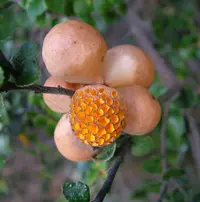
Beech orange, Cyttaria gunnii, is a fungus that forms round, orange, golf ball–like growths on the branches of southern beech trees (Nothofagus) in Tasmania and nearby regions. It is not a leafy plant but a parasitic fungus that depends on its host tree for nutrients.

The fruiting bodies are firm, pitted, and often appear in clusters, giving trees a distinctive spotted look. In cultivation, it is challenging because it requires specific beech hosts and cool, moist conditions.

Gardeners interested in how to care for beech orange should understand it is best suited to specialized collections or naturalistic plantings where suitable host trees and climate are available.

Main Plant Requirements

Care Difficulty

Hard Care

Light Preference

Partial Shade

Water Requirements

Moderate Water

Temperature Preference

Cool Climate

Hardiness Zone

8–10

Soil Texture

Loamy, Silty, Organic-rich

Soil pH

Acidic (5.5–6.5), Slightly acidic (6.5–7.0)

Soil Drainage

Moist but well-drained

Fertilization

Minimal (feed rarely)

Get Personalized Care Plan

Scan your plant to receive care tips personalized for your specific plant

Available on iOS and Android

How to Care for the beech orange

Cyttaria gunnii depends on its host Nothofagus (southern beech) and thrives in cool, bright outdoor conditions.

  • Aim for 3–5 hours of gentle morning sun with bright, dappled light the rest of the day, provided by the beech canopy.
  • Allow partial shade, especially strong shade from midday to late afternoon, to prevent scorching of exposed host branches and fruiting bodies of beech orange.
  • In summer, protect from intense, reflected sun; in winter, ensure the host site still gets at least 2–3 hours of open sky light for healthy development.

Water management focuses on maintaining consistently moist, free-draining soil around the host tree that supports Cyttaria gunnii.

  • Keep soil around the host evenly moist, allowing the top 3–5 cm to dry slightly between natural rains or irrigation, without letting it become powder-dry.
  • Improve drainage with organic matter on sloping or compacted sites so water does not pool for more than 1–2 hours after rain, which reduces root stress.
  • Watch for stress signs: underwatering appears as dull, prematurely yellowing beech leaves, while chronic overwatering leads to mossy, sour-smelling soil and dieback of fine roots.

This species is adapted to cool, maritime climates and depends on stable temperatures around its southern beech host.

  • Provide a climate where active growth occurs best at 50–68°F (10–20°C), typical of cool, moist forests and coastal ranges.
  • Protect from hard frost below 23°F (-5°C), which can damage young beech tissue and reduce future fruiting; brief light frosts around 30°F (-1°C) are usually tolerated.
  • Limit exposure to extreme heat above 82–86°F (28–30°C); during hot, dry spells, canopy shade and mulched soil help buffer temperature swings around the root zone.

This fungus develops on living Nothofagus trees and does not require active humidity management in cultivation.

Cyttaria gunnii is an obligate parasitic fungus that does not grow in conventional potting soil.

  • It develops only on living southern beech (Nothofagus) host tissue, so creating a separate soil mix for it is not applicable.
  • Focus on maintaining the host tree in slightly acidic, well-drained, humus-rich forest-type soil with abundant leaf litter.
  • Ensure the root zone of the host tree never becomes waterlogged, as prolonged saturation can damage roots and indirectly reduce fungal vigor.
  • Avoid compacted or heavily disturbed soils; preserve a loose, aerated structure that supports healthy fine roots where the fungus associates.

This species is not suitable for container growing because it must parasitize living Nothofagus trees in the ground.

Cyttaria gunnii is a specialized parasitic fungus that does not benefit from conventional fertilizing in garden or container culture.

Pruning has little direct role in Cyttaria gunnii management, since it fruits on its Nothofagus host rather than forming an independent plant canopy.

  • If shaping host trees, limit cuts to late winter or very early spring while they are dormant.
  • Remove only dead, crossing, or storm-damaged host branches to maintain tree health.
  • Use sharp, clean bypass pruners or a pruning saw and make clean cuts just outside the branch collar.
  • Avoid heavy canopy thinning, which can stress the host and indirectly reduce fruiting potential.

Cyttaria gunnii is not suited to conventional pot culture, so guidance focuses on transplanting young host trees rather than the fungus itself.

  • Transplant host Nothofagus saplings in early spring or early autumn when temperatures are mild and soil moisture is steady.
  • Choose a site with cool, moist, well-drained soil and minimal root disturbance during planting.
  • Handle roots gently, keeping the root ball intact and shaded; water thoroughly to settle soil and reduce stress.
  • Expect long establishment times; avoid frequent lifting or moving once trees are in the ground.

Propagation of Cyttaria gunnii is technically demanding and rarely attempted outside research or specialist collections.

In its natural cool-temperate range, Cyttaria gunnii is cold hardy with no special winter care needed beyond normal host tree management.

Care Tips

Host tree selection

Establish this fungus only on healthy, mature Nothofagus (southern beech) trees with good vigor, since stressed or young hosts are more likely to decline once galls form.

Inoculation timing

Time spore inoculation to cool, moist weather in late autumn or early winter so that bark remains damp for several days, which greatly improves infection success on selected branches.

Branch targeting

Apply spores only to a limited number of mid-sized branches on each tree, spacing inoculated points apart so galls do not cluster too densely and compromise branch strength.

Gall load management

Monitor gall size and number yearly and thin out heavily deformed or crossing branches during dormant season to reduce mechanical strain and lower disease entry points in the host.

Moist microclimate

Maintain a cool, humid microclimate around the host stand with leaf litter retention and minimal understorey disturbance, since a stable, damp environment supports fruiting consistency when growing beech orange.

Common Pests and Diseases

Nothofagus canker infections

This disease develops where the fungus forms galls on Nothofagus beech branches and stems, leading to swellings and localized dieback around the infection points. Symptoms include distorted branch tissue that can crack and provide further entry points for decay organisms.

Solution

Prune out and destroy badly cankered or structurally weak branches on host beeches during dry weather, cutting back into healthy wood and disinfecting tools between cuts. Maintain overall tree vigor by avoiding bark wounds and soil compaction, since healthy hosts tolerate gall formation better when growing beech orange in landscape settings.

Secondary wood decay fungi

This disease appears when other fungi colonize old Cyttaria galls and adjacent wounded wood, causing soft, crumbly tissue and progressive internal decay. Symptoms include brittle branches that break easily in wind and visible fruiting bodies of other wood-rotting fungi near old galls.

Solution

Remove and dispose of heavily decayed branches before they become hazardous, and avoid leaving cut gall tissue or large pruning wounds exposed where possible. For valuable trees, schedule periodic inspections by an arborist so compromised limbs can be removed early and canopy weight can be reduced safely.

Bark-boring beetles

These insects exploit stress points around Cyttaria galls on Nothofagus, tunneling under the bark and potentially girdling small branches. This pest leaves fine boring dust, small exit holes, and dieback beyond the infested area.

Solution

Promptly prune and destroy infested twigs and small branches, cutting well below visible tunneling and cleaning tools after use. Support host tree health through proper watering during drought and avoidance of trunk injury, because vigorous trees are less attractive and less susceptible to serious damage from bark borers.

Interesting Facts

Strict myrtle beech parasite

This fungus lives almost exclusively on the living tissues of Nothofagus cunninghamii (myrtle beech) in Tasmania, forming galls and fruiting bodies on branches and twigs without immediately killing the host tree.

Bright orange fruiting bodies

It produces conspicuous, spherical to cushion-shaped, bright orange fruiting bodies clustered on the host bark, which release spores through small surface pores rather than from exposed gills or pores like many common mushrooms.

Ancient Gondwanan lineage

The species belongs to a southern hemisphere group of fungi whose distribution closely tracks Nothofagus trees, reflecting a long evolutionary history linked to the breakup of the ancient supercontinent Gondwana.

Botan icon

Did you know?

The edible fruiting bodies of this fungus have historically been eaten raw or cooked by Tasmanian Aboriginal people, providing a seasonal food source that can be found directly on myrtle beech trees in cool temperate rainforests.

FAQs about beech orange

The orange fruiting bodies are generally considered edible and have been traditionally eaten cooked or raw in small amounts. Always harvest from clean, pesticide-free trees and confirm correct identification, as other fungi on beech may differ.

Grow Healthy Plants with Botan Care

Keep your plants happy and healthy with plant identification, disease detection, and easy care guidance.

Botan plant care app — identify plants on mobile

Explore More Plants