


Substrate rotation
Rotate and replace small sections of the decaying wood substrate every 2–3 months so fresh, fungus-ready material is always available while older, exhausted pieces are gradually removed.

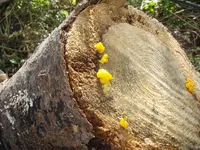
Orange jelly spot, Dacrymyces chrysospermus, is a jelly fungus rather than a traditional leafy plant. It forms bright orange, gelatinous patches or cushions on dead conifer wood, often appearing after wet weather. Its growth habit is low, spreading, and irregular, creating soft clusters that dry and shrink when conditions are drier. It plays a role in breaking down dead wood, so it is usually found in forests, woodpiles, or old fence posts. In cultivation, it is occasionally kept by fungi enthusiasts who care for Orange Jelly Spot on moist, decaying softwood. It prefers cool, damp, shaded locations and consistent surface moisture.

Care Difficulty
Moderate Care

Light Preference
Partial Shade

Water Requirements
Keep Soil Moist

Temperature Preference
Cool Climate

Hardiness Zone
Unknown

Soil Texture
Loamy, Organic-rich

Soil pH
Acidic (5.5–6.5)

Soil Drainage
Moist but well-drained

Fertilization
Minimal (feed rarely)
Scan your plant to receive care tips personalized for your specific plant
Available on iOS and Android
Dacrymyces chrysospermus, often seen on decaying wood, prefers low to moderate light rather than strong direct sun.
This wood-inhabiting fungus depends on consistently moist, but not waterlogged, substrate rather than a fixed watering schedule.
This species grows best in cool to mild conditions and declines in prolonged heat or hard freezes.
This wood-decay jelly fungus prefers consistently moist, humid conditions close to its substrate.
This species fruits best on very moist, highly organic, decaying wood rather than conventional potting soil.
This wood-inhabiting fungus can be maintained in containers if the setup mimics damp, decaying wood conditions.
This wood-decaying jelly fungus generally does not require fertilizer when growing on its natural dead-wood substrates.
Pruning is not applicable for Dacrymyces chrysospermus because it is a saprophytic fungus rather than a conventional ornamental plant.
Transplanting is rarely relevant, as this fungus naturally colonizes dead wood rather than living in pots.
Propagation of Dacrymyces chrysospermus is primarily ecological and not usually managed like a garden plant.
This fungus is generally cold hardy in its native range and needs no special winter care when left on outdoor dead wood.

Plant Health Check
Not sure what's wrong with your plant? Check your plant's health inside the app.
The orange to yellow jelly-like cushions of this species often become more intensely colored in strong light or after drying and rehydrating, making the fruit bodies stand out sharply on dark, decaying conifer wood.
This jelly fungus is typically found on dead or decaying conifer wood, especially pine and other softwoods, where it helps break down lignin and cellulose, contributing to nutrient cycling in forest ecosystems.
Its fruit bodies form numerous small, separate cushions that often fuse into irregular masses as they age, a growth pattern that helps it exploit the surface of decomposing wood efficiently.

The spores of Dacrymyces chrysospermus are often described as distinctly curved or sausage-shaped under the microscope, a characteristic that helps mycologists distinguish it from other similar-looking orange jelly fungi.
Growth is relatively fast when moisture and decaying wood are abundant. Fruiting bodies can appear within days after rain and expand over 3–7 days, then shrink and dry when conditions become less humid or the substrate dehydrates.
Keep your plants happy and healthy with plant identification, disease detection, and easy care guidance.

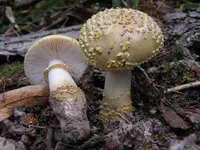
Franchet's Amanita
Amanita franchetii
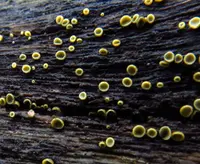
Chlorosplenium chlora
Chlorosplenium chlora
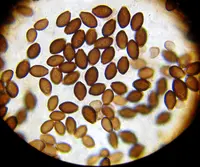
Panaeolus olivaceus
Panaeolus olivaceus
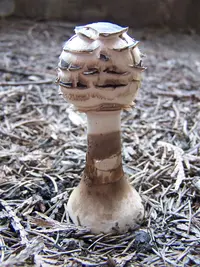
Shaggy Parasol
Chlorophyllum brunneum
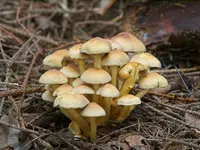
Sulphur Tuft
Hypholoma fasciculare
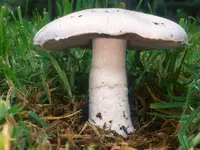
Meadow Mushroom
Agaricus campestris
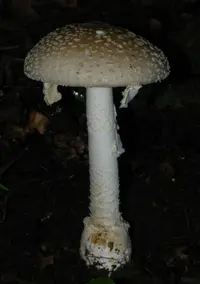
Small Funnel-Veil Amanita
Amanita multisquamosa
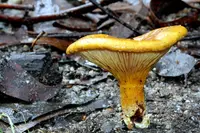
Austropaxillus infundibuliformis
Austropaxillus infundibuliformis