Sturdy staking system
Install tall, rigid stakes or a mesh support when shoots are 15–25 cm high so stems grow into the support and are less likely to snap in wind or under flower weight.

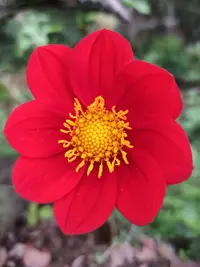
Red dahlia, Dahlia coccinea, is a tuberous perennial often grown as a summer bedding plant in temperate gardens. It forms upright, branching stems with finely divided foliage and bright red, daisy-like flower heads.
The species is native to the highlands of Mexico and Central America, where it grows in sunny, open areas with well-drained soils. Its fast growth and long flowering season make it rewarding, but tubers are sensitive to frost and need protection in colder climates.
It usually prefers full sun, moderate moisture, and fertile, well-drained soil. Understanding these natural preferences helps gardeners care for red dahlia with fewer losses and more reliable flowering.

Care Difficulty
Moderate Care

Light Preference
Full Sun

Water Requirements
Regular Water

Temperature Preference
Tropical / Frost Sensitive

Hardiness Zone
8–11

Soil Texture
Sandy, Loamy, Organic-rich

Soil pH
Acidic (5.5–6.5), Slightly acidic (6.5–7.0)

Soil Drainage
Moist but well-drained

Fertilization
Moderate (every 2–4 weeks)
Scan your plant to receive care tips personalized for your specific plant
Available on iOS and Android
Dahlia coccinea needs strong, direct light to produce abundant flowers and sturdy stems.
Dahlia coccinea performs best in evenly moist, well-drained soil that never stays waterlogged.
This species prefers warm conditions and does not tolerate frost at any stage.
This species handles a fairly wide humidity range and rarely needs special humidity management outdoors.
Dahlia coccinea prefers loose, fertile, well-drained soil that stays evenly moist but not waterlogged.
This species is suitable for container growing when the pot is large, stable, and drains efficiently.
Dahlia coccinea responds well to moderate, balanced nutrition during its active growing and flowering season.
Pruning is important for keeping Dahlia coccinea compact, well-shaped, and free-flowering.
This species is usually grown in beds or borders, so transplanting tubers and young plants is more common than container repotting.
Dahlia coccinea is commonly propagated from tuber division, stem cuttings, and seeds to maintain or create new plants.
Dahlia coccinea is frost-tender and requires distinct winter care in regions with freezing conditions.

Plant Health Check
Not sure what's wrong with your plant? Check your plant's health inside the app.
This species is native to the highlands of central Mexico, where it grows on open, sunny slopes and forest edges at relatively cool, elevated sites.
Dahlia coccinea is one of the wild species that contributed genetic material to many modern garden dahlias, especially for red and orange flower coloration.
Historical records indicate that Indigenous peoples in Mexico cultivated and ate the starchy underground tubers of this species and related dahlias, similar to root vegetables.

The first scientific descriptions of dahlias sent from Mexico to Europe in the late 18th century are believed to have included material of Dahlia coccinea, making it one of the foundational species that introduced the entire genus to European horticulture.
Lack of flowers usually comes from insufficient light, too much nitrogen fertilizer, or stressed tubers. Ensure full sun, use a balanced or low-nitrogen feed, avoid waterlogging, and do not let plants stay rootbound in small containers.
Keep your plants happy and healthy with plant identification, disease detection, and easy care guidance.