

Encourage radial form
Rotate container-grown plants 90° every 4–6 weeks so the rosette develops evenly and the leaves radiate symmetrically rather than leaning toward the primary light source.

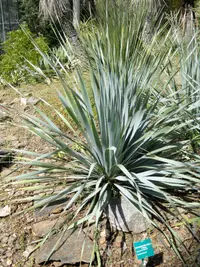
Dasylirion berlandieri, often called blue twister, is a drought-tolerant desert shrub from northern Mexico and southern Texas. It forms a dense rosette of narrow, twisted blue-green leaves with sharp, toothed margins. Over time, it develops a short, woody trunk and can produce tall flower spikes that rise well above the foliage. This species is adapted to arid, rocky slopes and open scrubland. It prefers full sun, very well-drained soil, and low moisture, which makes it suitable for xeriscapes and low-maintenance gardens. Once established, it grows slowly but reliably, and those who learn how to care for blue twister usually find it a durable, long-lived structural plant.

Care Difficulty
Easy Care

Light Preference
Full Sun

Water Requirements
Low Water

Temperature Preference
Warm Climate

Hardiness Zone
8–11

Soil Texture
Sandy, Loamy, Rocky

Soil pH
Slightly acidic (6.5–7.0), Slightly alkaline (7.0–7.5)

Soil Drainage
Well-drained

Fertilization
Minimal (feed rarely)
Scan your plant to receive care tips personalized for your specific plant
Available on iOS and Android
Dasylirion berlandieri thrives in strong, direct sun typical of arid and semi-arid climates.
This desert-adapted species prefers infrequent, deep watering and fast-drying soil.
This plant is highly heat tolerant but only moderately cold hardy.
Humidity is rarely limiting for Dasylirion berlandieri, which thrives in dry air.
This species needs very fast-draining, mineral-rich soil to avoid root rot.
This plant can be grown in containers outdoors if the pot manages its dry, heavy rosette safely.
Dasylirion berlandieri is adapted to nutrient-poor soils and needs only light feeding in cultivation.
Pruning needs for Dasylirion berlandieri are minimal and mostly cosmetic.
This species is usually grown in the ground; container plants or young specimens are transplanted infrequently to avoid root disturbance.
Dasylirion berlandieri is most often propagated from seed and is slow to reach landscape size.
Established plants are fairly cold hardy but benefit from basic winter care in colder regions.

Plant Health Check
Not sure what's wrong with your plant? Check your plant's health inside the app.
This species develops narrow, stiff leaves that end in a small, reflexed spoon-like tip rather than a sharp spine, a feature that helps distinguish it from many other Dasylirion species with more dangerous terminal spines.
It occurs naturally in dry, rocky habitats from south Texas into northeastern Mexico, where it is adapted to shallow, limestone-derived soils and intense seasonal drought.
The tall flowering stalks carry numerous small, creamy flowers that provide nectar and pollen for bees and other insects in arid and semi-arid ecosystems, supporting local pollinator communities even under harsh conditions.
Leaf tips often brown from low humidity, excess fertilizer salts, or old age of outer leaves. In wetter climates, prolonged moisture around the crown can cause rot. Remove dead leaves and improve drainage and air movement around the base.
Keep your plants happy and healthy with plant identification, disease detection, and easy care guidance.

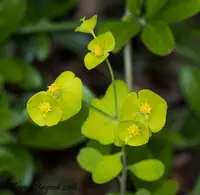
Roemer's spurge
Euphorbia roemeriana
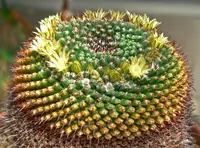
Mammillaria gigantea
Mammillaria gigantea
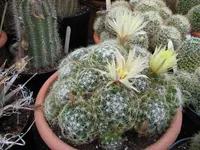
longmamma nipple cactus
Mammillaria sphaerica
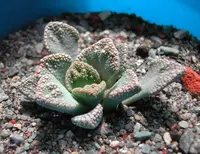
sheep's tongue
Titanopsis calcarea
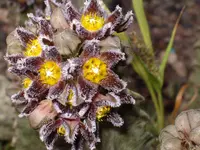
Apteranthes burchardii
Apteranthes burchardii
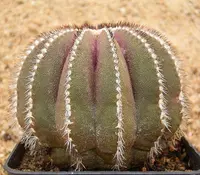
Uebelmannia pectinifera
Uebelmannia pectinifera
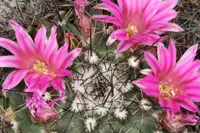
Mammillaria melanocentra
Mammillaria melanocentra

Euphorbia ramiglans
Euphorbia ramiglans