Protect lower trunk
As the trunk elongates, place a wide ring of coarse gravel or small rocks around the base to keep the lower stem dry and discourage rot where old leaves have been removed.

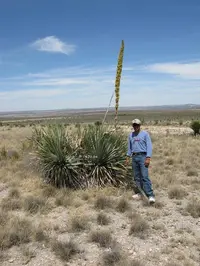
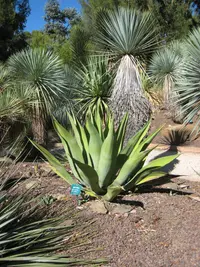
Dasylirion cedrosanum, commonly called Cedros desert spoon, is a slow-growing, evergreen succulent shrub from dry regions of northern Mexico and the southern United States. It forms a dense, spherical rosette of long, narrow, toothed leaves with a distinctive spoon-like base and a stout woody trunk over time.
In maturity, it can produce a tall flower spike with many small cream-colored flowers that attract pollinators. Its strong drought tolerance and low nutrient needs make it suitable for xeriscapes and low-maintenance gardens.
Understanding how to care for Dasylirion cedrosanum starts with providing bright light, excellent drainage, and infrequent watering to mimic its native arid habitat.

Care Difficulty
Easy Care

Light Preference
Full Sun

Water Requirements
Low Water

Temperature Preference
Warm Climate

Hardiness Zone
7–10

Soil Texture
Sandy, Loamy, Rocky

Soil pH
Slightly acidic (6.5–7.0), Slightly alkaline (7.0–7.5)

Soil Drainage
Well-drained

Fertilization
Minimal (feed rarely)
Scan your plant to receive care tips personalized for your specific plant
Available on iOS and Android
This desert species thrives in strong light and benefits from long, direct sun exposure.
This xeric plant is highly drought tolerant and must dry well between waterings.
This species prefers warm, arid climates and tolerates a wide temperature range once established.
This desert species tolerates very dry air and usually does not need humidity adjustment indoors or outdoors.
Dasylirion cedrosanum needs very fast-draining, mineral soil to prevent root and crown rot.
This species can be grown in large containers if stability and rapid drainage are prioritized.
Feeding needs are very low, as Dasylirion cedrosanum is adapted to nutrient-poor, arid soils.
Pruning is minimal and mainly cosmetic, aimed at maintaining a clean rosette and safe access around the plant.
This species is usually grown in the ground and dislikes frequent disturbance, so transplant only when clearly necessary.
Propagation is slow and usually done from seed rather than vegetative methods.
Mature plants handle significant cold, so winter care is minimal in suitable climates.

Plant Health Check
Not sure what's wrong with your plant? Check your plant's health inside the app.
This species forms a dense rosette of extremely narrow, rigid leaves that visually mimics a giant bunchgrass, an adaptation that helps reduce direct sun exposure to each leaf in its arid Mexican habitat.
Unlike many desert succulents, it has documented tolerance to brief frosts and subfreezing temperatures when dry, allowing it to survive in higher-elevation, semi-arid regions of northeastern Mexico.
Over many decades it gradually builds a woody trunk beneath the rosette, so older specimens develop a solitary, stout stem that can elevate the leaf crown well above ground level in rocky slopes and scrublands.

In parts of northern Mexico, the fermented sap of this species and close relatives is traditionally distilled to produce sotol, a regional spirit with a denomination of origin that legally defines which wild and cultivated plants may be used.
This species grows slowly, usually adding only 2–8 cm of trunk height per year once established. Growth is faster in warm, dry climates with excellent drainage and full sun, and slower in cool or overly moist locations.
Keep your plants happy and healthy with plant identification, disease detection, and easy care guidance.