


Host Substrate Choice
Attach the moss to rough, unsealed bark or weathered wood rather than smooth or treated surfaces, which helps rhizoids grip and reduces desiccation from air movement.

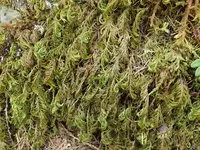
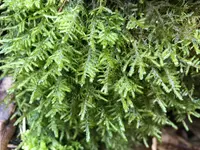
Dendroalsia abietina, often called dendroalsia moss, is a hardy, evergreen moss that forms dense, feathery mats on trees, rocks, and shaded ground. Its upright, branching shoots give a soft, conifer-like look at close range.
This species is native to the Pacific coast of North America, especially moist forests from California to British Columbia. It is adapted to cool, humid air and frequent fog, which keep its fine foliage hydrated.
Dendroalsia abietina is generally resilient once established but depends on consistent moisture and shelter from harsh sun. Understanding how to care for dendroalsia moss starts with providing shade, steady humidity, and a stable, undisturbed surface for attachment.

Care Difficulty
Moderate Care

Light Preference
Partial Shade

Water Requirements
Keep Soil Moist

Temperature Preference
Cool Climate

Hardiness Zone
8–10

Soil Texture
Loamy, Silty, Organic-rich

Soil pH
Strongly acidic (4.5–5.5), Acidic (5.5–6.5)

Soil Drainage
Moist but well-drained

Fertilization
Minimal (feed rarely)
Scan your plant to receive care tips personalized for your specific plant
Available on iOS and Android
This epiphytic moss prefers bright, cool, forest-like light conditions with limited direct sun.
This moss thrives with consistently moist surfaces and vulnerable, fine tissues that dry out quickly.
This Pacific coastal moss is adapted to mild, ocean-influenced temperatures with cool, moist air.
This moss prefers consistently moist, cool air and responds strongly to humidity levels.
This epiphytic moss anchors to rough, moist surfaces rather than relying on conventional soil.
This species can be grown in shallow containers or trays when moisture and anchoring surfaces are carefully managed.
This moss is adapted to nutrient-poor bark and rock, so added fertilizer is usually unnecessary for healthy growth.
Dendroalsia abietina rarely needs active pruning and is usually maintained by removing only compromised patches.
Transplanting is only needed when shifting Dendroalsia abietina colonies to a new host surface or refreshing display pieces.
Propagation is usually done by dividing and relocating small mats rather than through spores in a home setting.
This species is quite cold hardy across much of its native range and generally needs no special winter protection.

Plant Health Check
Not sure what's wrong with your plant? Check your plant's health inside the app.
This moss is naturally restricted to the Pacific coast of North America, especially coastal forests from central California to British Columbia, where it thrives in cool, fog-influenced, humid conditions on tree trunks and branches.
It forms dense mats of semi-pendulous, overlapping branches that drape from bark surfaces, creating a shaggy, layered texture that is characteristic and helps capture moisture from fog and rain.
Its thick mats retain water and organic particles, providing microhabitats for small invertebrates and microorganisms and contributing to nutrient cycling on tree surfaces in coastal forests.

This species is considered a California moss endemic in a broad sense, because its main stronghold and ecological importance center on the California coastal fog belt, where it has adapted to rely heavily on frequent fog and oceanic moisture rather than regular rainfall for much of its water supply.
This species performs best outdoors in cool, humid, shaded conditions, typically on tree trunks or rocks. Indoor environments are usually too dry and stagnant, so long‑term success as a houseplant is limited, even with careful humidity management.
Keep your plants happy and healthy with plant identification, disease detection, and easy care guidance.

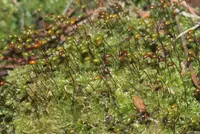
velvet feather-moss
Brachytheciastrum velutinum
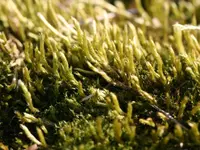
brachythecium moss
Brachythecium salebrosum
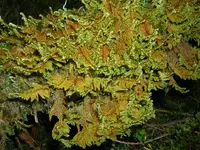
mollusc ctenidium moss
Ctenidium molluscum
Heller's Notchwort
Crossocalyx hellerianus
Cryptomitrium tenerum
Cryptomitrium tenerum
Lateral Cryphaea
Cryphaea heteromalla
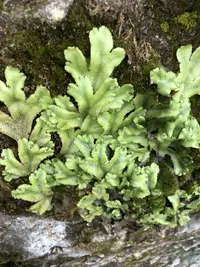
Snakewort
Conocephalum salebrosum
Flat Neckera
Alleniella complanata