


Mounting technique
Use a cork slab or hardwood branch with a thin pad of sphagnum moss to mount the plant, then secure canes with soft ties so roots can dry rapidly between waterings and mimic its natural epiphytic habit.

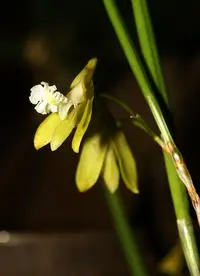
Straggly pencil orchid, Dendrobium bowmanii, is a thin-stemmed epiphytic orchid that often drapes from tree branches or rocky outcrops in its native range of eastern Australia. It produces narrow, pencil-like canes with small leaves and delicate cream to greenish flowers, sometimes marked with subtle color near the lip.
This species is adapted to bright, airy habitats with good air movement and periodic drying, which guides how to care for Straggly pencil orchid in cultivation. It suits growers who can provide stable warmth, filtered light, and a fast-draining orchid medium, and who are comfortable with plants that prefer being slightly under-watered rather than constantly moist.

Care Difficulty
Moderate Care

Light Preference
Partial Shade

Water Requirements
Moderate Water

Temperature Preference
Tropical / Frost Sensitive

Hardiness Zone
11–12

Soil Texture
Sandy, Organic-rich

Soil pH
Acidic (5.5–6.5)

Soil Drainage
Well-drained

Fertilization
Light (every 4–6 weeks)
Scan your plant to receive care tips personalized for your specific plant
Available on iOS and Android
This species prefers bright, gentle light that mimics lightly shaded forest or woodland edges.
Watering should balance regular moisture with very sharp drainage to protect the roots and pseudobulbs from rot.
This orchid prefers warm to intermediate conditions with a clear difference between day and night temperatures.
This orchid prefers moderate to high humidity and reacts quickly to very dry air.
This epiphytic species needs a very open, fast-draining medium rather than compact potting soil.
This species suits container growing when the pot supports its narrow, scrambling canes.
This epiphytic orchid benefits from modest, regular feeding during active growth for reliable flowering.
Pruning Dendrobium bowmanii focuses on hygiene and light shaping rather than heavy cutting.
This species prefers to stay slightly pot-bound, so repotting is infrequent and should be done carefully.
Propagation is usually done by division or keikis, rather than by seed, for predictable plants.
This orchid is sensitive to frost and needs mild, sheltered conditions in winter.

Plant Health Check
Not sure what's wrong with your plant? Check your plant's health inside the app.
This orchid often grows on exposed coastal rock faces and cliffs in eastern Australia, tolerating strong winds and salt-laden air that would damage many other orchids.
Its wiry, pencil-thin stems can reach considerable length while remaining only a few millimeters thick, an adaptation that reduces water loss in bright, drying habitats.
The small greenish-yellow flowers can produce a light fragrance, especially in the evening, which is thought to help attract nocturnal pollinators in its native range.

In the wild, this species frequently behaves as a lithophyte, anchoring its roots into tiny crevices of sandstone or other rocky substrates with very little organic matter, showing a high level of adaptation to nutrient-poor environments.
Lack of flowering is usually due to insufficient light, too-warm nights, or no distinct drier rest after growth. Provide bright filtered light, slightly cooler, drier conditions in late winter, and avoid heavy feeding during the rest period.
Keep your plants happy and healthy with plant identification, disease detection, and easy care guidance.
