Train As Epiphyte
Mount the plant on cork bark or a fern board and secure rhizomes gently with soft ties so it can form a natural, spreading mat similar to how it grows on tree trunks in the wild.

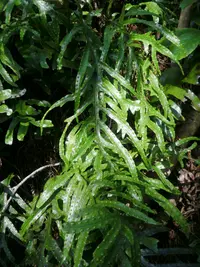
Fragrant fern, Dendroconche scandens, is an epiphytic fern that often grows on trees or rocks, forming trailing or climbing mats of delicate fronds. The foliage is typically small, finely divided, and can release a light scent when rubbed or brushed.
In nature it occurs in humid forests of Australia, New Zealand, and nearby Pacific regions, where it enjoys filtered light and consistent moisture. Its thin fronds and surface roots dry out quickly, so understanding how to care for fragrant fern focuses on steady humidity and gentle air movement.
With a sheltered position, loose, airy substrate, and protection from harsh sun, it is moderately easy to maintain indoors for growers who can provide stable moisture levels.

Care Difficulty
Moderate Care

Light Preference
Partial Shade

Water Requirements
Keep Soil Moist

Temperature Preference
Tropical / Frost Sensitive

Hardiness Zone
10–11

Soil Texture
Loamy, Peaty, Organic-rich

Soil pH
Acidic (5.5–6.5)

Soil Drainage
Moist but well-drained

Fertilization
Light (every 4–6 weeks)
Scan your plant to receive care tips personalized for your specific plant
Available on iOS and Android
Dendroconche scandens prefers bright, filtered light similar to a shaded forest canopy.
This epiphytic fern prefers consistently lightly moist, not saturated, growing media.
This fern grows best in mild, frost-free conditions with stable temperatures.
This epiphytic fern prefers stable, moderately high humidity for best growth.
This fern needs a loose, airy, moisture-retentive but fast-draining mix that mimics decomposing forest litter.
This species adapts well to container culture, including hanging baskets and mounted arrangements.
This epiphytic fern benefits from light, consistent nutrition rather than heavy feeding.
Pruning Dendroconche scandens is mainly cosmetic and helps maintain a tidy, compact plant.
This fern prefers slightly snug conditions but benefits from occasional repotting to refresh its medium.
This species is commonly propagated by division or by rooting creeping stems.
This fern is frost-sensitive and needs mild, protected conditions in winter.

Plant Health Check
Not sure what's wrong with your plant? Check your plant's health inside the app.
This species often grows as an epiphyte on tree trunks and branches, using its wiry rhizomes and rooting fronds to cling to bark rather than relying on soil. It can also shift to a terrestrial habit if it reaches the ground, showing flexible growth strategies in the wild.
Its fertile fronds are usually narrower and more elongate than the sterile ones, with dense, rounded sori (spore clusters) on the underside. This dimorphism makes it relatively easy to distinguish reproductive structures compared with many other small climbing ferns.
The species is native to coastal and lowland forests of eastern Australia, New Zealand, and some Pacific islands, where it prefers humid, shaded environments. It commonly occupies tree fern trunks, moist rock faces, and forest understory, especially in high-rainfall areas.

Genetic and morphological studies have led to this species being moved between several fern genera over time, and it is still widely known under its former name Microsorum scandens, making it a useful example of how evolving fern systematics can change botanical names while referring to the same plant.
Brown tips or fronds usually come from low humidity, missed waterings, or fertilizer burn. Check soil moisture, increase ambient humidity, and flush excess salts when needed. Trim only the damaged parts; healthy green tissue should remain.
Keep your plants happy and healthy with plant identification, disease detection, and easy care guidance.