Sturdy container choice
Use a broad, heavy container with a low center of gravity to prevent this top‑heavy plant from tipping as the trunk elongates, and secure it further with stone mulch around the base if grown in windy or exposed sites.

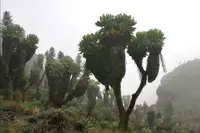
Giant groundsel, Dendrosenecio kilimanjari, is a striking, tree-like succulent native to the high, cold slopes of Mount Kilimanjaro in Tanzania. It forms tall, branched trunks topped with dense rosettes of large, rubbery leaves. The plant evolved to handle intense sun, strong temperature swings, and poor, rocky soils, which makes it unusual and challenging in cultivation. Outside its alpine habitat it dislikes heat combined with humidity and struggles in low light or stagnant, wet soil. Enthusiasts who care for Giant Groundsel often grow it in very bright, cool, well-drained conditions that mimic its mountain origin.

Care Difficulty
Hard Care

Light Preference
Full Sun

Water Requirements
Low Water

Temperature Preference
Cool Climate

Hardiness Zone
Unknown

Soil Texture
Sandy, Rocky, Loamy

Soil pH
Slightly acidic (6.5–7.0), Neutral (7.0)

Soil Drainage
Well-drained

Fertilization
Minimal (feed rarely)
Scan your plant to receive care tips personalized for your specific plant
Available on iOS and Android
This high-altitude shrub needs strong light that mimics open, mountainous slopes.
This species prefers cool, well-drained conditions and is sensitive to both drought and waterlogging.
This alpine plant is adapted to cool, stable conditions with large day–night temperature swings.
Humidity has some influence on Dendrosenecio kilimanjari health, especially away from its native alpine environment.
This species prefers very well-drained, mineral-rich soil that mimics rocky alpine slopes.
This species can be grown in containers only with very stable, highly drained setups.
In cultivation, Dendrosenecio kilimanjari benefits from light, infrequent feeding that mimics its low-nutrient alpine habitat.
Pruning Dendrosenecio kilimanjari is mainly corrective, aimed at maintaining plant health and a stable structure.
This species is rarely container-grown; transplanting young plants with care is more important than frequent repotting.
Propagation of Dendrosenecio kilimanjari is specialized and usually left to conservation or research settings.
This high-altitude species is adapted to cool conditions but is highly sensitive to sustained frost in typical garden settings.

Plant Health Check
Not sure what's wrong with your plant? Check your plant's health inside the app.
This species forms tall, palm-like rosettes on the upper slopes of Mount Kilimanjaro, where it can reach several meters in height despite growing in harsh, high-altitude conditions.
At night, its large leaves fold upward around the central stem, helping to reduce heat loss and protect the apical bud from freezing temperatures just above the frost line.
The stem contains a spongy, water-rich pith that acts as a reservoir, buffering the plant against daytime drought and intense solar radiation in its alpine habitat.

Dendrosenecio kilimanjari is part of a famous example of convergent evolution in African mountains, where unrelated giant rosette plants evolved similar growth forms independently in response to the same extreme high-altitude climate.
Growth is slow. In suitable cool, bright, outdoor conditions, it may add roughly 10–20 cm of trunk per year. Container culture and warmer lowland climates usually slow it further. Patience is essential when growing this alpine species.
Keep your plants happy and healthy with plant identification, disease detection, and easy care guidance.