red mombin Care (Spondias purpurea)

Also known as: purple mombin, ciruela, jocote, siniguela
red mombin

About red mombin

Red mombin (Spondias purpurea) is a small, deciduous tropical fruit tree valued for its tart, plum-like fruits and drought tolerance. It usually grows with a short trunk, open branching, and sparse foliage during dry periods. Native to tropical America and widely grown in Central America, the Caribbean, and parts of Mexico, it is now also cultivated in other warm regions. This species adapts well to poor, dry soils, which makes it relatively forgiving once established. Young plants benefit from regular moisture and good drainage, while full sun supports strong growth and fruiting. Because it is adapted to seasonal drought, basic knowledge of how to care for red mombin helps prevent overwatering issues in wetter climates.

Main Plant Requirements

Care Difficulty

Moderate Care

Light Preference

Full Sun

Water Requirements

Moderate Water

Temperature Preference

Tropical / Frost Sensitive

Hardiness Zone

10–12

Soil Texture

Sandy, Loamy, Organic-rich

Soil pH

Acidic (5.5–6.5), Slightly acidic (6.5–7.0)

Soil Drainage

Well-drained

Fertilization

Minimal (feed rarely)

Get Personalized Care Plan

Scan your plant to receive care tips personalized for your specific plant

Available on iOS and Android

How to Care for the red mombin

Spondias purpurea grows best in bright, warm sites with consistent direct sun exposure.

  • Provide 6–8 hours of direct sun daily; full sun promotes dense growth and better flowering and fruiting for red mombin.
  • Allow light partial shade in very hot inland areas, especially from intense afternoon sun, but avoid planting where buildings or trees block light for most of the day.
  • In cooler seasons, choose a south- or west-facing position to maximize light, and avoid deep shade which leads to weak, elongated shoots and reduced fruit set.

Spondias purpurea prefers deep, infrequent watering once established, with soil allowed to dry slightly between soakings.

  • Use well-drained soil and water only when the top 5–8 cm feels dry; apply a slow, deep soak, then let excess drain away completely.
  • During the first 1–2 growing seasons, monitor closely in warm, dry weather, watering when leaves start to lose gloss or slightly droop, then reduce frequency as roots spread.
  • Watch for overwatering signs such as yellowing leaves and soft new growth; improve drainage or lengthen intervals if this occurs, especially in heavy or clay soils.

This species is a tropical to subtropical tree that needs warm conditions and does poorly in cold climates.

  • Aim for optimal growth at 70–90°F (21–32°C); trees grow fastest and fruit most reliably in this range.
  • Protect from cold; serious damage occurs near 28–30°F (-2 to -1°C), and young trees can be killed by light frost, so avoid low-lying frost pockets.
  • In hot regions, trees tolerate short periods above 95°F (35°C) if soil moisture is sufficient, but prolonged extreme heat combined with drought can cause leaf scorch and fruit drop.

This drought-tolerant fruit tree grows well in 30–60% humidity and rarely needs special humidity management.

  • Red mombin tolerates dry air but foliage may look slightly dull or marginally crisp during prolonged very low humidity below 25%.
  • Humidity stress appears as tip browning on young leaves and premature leaf drop during hot, very dry periods.
  • Increase humidity only during extreme heat by grouping plants outdoors, mulching the root zone, and avoiding hot, reflected surfaces.

This species prefers well-drained, slightly sandy to loamy soil that does not stay waterlogged.

  • Use a mix such as 50% sandy loam, 30–40% compost, and 10–20% coarse material like sharp sand or fine bark to improve structure and drainage.
  • Aim for a slightly acidic to neutral pH of 6.0–7.0, where Spondias purpurea roots access nutrients efficiently without toxicity issues.
  • Ensure the planting site or container drains freely; avoid locations where water stands for more than 1–2 hours after heavy rain.
  • Improve aeration by incorporating coarse sand or fine gravel through the top 15–25 cm if soil is heavy or tends to compact.

This tree can be grown in large containers when managed as a compact specimen in warm climates.

  • Choose a deep, heavy container to anchor the tree against wind and to prevent tipping as the canopy becomes denser.
  • Select thick-walled clay or concrete pots when possible, since these moderate root-zone temperature and slow surface drying in hot sites.
  • Use an extra-deep saucer-free setup with raised pot feet so excess irrigation and rainwater leave the root zone quickly.

Spondias purpurea benefits from moderate feeding in containers or poor soils, but mature in-ground trees need only light supplementation.

  • Use a balanced NPK granular or slow-release fertilizer, or well-rotted compost, for caring for red mombin in nutrient-poor sites or pots.
  • Feed every 6–8 weeks during the warm growing season, stopping once growth slows in late fall.
  • Apply fertilizers at half the label strength, keeping product away from the trunk and main roots to prevent burn.
  • In winter or cool dormant periods, avoid nitrogen-heavy products and skip feeding entirely in cold climates.

Pruning Spondias purpurea helps maintain a strong framework and good fruiting wood.

  • Carry out structural pruning in late winter or very early spring, before vigorous new growth begins.
  • Remove dead, diseased, crossing, or storm-damaged branches first, cutting back to healthy wood with clean bypass pruners or a sharp saw.
  • Thin crowded interior branches to improve light penetration and air flow, which supports flowering and fruit quality.
  • Limit heading cuts on mature trees to avoid excessive, weak water sprouts and maintain a balanced canopy shape.

This species is usually grown in the ground, so guidance focuses on transplanting young Spondias purpurea trees rather than routine repotting.

  • Transplant during warm, stable weather in late spring or early summer, avoiding very hot or cold periods to limit shock.
  • Look for signs like roots circling the nursery pot, water running straight through, or slowed growth as indicators it is time to move up.
  • Shift to a hole or container 1–2 sizes larger, using well-drained soil and planting at the same depth as in the original pot.
  • Reduce root stress by watering thoroughly before and after transplanting, shading the canopy temporarily, and keeping soil consistently moist but not waterlogged.

New Spondias purpurea plants are commonly raised from semi-hardwood cuttings or seeds in warm conditions.

  • Take 15–30 cm semi-hardwood cuttings in late spring or summer, using disease-free, pencil-thick shoots.
  • Insert cuttings into a well-drained, slightly moist mix, optionally with rooting hormone, and maintain high humidity and 75–85°F warmth.
  • Sow fresh seeds in a sandy, draining medium, barely covered, and keep consistently warm and evenly moist for germination.
  • Provide bright, indirect light and gentle air movement, then harden off rooted plants gradually before planting out into full sun.

This tropical tree is frost sensitive and needs protection in regions with cold winters.

  • In ground, it suits frost-free or very mild climates; even light freezes can damage young Spondias purpurea growth.
  • Apply a 5–8 cm layer of organic mulch around the root zone, keeping it a few cm from the trunk, to buffer soil temperatures.
  • Wrap young trunks with breathable frost cloth or horticultural fleece during cold snaps to reduce bark injury.
  • For container plants in marginal climates, move pots indoors or into a heated greenhouse before temperatures drop near 32°F.

Care Tips

Encourage Strong Framework

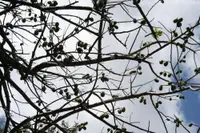
During the first 2–3 years, select 3–5 well-spaced main branches and remove low, crowded, or steeply upright shoots to build a sturdy, open canopy that will support heavy fruit loads without breaking.

Manage Fruit Load

In years with very heavy flowering, thin excess young fruits by hand so that clusters are not overcrowded, which helps improve individual fruit size and reduces limb stress and breakage.

Protect From Wind

In exposed sites, install a simple windbreak such as shade cloth on stakes or a hedge on the windward side to reduce branch damage and flower loss during storms.

Mulch The Dripline

Apply a 5–8 cm ring of coarse organic mulch under the canopy, keeping it a few cm away from the trunk, to stabilize soil temperature, reduce weed competition, and protect surface feeder roots.

Monitor For Borers

Inspect the trunk and main branches every few weeks for small holes, frass (sawdust-like material), or dieback, and promptly prune and destroy affected wood to limit borer spread when growing red mombin.

Common Pests and Diseases

Fruit fly infestation

These insects lay eggs in developing fruits, leading to soft spots, internal tunneling, and premature fruit drop. Symptoms include small puncture marks on the skin and watery, spoiled flesh inside the fruit.

Solution

Collect and destroy all infested and fallen fruits at least weekly to break the life cycle, and avoid leaving ripe fruit on the tree for long periods. Use fruit fly traps around the canopy, bag valuable fruit clusters with fine mesh bags, and maintain good orchard sanitation as a core part of Spondias purpurea care.

Anthracnose

This disease causes dark, sunken lesions on leaves, young shoots, flowers, and fruits, often with irregular brown or black patches. Symptoms include defoliation, fruit blemishes, and dieback of tender growth during warm, humid weather.

Solution

Prune and destroy affected twigs and leaves, and avoid overhead watering to keep foliage as dry as possible. Improve airflow by thinning crowded branches and, where disease pressure is high, apply a copper-based or other labeled fungicide at the start of wet periods and during early fruit development.

Leaf spot

This disease produces small, circular to irregular brown spots on leaves that may merge into larger patches, sometimes with yellow halos. Symptoms include partial defoliation and a generally sparse canopy in severe cases.

Solution

Rake and remove fallen leaves, and prune to open the canopy so leaves dry quickly after rain. For repeated problems, use preventive copper or other labeled fungicide sprays at the beginning of the rainy season, focusing on young foliage.

Scale insects

These pests appear as small, immobile bumps on stems, twigs, and sometimes leaves, sucking sap and weakening the tree. Symptoms include sticky honeydew, sooty black mold on surfaces, and slow growth or yellowing leaves.

Solution

Prune out heavily infested twigs and dispose of them away from the tree, then wash remaining colonies off with a strong stream of water. For persistent infestations, apply horticultural oil thoroughly to branches and leaf undersides during mild weather to smother scales, repeating according to label directions.

Mealybugs

This pest forms white, cottony clusters on tender shoots, leaf nodes, and fruit stalks, feeding on sap and excreting honeydew. Symptoms include leaf curling, sooty mold growth, and reduced vigor, especially on young trees or container-grown plants.

Solution

Physically remove small colonies with a cotton swab dipped in 70% isopropyl alcohol and prune heavily infested tips. Improve air movement in and around the canopy and, for larger infestations, use insecticidal soap or horticultural oil, ensuring good coverage of hidden areas where mealybugs shelter.

Interesting Facts

Clonal living fences

In many parts of tropical America, farmers plant fresh branches of this tree directly into the ground to form living fences, because the cut branches root easily and grow into new individuals that still produce fruit.

Fruit color variability

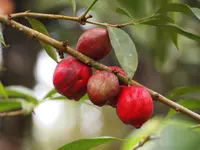
The plum-like fruits vary widely in color between trees, ranging from bright red and purple to yellow or orange, reflecting a high genetic diversity within the species.

Dry-season fruiting strategy

This species often flowers and fruits during the dry season, when many other trees are leafless, providing an important food source for local people and wildlife when resources are scarce.

Botan icon

Did you know?

Archaeobotanical evidence from sites in Mesoamerica shows that this species was cultivated and transported by pre-Columbian peoples, indicating a long history of human selection and movement across its native range.

FAQs about red mombin

The fruit is edible and widely consumed fresh, in juices, jams, and preserves. The pulp is tart to sweet, depending on ripeness. The skin and flesh are generally safe, but the hard seed is not eaten.

Grow Healthy Plants with Botan Care

Keep your plants happy and healthy with plant identification, disease detection, and easy care guidance.

Botan plant care app — identify plants on mobile

Explore More Plants