

Host log selection
Choose well-seasoned but not fully decayed hardwood logs or large branches with intact bark, as this provides a stable, slowly decomposing substrate that supports the fungus over several years.

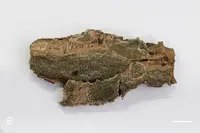
Dentocorticium portoricense is a crust-like wood-decay fungus rather than a traditional leafy plant. It forms thin, spreading patches on dead wood, often with a smooth to slightly bumpy surface. Color ranges from pale to creamy tones that blend into the bark. The fruiting layer lies flat against the substrate, so it can be overlooked at first glance.
This species is recorded mainly from tropical and subtropical forests, especially in the Caribbean and parts of the Americas. It plays an important ecological role by breaking down dead wood. For those interested in how to care for Dentocorticium portoricense in culture, stable moisture, shaded conditions, and a wood-based substrate are typically important, but it is not a common species in home cultivation.

Care Difficulty
Moderate Care

Light Preference
Partial Shade

Water Requirements
Moderate Water

Temperature Preference
Warm Climate

Hardiness Zone
Unknown

Soil Texture
Loamy

Soil pH
Slightly acidic (6.5–7.0)

Soil Drainage
Well-drained

Fertilization
Minimal (feed rarely)
Scan your plant to receive care tips personalized for your specific plant
Available on iOS and Android
This crust-forming wood-decay fungus prefers low to moderate natural light similar to a shaded forest floor.
This species relies on consistently damp, but not waterlogged, woody material rather than direct watering like a typical potted plant.
This wood-inhabiting fungus favors warm, frost-free conditions similar to lowland tropical or subtropical forests.
This crust-forming wood fungus has minimal humidity needs and thrives in typical outdoor ambient ranges.
This wood-decaying fungus grows directly on dead wood rather than in conventional soil.
This species is not suitable for conventional container growing, as it naturally colonizes dead wood surfaces instead of potting media.
This saprophytic fungus usually gains nutrients from decaying wood and, under natural conditions, Dentocorticium portoricense does not benefit from added fertilizer.
As a crust fungus on dead wood, Dentocorticium portoricense does not require targeted pruning in the usual horticultural sense.
This species grows on dead wood in natural or semi-natural settings, so management focuses on suitable substrate placement rather than true repotting.
In horticulture, this wood-decay fungus is rarely propagated intentionally, and reliable, routine methods for home growers are limited.
In regions with mild to moderate winters, this wood-inhabiting fungus generally persists on logs without special intervention.

Plant Health Check
Not sure what's wrong with your plant? Check your plant's health inside the app.
This species is a corticioid (crust-forming) basidiomycete that spreads as a thin, smooth to slightly granular film over dead wood rather than forming brackets or caps, which makes it easy to overlook in the field.
The species was first described from material collected in Puerto Rico, and much of what is known about it comes from tropical and subtropical American forests where it colonizes decaying branches and logs.
It functions as a saprotroph, meaning it feeds on dead plant material and contributes to nutrient cycling by breaking down woody tissues in forest ecosystems.
This crust fungus slowly colonizes dead wood surfaces rather than soil or living plants. It spreads locally along logs or branches but is not aggressive or invasive in garden beds or landscaped areas.
Keep your plants happy and healthy with plant identification, disease detection, and easy care guidance.

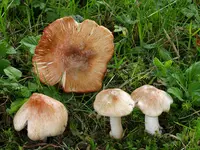
deadly fibrecap
Inosperma erubescens
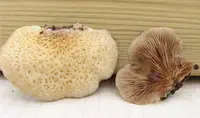
Crepidotus calolepis
Crepidotus calolepis
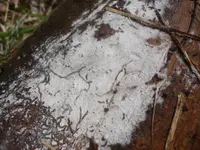
Botryobasidium subcoronatum
Botryobasidium subcoronatum
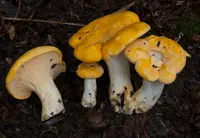
Ghost chanterelle
Cantharellus phasmatis
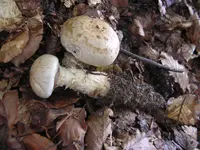
rooting poisonpie
Hebeloma radicosum
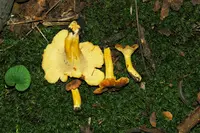
Cantharellus appalachiensis
Cantharellus appalachiensis
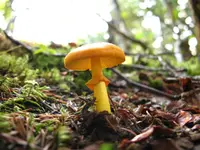
Peck's Yellow Dust Amanita
Amanita elongata
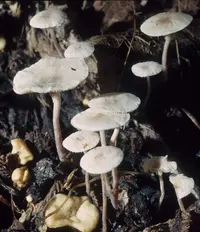
Splitpea Shanklet
Collybia cookei