

Use acidity buffers
When mounting on wood or rock, tuck a thin layer of long-fiber sphagnum or fine, pesticide-free pine needles under the moss to help maintain the slightly acidic, consistently moist micro-layer it prefers.

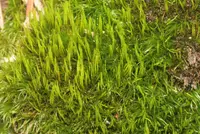
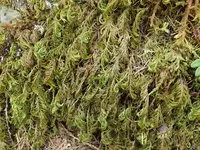
Dicranum flagellare, commonly called dicranum moss or flagellate fork moss, is a clump-forming bryophyte that creates dense, soft, upright tufts. Its narrow, slightly curved leaves give a neat, textured look that works well in terrariums, shaded gardens, and naturalistic displays.
In nature it typically grows on rotting logs, stumps, and moist forest soil across parts of North America, especially in cool, shaded woodlands. It has no true roots and absorbs water and nutrients across its leaf surfaces, so it is sensitive to drying out and air movement.
These traits make it moderately easy to keep if moisture and shade are consistent. Light shade, high humidity, and a stable, soft, acidic substrate support healthy growth and make it easier to care for dicranum moss.

Care Difficulty
Moderate Care

Light Preference
Partial Shade

Water Requirements
Keep Soil Moist

Temperature Preference
Cold Hardy

Hardiness Zone
3–8

Soil Texture
Loamy, Peaty, Organic-rich

Soil pH
Strongly acidic (4.5–5.5), Acidic (5.5–6.5)

Soil Drainage
Moist but well-drained

Fertilization
Minimal (feed rarely)
Scan your plant to receive care tips personalized for your specific plant
Available on iOS and Android
This moss prefers soft, forest-like light and is sensitive to strong direct sun.
This species depends on steady surface moisture but does poorly in stagnant water.
This moss is adapted to cool, temperate conditions and dislikes extreme heat or deep freeze without insulation.
This moss needs consistently moist, high-humidity conditions to stay dense and green.
This species prefers a consistently moist, loose, and organic-rich substrate rather than mineral garden soil.
This species can adapt well to shallow containers and terrariums when moisture is carefully managed.
This moss species thrives in low-nutrient conditions and usually does not need added fertilizer in cultivation.
Dicranum flagellare needs minimal pruning, focused on tidying rather than shaping.
Transplanting is mainly needed when ground or substrate conditions change or when expanding a Dicranum flagellare patch.
Propagation of this moss is commonly done by division and replanting of intact clumps.
This species is naturally cold hardy and generally needs no special winter care in outdoor settings.

Plant Health Check
Not sure what's wrong with your plant? Check your plant's health inside the app.
This species produces distinctive whip-like or flagelliform leaf tips that extend beyond the main tuft, a trait used by bryologists to distinguish it from closely related Dicranum species.
It most often grows on well-rotted, decorticated logs of hardwoods and conifers in humid forests, playing a role in late-stage wood decay microhabitats rather than on fresh bark or soil.
In North America it occurs mainly in the humid forests of eastern and southeastern regions, often locally abundant on suitable rotting logs but entirely absent from nearby areas lacking stable shade and moisture.
This species grows slowly, usually adding only a few millimeters of height per year. It spreads gradually by creeping stems and fragments, so visible carpet formation can take several seasons, especially in drier or brighter locations.
Keep your plants happy and healthy with plant identification, disease detection, and easy care guidance.

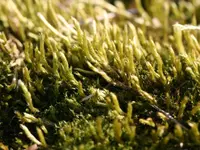
brachythecium moss
Brachythecium salebrosum
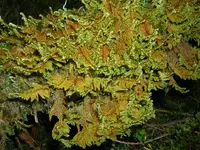
mollusc ctenidium moss
Ctenidium molluscum
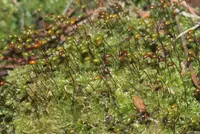
velvet feather-moss
Brachytheciastrum velutinum
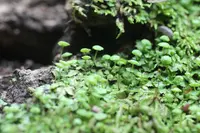
Cryptomitrium tenerum
Cryptomitrium tenerum
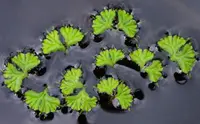
fringed heartwort
Ricciocarpos natans
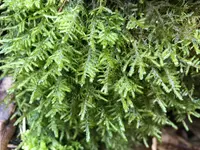
Flat Neckera
Alleniella complanata
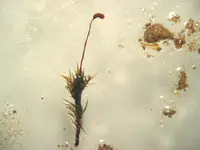
dicranella moss
Dicranella varia
dendroalsia moss
Dendroalsia abietina