Rotate For Symmetry
Turn the pot 90° every 1–2 weeks so the stems do not lean heavily toward the light and the plant keeps a compact, balanced form instead of stretching to one side.

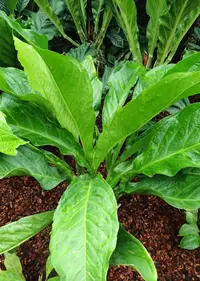
Dieffenbachia 'Camille', commonly called dumbcane, is a tropical foliage houseplant valued for its bold, patterned leaves. It forms a leafy, upright clump with a cane-like stem over time.
Its broad, creamy-white centers and green edges give a bright, decorative look in living rooms and offices. In its native tropical American habitats, Dieffenbachia grows on the forest floor under filtered light.
This variety is considered moderately easy indoors when its basic needs are met. Stable warmth, moderate light, and evenly moist but not waterlogged soil are the main foundations of how to care for Dumbcane.

Care Difficulty
Moderate Care

Light Preference
Bright Indirect Light

Water Requirements
Moderate Water

Temperature Preference
Tropical / Frost Sensitive

Hardiness Zone
11–12

Soil Texture
Loamy, Peaty, Organic-rich

Soil pH
Acidic (5.5–6.5), Slightly acidic (6.5–7.0)

Soil Drainage
Moist but well-drained

Fertilization
Light (every 4–6 weeks)
Scan your plant to receive care tips personalized for your specific plant
Available on iOS and Android
Dieffenbachia 'Camille' grows best in bright, indirect light that mimics dappled forest shade.
Dieffenbachia 'Camille' prefers evenly moist but not saturated soil.
This plant prefers warm, stable temperatures similar to a tropical understory environment.
This plant prefers moderate to high indoor humidity for stable foliage health.
This plant needs a loose, airy, organic-rich mix that drains quickly yet holds some moisture.
This species is well suited to container growing in homes and offices.
Dieffenbachia 'Camille' responds well to moderate feeding during the active growing season.
Pruning helps keep Dieffenbachia 'Camille' compact, safe, and attractive indoors.
Container-grown plants benefit from occasional repotting to maintain healthy roots and stable growth.
Propagation of this plant is commonly done from stem cuttings taken from healthy, mature canes.
This tropical houseplant lacks frost tolerance and must be kept in warm indoor conditions during winter.

Plant Health Check
Not sure what's wrong with your plant? Check your plant's health inside the app.
This cultivar was selected for its creamy central leaf pattern that stays relatively stable under a wide range of indoor light, unlike many variegated Dieffenbachia that revert to greener foliage more easily.
Compared with many other Dieffenbachia, this selection maintains a more compact, bushy form, which makes it suitable for tabletops and small indoor spaces without heavy pruning.
Most plants sold as this cultivar are propagated clonally in tissue culture, so they share nearly identical genetic material and display very uniform color and growth form across different nurseries.
Brown tips or margins usually come from low humidity, inconsistent watering, or fertilizer buildup. Fluoride and salts in tap water can also scorch edges. Use filtered water, flush the pot occasionally, and maintain moderate, stable humidity.
Keep your plants happy and healthy with plant identification, disease detection, and easy care guidance.