Suckering Control
Inspect the base annually and remove unwanted suckers with clean, sharp pruners to keep the shrub within its space and prevent it from forming an uncontrolled thicket.

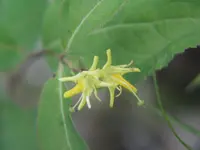
Northern bush honeysuckle (Diervilla lonicera) is a compact, deciduous shrub valued for its toughness and adaptability. It forms dense mounded clumps with arching stems, small pointed leaves, and yellow summer flowers that mature to orange tones.
This species is native to eastern North America, where it grows on rocky slopes, open woods, and roadsides. It is often used in landscapes for erosion control, mass plantings, and naturalized borders.
The plant is easy to grow, tolerating urban conditions, poor soils, and occasional drought once established. It prefers sun to light shade and moderately moist, well-drained soil. These traits make it straightforward to care for northern bush honeysuckle in many garden settings.

Care Difficulty
Easy Care

Light Preference
Partial Sun

Water Requirements
Moderate Water

Temperature Preference
Cold Hardy

Hardiness Zone
3–7

Soil Texture
Sandy, Loamy, Clay

Soil pH
Acidic (5.5–6.5), Slightly acidic (6.5–7.0)

Soil Drainage
Moist but well-drained

Fertilization
Minimal (feed rarely)
Scan your plant to receive care tips personalized for your specific plant
Available on iOS and Android
This shrub prefers moderate sun exposure and adapts well to varied garden light conditions.
This shrub has moderate water needs and becomes quite drought-tolerant once established.
This hardy shrub tolerates a wide temperature range typical of temperate outdoor climates.
This shrub is tolerant of a broad humidity range and rarely needs special humidity management outdoors.
Diervilla lonicera prefers moderately fertile, well-structured soil that drains freely yet retains some moisture.
This species can be grown successfully in containers outdoors.
Diervilla lonicera is a tough native shrub that needs only light feeding in average garden soil.
Pruning Diervilla lonicera keeps the shrub compact, encourages fresh shoots, and maintains good flowering.
This shrub is usually grown in the ground, so care focuses on transplanting rather than frequent repotting.
Diervilla lonicera is commonly propagated from softwood or semi-hardwood cuttings and by division of suckering clumps.
This shrub is cold hardy in most temperate climates and usually needs minimal winter care in the ground.

Plant Health Check
Not sure what's wrong with your plant? Check your plant's health inside the app.
This species naturally thrives on rocky slopes and open woods in eastern North America, where soils are often dry and nutrient poor, showing a strong adaptation to low-moisture, low-fertility sites compared with many other flowering shrubs.
Its tubular yellow flowers produce nectar that attracts bumblebees, other native bees, and hummingbirds, making it an important summer nectar source in forest-edge and understory habitats.
The shrub spreads through short rhizomes, forming loose colonies over time, which helps stabilize slopes and provides connected habitat structure for small animals and insects.

Unlike many introduced honeysuckles, this North American species is considered non-invasive and is sometimes recommended in restoration projects as a native alternative that supports pollinators without aggressively displacing local plant communities.
This shrub spreads slowly by short rhizomes and basal shoots, forming clumps rather than running long distances. It can gently colonize a slope or border but is not considered aggressively spreading in typical garden settings.
Keep your plants happy and healthy with plant identification, disease detection, and easy care guidance.