Shape With Pinching
Pinch back just the soft new shoot tips in late spring to keep the plant compact and dense, rather than making hard cuts into old wood that may not resprout well.

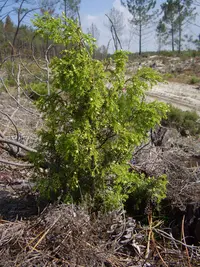
Portuguese prickly juniper (Juniperus navicularis) is a low, dense coniferous shrub with stiff, sharp needles and small berry-like cones. It forms compact mounds that stay close to the ground, making it suitable for rock gardens and coastal-style plantings.
This species is native to sandy, maritime habitats in Portugal and nearby parts of western Europe. It is adapted to poor, well-drained soils and dry, exposed sites.
Growth is slow but steady, and the plant is long-lived when placed in a sunny spot with good drainage. Once established, it tolerates drought and wind, so care for Portuguese prickly juniper is usually straightforward for gardeners who avoid overwatering and heavy, wet soils.

Care Difficulty
Easy Care

Light Preference
Full Sun

Water Requirements
Low Water

Temperature Preference
Cold Hardy

Hardiness Zone
6–9

Soil Texture
Sandy, Loamy, Rocky

Soil pH
Slightly acidic (6.5–7.0), Neutral (7.0)

Soil Drainage
Well-drained

Fertilization
Minimal (feed rarely)
Scan your plant to receive care tips personalized for your specific plant
Available on iOS and Android
This low, coastal juniper thrives in open, bright conditions with long daily sun exposure.
This species is strongly drought-tolerant once established and prefers infrequent, deep watering.
This coastal juniper is adapted to mild climates but tolerates a wide range of outdoor temperatures once established.
This species tolerates a wide humidity range and does not need special air moisture management.
Juniperus navicularis prefers lean, fast-draining, slightly acidic to neutral mineral soils.
This species can grow successfully in containers when drainage and stability are carefully managed.
This coastal conifer grows naturally in poor soils and usually needs very little feeding in gardens.
Pruning for Juniperus navicularis focuses on light shaping and sanitation rather than heavy cutting.
This species is usually grown in the ground, so care focuses on careful transplanting rather than frequent repotting.
Propagation of Juniperus navicularis is possible but slow and better suited to patient growers.
This low-growing juniper is quite cold hardy and usually needs minimal winter care in typical garden settings.

Plant Health Check
Not sure what's wrong with your plant? Check your plant's health inside the app.
This species is naturally restricted to sandy, maritime habitats of southwestern Portugal, where it grows on stabilized dunes and low coastal heaths exposed to strong winds and salt spray.
Its seed cones are small, fleshy, bluish to blackish structures whose scales form a slightly elongated, boat-like shape, which inspired the species name navicularis, meaning boat-shaped.
Unlike many tree-forming junipers, it usually remains a low, compact shrub, often forming dense, cushion-like mounds that help anchor sandy soils and provide shelter for small coastal fauna.

This species is considered globally vulnerable due to its very limited natural range and ongoing habitat loss along the Portuguese coast, making habitat conservation crucial for long-term Juniperus navicularis care and survival in the wild.
This species grows slowly, typically only a few centimeters per year. Growth is most noticeable in the first 10–15 years, then slows further. Good drainage, full sun, and avoiding excessive fertilization support steady but compact development.
Keep your plants happy and healthy with plant identification, disease detection, and easy care guidance.