Wind-training seedlings
Expose young plants to steady, unobstructed wind rather than staking tightly, so trunks develop strong taper and flexible wood adapted to exposed sites.

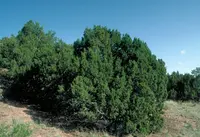
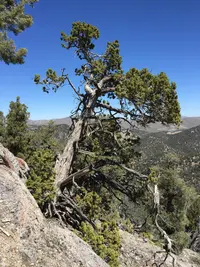
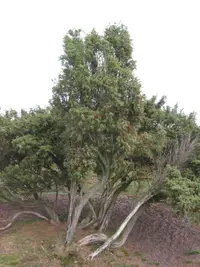
One-seed juniper, Juniperus monosperma, is a small coniferous tree or large shrub native to arid regions of the southwestern United States and northern Mexico. It often forms multi-stemmed, rounded clumps with dense, fine-textured foliage that ranges from gray-green to blue-green.
This species grows slowly and can live a long time, developing a gnarled trunk and fibrous bark in older plants. Its natural adaptation to dry, rocky slopes makes it very drought tolerant and generally low maintenance in suitable climates.
Because it prefers full sun, well-drained soils, and low to moderate moisture, it suits xeriscapes and low-water gardens. These traits make it relatively straightforward to care for One-seed Juniper once established.

Care Difficulty
Easy Care

Light Preference
Full Sun

Water Requirements
Low Water

Temperature Preference
Cold Hardy

Hardiness Zone
4–7

Soil Texture
Sandy, Loamy, Rocky

Soil pH
Slightly acidic (6.5–7.0), Slightly alkaline (7.0–7.5)

Soil Drainage
Well-drained

Fertilization
Minimal (feed rarely)
Scan your plant to receive care tips personalized for your specific plant
Available on iOS and Android
This high-desert conifer thrives in strong, direct sun and needs many hours of light for dense, healthy growth.
This species is strongly drought-tolerant and prefers infrequent, deep watering once established.
This juniper is naturally adapted to wide temperature swings and performs best in climates with cold winters and hot, dry summers.
This species handles low humidity well and rarely needs special humidity management.
Juniperus monosperma prefers lean, mineral, well-drained soil that mimics dry, rocky habitats.
This species can be grown in containers if the potting setup prevents waterlogging and root overheating.
This drought-adapted species needs only light feeding in most garden soils.
Pruning Juniperus monosperma focuses on light shaping and removal of problem wood rather than heavy cutting.
This juniper is usually grown in the ground, so focus on thoughtful transplanting rather than frequent repotting.
Juniperus monosperma is most often propagated by semi-hardwood cuttings rather than seed for consistent traits.
This species is naturally cold hardy in much of its range and usually needs minimal winter care in the ground.

Plant Health Check
Not sure what's wrong with your plant? Check your plant's health inside the app.
Unlike many other junipers with multiple seeds per cone, this species typically produces fleshy berry-like cones containing just one seed, which is the origin of its common name one-seed juniper.
It is a dominant tree in the piñon-juniper woodlands of the US Southwest, shaping habitat structure, stabilizing soils, and providing food and cover for birds, small mammals, and insects.
This species survives on very low rainfall by developing deep and wide-spreading roots and by maintaining small, scale-like leaves that reduce water loss through transpiration.

Archaeological charcoal and pollen records show that this species has been a stable component of Southwestern North American woodlands for thousands of years, allowing scientists to use it as an indicator when reconstructing past climates and vegetation patterns.
This species performs best outdoors in full sun and open air. Indoors, light and airflow are usually insufficient, causing weak, sparse growth and higher pest risk. One-seed Juniper indoor care is generally challenging and rarely long term.
Keep your plants happy and healthy with plant identification, disease detection, and easy care guidance.