Staking tall spikes
Install thin, unobtrusive stakes on the windy side of young flower spikes and tie them loosely with soft ties to prevent stem snap without restricting natural movement.

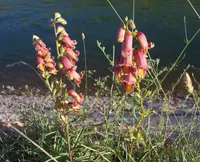
Spanish rusty foxglove, Digitalis obscura, is a short-lived perennial or subshrub grown mainly for its tubular, rusty orange to reddish-brown flowers. The blooms often have darker veining and appear on upright stems above narrow, evergreen to semi-evergreen foliage.
This species is native to dry, rocky slopes in Spain and parts of North Africa, where it experiences hot summers and relatively poor soils. It adapts well to sunny, well-drained garden sites and suits gravel or rock gardens.
Once established, it shows good drought tolerance but dislikes heavy, wet ground. Gardeners who learn how to care for Spanish Rusty Foxglove usually find it moderately easy to maintain, provided drainage and sun are adequate.

Care Difficulty
Moderate Care

Light Preference
Full Sun

Water Requirements
Moderate Water

Temperature Preference
Cool Climate

Hardiness Zone
6–9

Soil Texture
Sandy, Loamy, Rocky

Soil pH
Acidic (5.5–6.5), Slightly acidic (6.5–7.0)

Soil Drainage
Well-drained

Fertilization
Minimal (feed rarely)
Scan your plant to receive care tips personalized for your specific plant
Available on iOS and Android
Digitalis obscura prefers bright conditions that mimic its native sunny, rocky slopes.
Digitalis obscura benefits from evenly moist but never waterlogged soil.
This foxglove thrives in mild, dry conditions with moderate temperature swings.
This species handles typical outdoor humidity well and rarely needs special adjustment in most gardens.
Digitalis obscura prefers freely draining, light mineral soils that never stay waterlogged.
This foxglove can be grown in containers for a few years if the pot supports its deep, upright root system.
Digitalis obscura benefits from light, controlled feeding in lean, well-drained soil.
Pruning Digitalis obscura is mainly about tidiness and encouraging a longer display of flowers.
This species is usually grown in the ground, so focus on careful transplanting rather than frequent repotting.
Digitalis obscura is most often propagated from seed, with some potential for careful division of clumps.
Digitalis obscura is generally cold hardy in mild to moderate climates and needs only modest winter care.

Plant Health Check
Not sure what's wrong with your plant? Check your plant's health inside the app.
This species produces narrow, tubular bells in rusty orange to reddish-brown tones with darker venation, a coloration adapted to attract certain Mediterranean pollinators such as bees and bumblebees that can navigate the deep corolla.
It is native to dry, rocky slopes and open pine or oak woodlands of Spain and adjacent regions, where it tolerates poor, stony soils and seasonal summer drought far better than many other foxgloves.
Like other foxgloves, it contains toxic cardiac glycosides called cardenolides, which deter herbivores, yet horticulturists value it as an ornamental species for its compact growth, distinctive flower color, and suitability to dry gardens when following appropriate Digitalis obscura care.

Digitalis obscura is one of the few foxglove species that can behave as a short-lived shrub in mild Mediterranean climates, forming woody-based, semi-evergreen clumps that persist for multiple years rather than dying back completely after flowering like typical biennial foxgloves.
This species usually has one main flowering period in late spring to early summer. In mild climates and with deadheading, a lighter second flush of blooms may appear, but repeat flowering is not guaranteed.
Keep your plants happy and healthy with plant identification, disease detection, and easy care guidance.