
Virginia buttonweed Identification (Diodia virginiana)

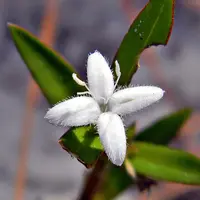
Recognize Virginia buttonweed by its low, creeping stems that root at the nodes, opposite narrow leaves, and small white star-shaped flowers held singly in the leaf axils.

Leaves are usually 1-3 inches (2.5-7.5 cm) long, and the mat-forming stems spread close to the ground rather than growing upright.

Diodia virginiana Identification

Identify a Plant by Photo

Check your plant ID by uploading a clear photo to Botan.

Clear images work best. Avoid photos taken too close or too far away

  • 1 free identification
  • No sign-up
  • 30,000+ plants in database

Check the plant’s low, spreading stems and paired leaves first.

  • Stems trail along the ground and root at the nodes, forming flat mats.
  • Leaves are opposite, narrow to lance-shaped, and usually about 1-3 inches (2.5-7.5 cm) long.
  • Small white flowers sit singly in the leaf axils, where each leaf meets the stem.
  • Flowers are star-like with 4 pointed lobes, and the fruit forms as a small rounded capsule.

Look closely at the leaf axils, since the flowers are small and easy to miss.

Virginia buttonweed shows clear visual shifts from low seedlings to flowering, fruiting mats.

  • Seedling: Seedlings have opposite first leaves on short nodes, with a simple upright start before stems begin creeping and rooting at lower joints.
  • Young plant: Young plants form slender, prostrate stems that branch outward, creating a flat mat; leaves become narrow to lance-shaped, often about 1-3 inches (2.5-7.5 cm) long.
  • Flowering stage: At flowering, small white star-like flowers appear singly in leaf axils, making the stem nodes look more crowded than on nonflowering shoots.
  • Fruiting stage: After bloom, each axil holds a rounded capsule enclosed by persistent sepal lobes, replacing the open flower with a firmer, buttonlike structure.

From late spring into summer, Virginia buttonweed becomes easier to spot when small white, star-like flowers appear in the leaf axils, where the leaves meet the stem. These flowers can continue into fall, adding a clear visual clue. In colder months, top growth may die back after frost, leaving less obvious stems or bare patches. That seasonal thinning can make established patches harder to recognize until new leafy growth returns.

A few low, mat-forming weeds can be mistaken for Virginia buttonweed at a glance.

Largeflower false buttonweed(Spermacoce alata)

Both are creeping broadleaf weeds with opposite leaves and small white flowers at the nodes. Spermacoce alata usually has winged, sharply angled stems and larger, more obvious flower clusters; Diodia virginiana has rounder stems and fewer flowers per node.

Turkey tangle frogfruit(Phyla nodiflora)

It can form similar flat patches with opposite leaves and rooting stems. Frogfruit differs by its dense, short flower spikes and often toothed leaves near the tip, while Diodia virginiana bears small star-shaped flowers singly or in small groups in the leaf axils.

Diodia virginiana is native to the southeastern and south-central United States and extends into parts of eastern Mexico, Central America, and the Caribbean. It is most often found in wet places such as marsh edges, ditches, pond margins, flood-prone lawns, and other low ground. Seeing it in persistently moist or shallowly flooded sites helps separate it from similar mat-forming weeds of drier turf.

Not Sure About the ID?

Use Botan to identify or confirm the plant from a photo so you can make a more confident next step.

FAQ

The most reliable feature is the small white, star-shaped flower cluster sitting in the leaf axils, where leaves join the stem. Opposite leaves and creeping, rooting stems support Virginia buttonweed identification.

More Plant Identification Guides

Identify It. Learn More About It.

Use Botan to identify it from a photo, then get plant details, care information, and common problems for that species.

Botan app identifying a plant from a photo
20 Most Popular Fruits Around the World

7 min read · 22 Jul 2026

20 Most Popular Fruits Around the World

Curious which fruits the world actually eats the most? Here's the top-20 by production volume, an overview of what people choose in each region, and a few figures that defy common assumptions.

Plant Recommendations
20 Most Popular Fruits Around the World
12 Best Plants That Repel Spiders For Your Home and Garden

8 min read · 24 Jul 2026

12 Best Plants That Repel Spiders For Your Home and Garden

Spiders constantly appear in places you don't want them. A few common plants can help repel them using scent alone. Here are 12 options suitable for both indoors and outdoors, plus care tips for each.

Plant Recommendations
12 Best Plants That Repel Spiders For Your Home and Garden
How to Group Plants in Landscaping: A Practical Layout Guide

8 min read · 31 Aug 2026

How to Group Plants in Landscaping: A Practical Layout Guide

Good plant grouping can mean the difference between a well-planned garden and one that looks sloppy. This guide explores layers, spacing, cluster shapes, and the plants that thrive when you group them.

Plant Care
How to Group Plants in Landscaping: A Practical Layout Guide