japanese persimmon Care (Diospyros kaki)

Also known as: Asian Persimmon, Kaki, Korean Mango, Sharon Fruit
japanese persimmon

About japanese persimmon

Japanese persimmon, Diospyros kaki, is a deciduous fruit tree valued for its sweet, orange fruits and attractive autumn foliage. It has a rounded crown and can be grown as a small tree in gardens or larger containers in mild climates. Native to China and widely cultivated in East Asia, it is now grown in many warm temperate regions around the world. The tree is generally hardy, long-lived, and not very demanding once established, which makes it reasonably straightforward to manage. To care for japanese persimmon, provide a sunny spot, well-drained soil, and moderate, consistent moisture without prolonged waterlogging.

Main Plant Requirements

Care Difficulty

Moderate Care

Light Preference

Full Sun

Water Requirements

Moderate Water

Temperature Preference

Cool Climate

Hardiness Zone

7–10

Soil Texture

Sandy, Loamy, Clay

Soil pH

Acidic (5.5–6.5), Slightly acidic (6.5–7.0)

Soil Drainage

Moist but well-drained

Fertilization

Minimal (feed rarely)

Get Personalized Care Plan

Scan your plant to receive care tips personalized for your specific plant

Available on iOS and Android

How to Care for the japanese persimmon

This species needs abundant direct light to flower and fruit well outdoors.

  • Provide 6–8 hours of full sun daily, ideally with morning sun and light afternoon shade in very hot climates to reduce leaf scorch.
  • Tolerates light partial shade (3–4 hours sun), but japanese persimmon will produce fewer and smaller fruits under these conditions.
  • In summer, monitor for leaf curling, pale foliage, or sunburned patches as signs of excessive heat; in spring and fall, ensure trees are not shaded by buildings or taller plants.

Diospyros kaki prefers steadily moist but not saturated soil, especially while young.

  • Water when the top 3–5 cm of soil in the root zone feels dry, applying a deep soak rather than frequent light sprinklings to encourage deep rooting.
  • During the first 2–3 growing seasons, monitor weekly in warm weather; ease back in cool or rainy periods, and avoid waterlogging by using well-drained loam or sandy loam soil.
  • Yellowing leaves and soft new growth suggest overwatering, while dull, drooping, or browning leaf edges indicate the tree is staying too dry between irrigations.

This fruit tree is moderately cold hardy and handles warm summers if soil moisture is stable.

  • Optimal growth occurs around 70–85°F (21–29°C), with active shoot and fruit development in late spring and summer under these temperatures.
  • Mature trees often tolerate short dips to about 5–10°F (-15 to -12°C), but young plants are more vulnerable and benefit from trunk wrapping or mulching in cold winters.
  • In hot spells above 95°F (35°C), provide extra irrigation and, if possible, light afternoon shade to limit heat stress, fruit drop, and leaf scorch.

This species handles a wide humidity range and rarely needs special humidity management outdoors.

  • Target 40–60% humidity, which typical outdoor conditions in many regions already provide.
  • Trees tolerate brief drier air, but prolonged hot, very dry winds can cause leaf edge browning and premature leaf drop.
  • In very dry, exposed sites, reduce humidity stress by mulching the root zone 5–8 cm deep and providing occasional wind protection.

Diospyros kaki grows best in deep, well-drained, moderately fertile soil with stable moisture.

  • Use a loamy or sandy-loam soil with 20–30% organic matter such as compost to improve moisture retention and nutrient supply.
  • Ensure drainage by avoiding heavy, compacted clay; if unavoidable, mound or raise the planting area so excess water flows away from roots.
  • Aim for slightly acidic to neutral pH, around 6.0–7.0, since strongly alkaline soil can limit nutrient uptake and cause chlorotic leaves.
  • For container or raised-bed growing, blend roughly 50% loam-based mix, 30–40% compost, and 10–20% coarse material such as perlite or pine bark to keep pores open and aerated.

This species can be grown in large containers when kept pruned and managed carefully.

  • Choose a tall, heavy container that resists tipping, since mature top growth and fruit load can make the tree top-heavy in wind.
  • Select a pot at least 45–60 cm deep so the strong taproot and lateral roots have enough vertical and horizontal space to develop.
  • Use a fast-draining, slightly heavier mix than typical houseplant soil to balance aeration with pot stability and prevent the root ball from shifting in storms.

Diospyros kaki benefits from modest, well-timed feeding rather than heavy fertilization.

  • Apply a balanced slow-release fertilizer (around 8-8-8 or 10-10-10) once in early spring as new growth starts.
  • In mild climates, a second light application in early summer supports fruiting without pushing excessive leafy growth.
  • Use compost or well-rotted manure as a surface mulch 5–8 cm deep, keeping it away from the trunk.
  • Avoid feeding in late summer and winter; if using liquid feeds, apply at half strength during active growth only.

Pruning Diospyros kaki helps maintain a strong framework and reliable fruiting.

  • Carry out main pruning in late winter while the tree is dormant and leafless.
  • Remove dead, diseased, crossing, or inward-growing branches first, cutting back to healthy wood with clean bypass pruners or a sharp saw.
  • Thin crowded interior shoots to improve light and air, which supports better flowering and fruit quality.
  • Shorten overly long branches to maintain height and spread, keeping an open, vase-like or central leader structure.

This species is usually grown in the ground, so focus on careful transplanting rather than frequent repotting.

  • Transplant young trees in late winter or early spring, before buds break, for the least stress.
  • Look for circling roots at the container edge or slowed growth as signals that a potted tree needs a larger container.
  • Move up only 1–2 pot sizes, loosening or teasing circling roots and pruning any damaged ones cleanly.
  • Water thoroughly after planting, then keep soil evenly moist and shaded from harsh sun for 1–2 weeks to aid recovery.

Propagation of Diospyros kaki is possible from seed or cuttings but is often slow and requires patience.

  • Sow fresh seeds in autumn or early spring after a cold stratification period of 60–90 days at about 35–40°F.
  • Use a well-drained, sandy seed mix, keeping it just moist and warm (68–77°F) to support germination.
  • Take semi-hardwood cuttings in midsummer, treat bases with rooting hormone, and place in high humidity with bottom heat.
  • Many named cultivars are grafted onto seedling rootstocks for vigor and consistency, a method usually done by skilled growers.

Mature trees tolerate moderate winter cold, but young Diospyros kaki benefit from extra protection in colder regions.

  • Most cultivars handle about 0 to -10°F once established, but late spring frosts can still damage young shoots and flowers.
  • Apply 5–10 cm of organic mulch over the root zone in late fall, keeping it a few cm away from the trunk.
  • Wrap young trunks with breathable tree wrap or use a light burlap screen in exposed, windy sites to limit freeze damage.
  • In cold climates, grow Diospyros kaki in large containers and move them into a cool, bright, frost-free space for winter.

Care Tips

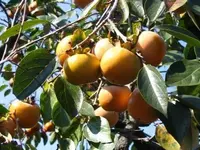
Fruit thinning method

Once fruits reach marble size, thin to 1 fruit every 15–20 cm along the branch to reduce limb stress and improve final fruit size and sweetness.

Branch support planning

Before heavy fruit set, install soft ties and sturdy props under heavily laden branches to prevent breakage, especially on younger trees with narrow crotch angles.

Trunk sunburn protection

In hot, high-sun areas, paint the southwest side of the trunk and major limbs with a 1:1 mix of interior white latex paint and water to reduce sunscald and bark cracking.

Wind and load training

During the first 3–4 years, selectively head back whippy vertical shoots and favor wide-angled scaffold branches to build a strong framework that can safely carry future crops when growing japanese persimmon.

Rodent and rabbit guard

Install a rigid tree guard or hardware cloth cylinder around the lower trunk, 5–8 cm away from the bark and 20–30 cm high, to prevent girdling from rabbits, voles, or other small animals in winter.

Common Pests and Diseases

Persimmon psyllid

This pest feeds on young leaves and shoots, causing curling, distortion, and sticky honeydew that can lead to sooty mold on Diospyros kaki.

Solution

Prune and discard heavily infested shoot tips, then spray remaining foliage with a strong jet of water to dislodge nymphs. If needed, use a horticultural oil or insecticidal soap labeled for psyllids, applied thoroughly to the undersides of leaves in early spring when new growth starts.

Twig girdler borer

This pest causes characteristic girdling and dieback of young twigs, often leading to broken or hanging branch tips later in the season.

Solution

Collect and destroy fallen or partially severed twigs during late summer and fall to remove larvae before they complete development. In larger trees, focus on sanitation and pruning out affected twigs rather than chemical control, as this is usually sufficient to reduce recurring damage.

Persimmon anthracnose

This disease produces dark, sunken spots on leaves and fruit, sometimes coalescing into larger blotches and causing premature leaf or fruit drop.

Solution

Remove and discard infected leaves and fruit from the tree and ground to break the disease cycle, and avoid overhead watering that keeps foliage wet. In areas with frequent outbreaks, apply a copper-based or other labeled fungicide at bud break and during early leaf expansion, following local extension recommendations for Diospyros kaki care instructions.

Cercospora leaf spot

This disease causes small, circular to irregular brown or gray spots on leaves, which can merge and lead to partial defoliation in mid to late summer.

Solution

Rake and dispose of fallen leaves and maintain good spacing and pruning to improve airflow through the canopy. Where leaf spot recurs annually, start a preventative fungicide program in spring using a product labeled for Cercospora on fruit trees, and avoid excess nitrogen fertilization that encourages dense, susceptible foliage.

Scale insects

These insects appear as small, immobile bumps on stems and leaves, sucking sap and causing yellowing, leaf drop, and honeydew buildup on persimmon trees.

Solution

For light infestations, gently scrape or wipe scales off stems and leaves with a soft cloth or brush dipped in soapy water, then rinse. For heavier cases, treat with horticultural oil during the dormant season and, if needed, follow with growing-season applications of oil or insecticidal soap targeting young, crawler-stage scale.

Interesting Facts

Ancient East Asian crop

Diospyros kaki was first domesticated in China more than 2,000 years ago and later spread to Korea and Japan, where many traditional cultivars and regional types were developed.

Astringent vs non-astringent

This species includes both astringent types, which are rich in soluble tannins and must be fully soft and ripe before eating, and non-astringent types, which lose tannic bitterness earlier and can be eaten while still firm.

High cold tolerance

Compared with many subtropical fruit trees, Diospyros kaki tolerates relatively low winter temperatures and can be grown in regions with moderate frost, which has enabled its cultivation in parts of the US, southern Europe, and the Caucasus.

Botan icon

Did you know?

Many long-lived Diospyros kaki trees in Japan are believed, based on historical temple and shrine records, to be several hundred years old, reflecting the species’ capacity for exceptional longevity under stable conditions.

FAQs about japanese persimmon

Yes, this species can grow well in large containers if the pot is deep, heavy, and well-drained. Use quality loam-based mix, repot gradually, and prune roots and canopy periodically to keep the tree manageable and productive.

Grow Healthy Plants with Botan Care

Keep your plants happy and healthy with plant identification, disease detection, and easy care guidance.

Botan plant care app — identify plants on mobile

Explore More Plants