Dragon Tree Care (Dracaena reflexa var. angustifolia 'Tricolor')

Also known as: Red-Margined Dracaena, Rainbow Tree
Dragon Tree

About Dragon Tree

Dracaena reflexa var. angustifolia 'Tricolor', often called dragon tree, is a woody evergreen shrub commonly grown indoors as a compact, upright houseplant. It has narrow, arching leaves with green, cream, and pink stripes that create a clean, architectural look.

This cultivar originates from tropical regions of the Indian Ocean, where it grows in warm, bright, but filtered light under taller trees. Its slow to moderate growth and tolerance of indoor conditions make it suitable for homes and offices.

The plant generally prefers bright, indirect light, moderate watering, and a free-draining potting mix. Once basic needs are understood, many owners find it straightforward to care for Dragon Tree.

Main Plant Requirements

Care Difficulty

Moderate Care

Light Preference

Bright Indirect Light

Water Requirements

Moderate Water

Temperature Preference

Tropical / Frost Sensitive

Hardiness Zone

11–12

Soil Texture

Loamy, Sandy, Organic-rich

Soil pH

Acidic (5.5–6.5), Slightly acidic (6.5–7.0)

Soil Drainage

Well-drained

Fertilization

Light (every 4–6 weeks)

Get Personalized Care Plan

Scan your plant to receive care tips personalized for your specific plant

Available on iOS and Android

How to Care for the Dragon Tree

This plant prefers bright, gentle light to maintain strong growth and clear leaf variegation.

  • Provide 4–6 hours of bright, indirect light daily; an east or north-facing window is ideal for Dragon Tree indoor care.
  • It tolerates light shade, but in very low light new growth becomes sparse and variegation fades toward solid green.
  • Avoid harsh midday sun, especially through glass, which can cause brown, scorched patches; increase filtered light in winter as outdoor light intensity drops.

Dracaena reflexa var. angustifolia 'Tricolor' prefers evenly moist but not saturated soil.

  • Water when the top 3–5 cm of soil feels dry, using enough water to moisten the root zone, then let excess drain away fully.
  • Reduce frequency in winter when growth slows, but do not let the root ball stay dry for long enough that leaves curl or droop noticeably.
  • Watch for yellowing lower leaves and soft stems as overwatering signs, and crispy brown leaf tips or folding leaves as underwatering indicators.

This species grows best in stable, warm conditions without sudden temperature swings.

  • Aim for 65–80°F (18–27°C) for active growth; it tolerates brief peaks to about 85°F (29°C) if humidity and watering are adequate.
  • Protect from cold drafts and air conditioning blasts, keeping it above 60°F (16°C) for reliable growth.
  • The plant is not frost hardy; exposure below 50°F (10°C), especially with frost, can cause leaf blackening and stem damage.

This plant prefers moderate household humidity but benefits from slightly increased levels in very dry homes.

  • Aim for 40–60% humidity; it tolerates brief dips lower but prolonged very dry air can cause leaflet tip browning.
  • Watch for crispy tips, dull foliage, and slowed growth as signs of humidity stress in Dragon Tree.
  • Increase humidity with a nearby humidifier, grouping plants, or placing the pot on a pebble tray, avoiding wetting the crown directly.

This plant needs a loose, fast-draining mix that still holds some moisture.

  • Use a peat- or coco-based mix amended with 20–40% perlite or pumice for structure and aeration.
  • A loamy, organic-rich texture works best, allowing roots of Dracaena reflexa var. angustifolia 'Tricolor' to anchor without becoming waterlogged.
  • Target slightly acidic to neutral pH around 6.0–7.0, which supports nutrient availability and root health.
  • Avoid heavy garden soil, unamended clay, or mixes that stay wet longer than 3–4 days after thorough watering.

This species is well suited to long-term container growing.

  • Choose a pot just 2–5 cm wider than the root ball to limit excess wet substrate that can sour around the roots.
  • Select a heavier or wide-based container to reduce tipping as the tall, narrow stems become top-heavy.
  • Use containers with multiple drainage holes so excess water exits quickly, preventing saturated zones at the base of the root mass.

Dracaena reflexa var. angustifolia 'Tricolor' benefits from modest, diluted feeding during active growth.

  • Use a balanced liquid fertilizer (around 10-10-10 or 20-20-20) at 1/4–1/2 strength for Dragon Tree indoor care.
  • Feed every 4–6 weeks in spring and summer when growth is visible.
  • Avoid fertilizing in late fall and winter, or limit to 1 very light feeding if growth continues.
  • Water before fertilizing to reduce root burn, and skip feeding if the plant is stressed or recently repotted.

Pruning Dracaena reflexa var. angustifolia 'Tricolor' is useful to control height and maintain a neat, bushy form.

  • Carry out most pruning in spring or early summer when the plant is actively growing.
  • Remove dead, yellowing, or damaged leaves and any crossing or crowded stems with clean, sharp shears.
  • Shorten tall or bare canes just above a node to encourage branching and denser foliage.
  • Disinfect tools before and after pruning to minimize the risk of spreading disease.

This plant prefers slightly snug conditions, so repotting aims to refresh soil more than increase pot size.

  • Check for roots circling the pot, pushing through drainage holes, or noticeably slowed growth as signs to repot.
  • Plan repotting for spring, typically every 2–3 years, using a free-draining peat- or coco-based mix with perlite.
  • Choose a pot only 2–5 cm wider than the old one to avoid excess wet soil around the roots.
  • Water lightly after repotting, keep in bright indirect light, and avoid fertilizing for 4–6 weeks to reduce root stress.

Dracaena reflexa var. angustifolia 'Tricolor' is most commonly propagated from stem cuttings taken in the growing season.

  • Take 8–15 cm tip or mid-stem cuttings in late spring or summer, including at least 2–3 nodes.
  • Allow cut ends to dry for a few hours, then place in water or a moist, sterile mix such as perlite and peat.
  • Provide bright, indirect light, warmth around 70–80°F, and high humidity to encourage rooting.
  • Transplant rooted cuttings into small pots with well-drained soil and keep slightly moist until new growth appears.

This tropical houseplant is frost tender and needs warm, sheltered conditions through winter.

  • Keep indoor temperatures around 60–75°F and avoid cold drafts or sudden temperature drops.
  • For outdoor containers, move plants indoors before temperatures fall near 50°F.
  • Reduce watering in winter so the soil dries slightly between waterings, but do not let it stay bone dry for long.
  • Ensure the pot has good drainage and avoid cold, waterlogged soil to prevent root rot.

Care Tips

Rotate For Symmetry

Rotate the pot 90° every 2–3 weeks to prevent leaning and encourage even, compact growth along the canes.

Selective Cane Pruning

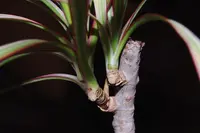
When a cane becomes bare at the base, cut it back just above a node and keep light consistent; this encourages multiple new shoots that thicken the plant from lower down.

Staggered Cane Heights

Plant or position canes at different heights in the same pot to create a tiered structure and reduce top‑heaviness that can cause tipping.

Support Tall Canes

For tall, narrow plants in light nursery mix, insert a slim stake beside each main cane and secure loosely with soft ties to prevent wobbling and root disturbance when the pot is moved.

Routine Pest Checks

During regular watering, inspect leaf axils and along the canes for scale or spider mites and wipe them with a damp cloth or cotton pad with mild soapy water at the first sign, which is a key part of caring for Dragon Tree long term.

Common Pests and Diseases

Fluoride toxicity

Symptoms include brown, scorched leaf tips and margins, often worse on older leaves while new growth looks relatively healthy. This physiological problem is linked to sensitivity to fluoride and salts in tap water and some phosphate fertilizers.

Solution

Use filtered, distilled, or rainwater and leach the pot thoroughly by watering until excess drains to flush built-up salts. Remove the worst damaged leaves, switch to a low-fluoride fertilizer, and avoid superphosphate products to support long-term Dracaena reflexa var. angustifolia 'Tricolor' plant care.

Spider mites

This pest creates fine webbing on leaf undersides and causes tiny yellow or pale speckles that can make foliage look dull and dusty. These arachnids thrive in warm, dry indoor air and can quickly weaken the plant if not controlled.

Solution

Rinse leaves thoroughly with lukewarm water, including undersides, then treat with insecticidal soap or a neem oil solution every 5–7 days until new growth appears clean. Increase humidity slightly and keep the plant away from hot, dry air vents to reduce reinfestation.

Mealybugs

These insects appear as white, cottony clusters in leaf axils, on stems, and sometimes on roots, causing leaf yellowing, distortion, and sticky honeydew. Infestations are common on dracaenas grown indoors with limited air movement.

Solution

Isolate the plant, then dab visible insects with cotton swabs dipped in 70% isopropyl alcohol and wipe affected areas. Follow up with regular applications of insecticidal soap or neem oil and inspect hidden leaf joints and the pot rim to remove any remaining pests.

Leaf spot

This disease causes irregular brown or tan spots with darker edges, sometimes surrounded by a yellow halo, mainly on older leaves. High humidity on leaf surfaces, poor air circulation, and overhead watering favor development of these fungal or bacterial spots.

Solution

Remove and discard affected leaves, avoid wetting the foliage, and space plants so air can move around them. If new spots continue to appear, apply a copper-based or broad-spectrum houseplant fungicide according to label directions and keep leaves dry after treatment.

Soft scale

These insects form small, dome-shaped brown or gray bumps on stems and leaf midribs and excrete honeydew that can lead to sooty mold. Heavy infestations cause general decline, yellowing, and reduced vigor in this slow-growing species.

Solution

Gently scrape or wipe off visible scales with a soft cloth or nail, then wash stems and leaves with insecticidal soap. Repeat treatments every 7–10 days and check regularly along stems and leaf bases, where young crawlers tend to settle.

Interesting Facts

Variegation from mutation

The cream and pink striping on the narrow leaves comes from a stable chimeric mutation, where genetically different tissues coexist in the same plant and alter chlorophyll distribution.

Not naturally occurring

This tricolor form is a horticultural selection of Dracaena reflexa var. angustifolia and is not known from wild populations, relying entirely on human propagation to persist.

Slow, upright cane habit

Unlike many dracaenas that branch freely, this plant typically grows as upright canes with leaves clustered near the tips, giving a cane-like, tiered architectural shape that suits long-term container culture.

FAQs about Dragon Tree

Brown tips usually come from low humidity, fluoride or salts in tap water, or light overfertilizing. Use filtered or distilled water, leach the pot occasionally, and trim dry tips without cutting into healthy tissue.

Grow Healthy Plants with Botan Care

Keep your plants happy and healthy with plant identification, disease detection, and easy care guidance.


Botan plant care app — identify plants on mobile

Explore More Plants