guapa Care (Dracontium polyphyllum)

About guapa

Guapa, Dracontium polyphyllum, is a rare aroid grown mainly by collectors for its dramatic foliage and unusual inflorescences. It is a tuberous plant that produces one large, umbrella-like leaf with many radiating leaflets, emerging from a single tall petiole. In nature it occurs in tropical South American forests, often in shaded, humid understories with rich, moist soil. The plant has a seasonal growth pattern, with active leafy growth followed by a rest period when the tuber stays dormant. This rhythm, along with its need for warmth and stable moisture, makes it moderately challenging for beginners. Understanding its natural habitat helps guide how to care for guapa in indoor or greenhouse conditions.

Main Plant Requirements

Care Difficulty

Hard Care

Light Preference

Partial Shade

Water Requirements

Keep Soil Moist

Temperature Preference

Tropical / Frost Sensitive

Hardiness Zone

11–12

Soil Texture

Loamy, Peaty, Organic-rich

Soil pH

Acidic (5.5–6.5), Slightly acidic (6.5–7.0)

Soil Drainage

Moist but well-drained

Fertilization

Light (every 4–6 weeks)

Get Personalized Care Plan

Scan your plant to receive care tips personalized for your specific plant

Available on iOS and Android

How to Care for the guapa

Dracontium polyphyllum prefers bright, gentle light that mimics a filtered tropical forest floor.

  • Provide 3–5 hours of soft morning sun with dappled or filtered light for the rest of the day, especially in spring and summer.
  • Allow partial shade at midday; strong afternoon sun can scorch foliage of guapa, causing pale patches or crisp leaf edges.
  • In lower light, growth becomes sparse and petioles stretch; in winter, accept slower growth but still give bright indirect light near an east- or north-facing exposure.

This species prefers consistently moist but not waterlogged soil during its active growing season.

  • Water when the top 3–5 cm of soil feel slightly dry, aiming for evenly damp soil around the tuber but never soupy conditions.
  • Use well-drained, humus-rich soil; yellowing, mushy petioles suggest overwatering, while drooping, thin leaves and dry soil indicate underwatering.
  • Reduce watering sharply in the dormant season when foliage dies back, keeping soil just barely moist to protect the tuber from shriveling or rot in heavy soils.

Stable warmth is important for strong growth and reliable foliage on this tropical aroid.

  • Aim for 70–85°F (21–29°C) during active growth; tubers sprout and expand best once soil has warmed consistently above about 65°F (18°C).
  • Protect from cold; growth slows below 60°F (16°C), and prolonged exposure under 50°F (10°C) can damage tissue or kill unprotected tubers.
  • Avoid frost entirely, and in hot periods above 90°F (32°C) increase shade and soil moisture while ensuring airflow to limit heat stress and fungal issues.

This aroid prefers consistently moist air to support its large leaf and inflorescence development.

  • Aim for 60–80% humidity, as guapa grows best in a warm, tropical-style environment.
  • It tolerates brief dips to 40–50%, but prolonged dry indoor air can cause leaf edges to brown and tips to curl.
  • Increase humidity with a room humidifier, clustered plants on pebble trays, and by keeping it away from heating or cooling drafts.

This tuberous species needs loose, airy, organic-rich soil that drains rapidly yet retains some moisture around the roots.

  • Use a chunky mix of 40% peat or coco coir, 30% fine bark, 20% perlite, and 10% compost to mimic a forest floor.
  • Ensure fast drainage so water runs through in seconds, leaving the mix lightly moist but never waterlogged around the tuber.
  • Keep pH slightly acidic to neutral, around 6.0–7.0, which supports nutrient availability without risking toxicity.
  • Avoid dense clay, pure garden soil, or peat-only mixes that compact, exclude air, and encourage rot in Dracontium polyphyllum.

This species is suitable for container growing when the pot is chosen to match its underground tuber and tall foliage.

  • Select a deep, wide container to allow the tuber and spreading roots to expand without pressing hard against the pot walls.
  • Choose a heavier or wider-base pot to prevent tipping when the single tall leaf or inflorescence acts like a sail in wind.
  • Use a pot material with moderate breathability, such as thick plastic or glazed ceramic, to balance moisture retention with root aeration.

Dracontium polyphyllum benefits from modest feeding during its active growth but reacts poorly to heavy fertilization.

  • Use a balanced liquid fertilizer (for example 10-10-10) at 1/4–1/2 strength every 4–6 weeks in spring and summer when foliage is present.
  • Alternatively, apply a light top-dressing of fine compost, keeping it away from the petiole bases to avoid rot.
  • Suspend feeding once leaves yellow and die back for dormancy, resuming only when new growth emerges.
  • Many growers treating it as guapa indoor care avoid high-salt products and always water before applying fertilizer to prevent root burn.

Pruning Dracontium polyphyllum is minimal and mainly hygienic rather than shaping-focused.

  • Cut away dead or yellowing leaves at the base during or after dormancy using clean, sharp scissors or pruners.
  • Remove any damaged or diseased tissue promptly to limit fungal spread and improve airflow around the petioles.
  • Avoid heavy shaping; the plant’s natural form is best, and excessive removal can weaken the tuber.
  • Disinfect tools with alcohol before and after use to reduce the risk of transmitting pathogens between plants.

Container-grown plants or nursery stock benefit from careful transplanting to maintain a healthy tuber and root system.

  • Plan transplanting for late winter to early spring, just before new shoots emerge and while the tuber is still dormant.
  • Check for roots circling the pot, very slow growth, or soil that dries out rapidly as signs it has outgrown its container.
  • Move the plant only every 2–3 years, choosing a pot 2–5 cm wider and using a free-draining mix to limit rot risk.
  • Handle the tuber gently, keep roots shaded and moist during the move, then water once to settle soil and allow it to dry slightly before the next watering.

Dracontium polyphyllum is typically propagated during dormancy, mainly by division of its tubers when available.

  • Lift the dormant tuber in late winter and divide only if clear offsets or natural segments are visible, minimizing cutting surfaces.
  • Dust cut surfaces with a dry fungicidal powder or ground cinnamon, then allow them to callus for 1–2 days before planting.
  • Replant divisions in a well-drained, airy mix, burying shallowly and keeping soil just slightly moist until new shoots appear.
  • Seed propagation is possible but slow; provide warm temperatures (75–85°F) and consistent, light moisture for germination.

This species is not frost hardy and needs a dry, protected dormancy in regions with cool or cold winters.

  • In climates below about 55°F, grow Dracontium polyphyllum in containers so the tuber can be moved indoors for winter.
  • Once foliage dies back, keep the tuber in a barely moist, well-drained medium at 55–65°F, avoiding prolonged cold or wet conditions.
  • Garden-grown plants in mild climates benefit from a dry mulch layer over the root zone to buffer temperature swings and excess rain.

Care Tips

Dormancy management

Allow the tuber to rest almost dry after the foliage naturally dies back, then restart light watering only when a new shoot appears to reduce rot risk and extend tuber lifespan.

Deep, stable container

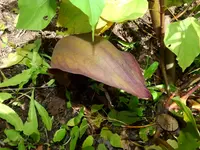
Use a tall, heavy pot with at least 20–30 cm of depth so the large tuber can sit securely with 5–8 cm of mix above it, which helps prevent toppling as the large leaf expands.

Encouraged air circulation

Position a small oscillating fan on a low setting nearby during active growth to reduce fungal issues on the petiole and improve gas exchange around the foliage.

Targeted pest scouting

Inspect the petiole grooves and the undersides of the leaflets every 1–2 weeks during warm months, since spider mites and scale often settle in these sheltered areas first.

Tuber health checks

At the start of each growth cycle, unpot the tuber to check for soft spots or foul odor, trim any clearly rotten tissue with a sterile knife, then repot in fresh mix to support long-term Dracontium polyphyllum plant care.

Common Pests and Diseases

Rhizome soft rot

This disease causes the underground tuberous rhizome to become soft, watery, and foul-smelling, often leading to sudden collapse of the leaf stalk. Symptoms include yellowing foliage, wilting, and rapid tissue breakdown at or below the soil line.

Solution

Remove and discard any affected rhizome sections and repot only firm, healthy tissue in fresh, well-drained mix; sterilize tools and pots before reuse. Reduce watering, keep the substrate airy, maintain moderate temperatures, and improve drainage to prevent recurrence, as this problem is strongly favored by soggy, warm conditions in Dracontium polyphyllum care.

Fungal leaf spot

This disease produces small, water-soaked or brown spots on the large leaf segments, which may enlarge, darken, and sometimes develop yellow halos. Symptoms include irregular blotches that can cause partial leaf dieback in humid or poorly ventilated conditions.

Solution

Remove and discard heavily spotted leaves and avoid overhead watering so foliage dries quickly. Improve air circulation around the plant, keep humidity moderate rather than extreme, and if spotting progresses, apply a copper- or chlorothalonil-based fungicide labeled for ornamental aroids, following label directions carefully.

Spider mites

These insects feed on the underside of the broad leaf, causing fine stippling, dulling of the surface, and, in severe cases, thin webbing along veins and petioles. This pest is most problematic in warm, dry indoor or greenhouse conditions where large leaves are not regularly washed.

Solution

Rinse the foliage thoroughly with lukewarm water, including leaf undersides, and wipe with a soft cloth to remove mites and webbing. Increase ambient humidity slightly, isolate heavily infested plants, and use repeated applications of insecticidal soap or horticultural oil, making sure to coat the undersides of the leaf where mites concentrate.

Scale insects

These insects appear as small, fixed bumps on petioles and leaf veins, sucking sap and causing localized yellowing, sticky honeydew, and sometimes sooty mold on the large leaf surface. This pest can build up on thick petioles and at the base of the plant where it is less noticeable.

Solution

Physically remove visible scales by gently scraping or wiping with a cotton swab dipped in isopropyl alcohol, then rinse the plant to clear honeydew. Inspect regularly, especially along petioles and at the crown, and apply insecticidal soap or horticultural oil in several cycles to target newly hatched crawlers.

Interesting Facts

Largest Dracontium species

This species is considered one of the largest in its genus, producing an enormous, much-branched leaf blade carried on a single tall, mottled petiole that can resemble a small tree in the forest understory.

Carrion-scented inflorescence

The inflorescence emits a strong odor similar to decaying organic matter, an adaptation that attracts carrion-associated insects which act as pollinators.

Seasonal leaf and tuber cycle

It grows from a substantial underground tuber that stores nutrients, allowing the plant to produce a single huge leaf in the rainy season and then retreat to dormancy when conditions become less favorable.

Botan icon

Did you know?

In parts of its native range in northern South America and the Guianas, this species is associated with periodically inundated or swampy forest habitats, showing a marked tolerance for waterlogged soils that would damage the roots of many other aroids.

FAQs about guapa

This aroid usually flowers only when fully mature and well-rested after its dormant period. Insufficient tuber size, recent repotting, or stress from low humidity or irregular moisture often delays flowering, even under otherwise good conditions.

Grow Healthy Plants with Botan Care

Keep your plants happy and healthy with plant identification, disease detection, and easy care guidance.

Botan plant care app — identify plants on mobile

Explore More Plants