Passive air circulation
Keep the pot in a terrarium or tray setup with a small gap or vent for slow air exchange so leaves dry between dew cycles and fungal issues stay minimal without lowering humidity too much.

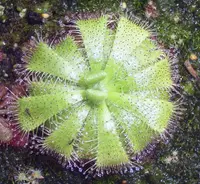
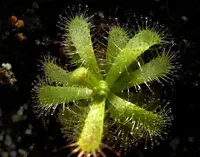
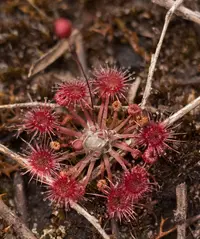
Floating sundew, Drosera admirabilis, is a small carnivorous plant that forms flat rosettes of round leaves covered in sticky, glistening hairs. These glandular hairs trap small insects, which the plant digests to supplement nutrients in poor, sandy or peaty substrates.
In nature it occurs in South Africa, where it grows in sunny, seasonally wet habitats. It stays compact and low-growing, which suits small containers and terrariums.
Its needs are specific but consistent, so it is manageable once conditions are stable. Good light, pure water, and nutrient-poor, constantly moist media are the main points to understand when learning how to care for Floating Sundew.

Care Difficulty
Moderate Care

Light Preference
Partial Sun

Water Requirements
Keep Soil Moist

Temperature Preference
Warm Climate

Hardiness Zone
10–11

Soil Texture
Sandy, Peaty, Organic-rich

Soil pH
Strongly acidic (4.5–5.5)

Soil Drainage
Waterlogged tolerant

Fertilization
Minimal (feed rarely)
Scan your plant to receive care tips personalized for your specific plant
Available on iOS and Android
This South African sundew needs strong light to keep its leaves compact and colorful.
This species prefers consistently wet conditions with low‑mineral water.
This sundew grows best in mild, frost‑free conditions with moderate warmth.
This species prefers consistently moist air but adapts to typical home humidity if other conditions are correct.
This carnivorous species requires very low-nutrient, acidic, moisture-retentive but airy soil.
This sundew is very suitable for container growing when moisture and depth are managed carefully.
Drosera admirabilis is sensitive to nutrients, so use only very weak feeding when growth slows without obvious cause.
Drosera admirabilis needs only light pruning to keep rosettes clean and healthy.
Repotting maintains healthy roots and fresh, low-nutrient substrate for this carnivorous sundew.
Drosera admirabilis is commonly multiplied by leaf cuttings, division, and seeds under controlled conditions.
This species dislikes hard frost and needs protection in colder climates.

Plant Health Check
Not sure what's wrong with your plant? Check your plant's health inside the app.
This species forms very compact, flat rosettes, often only a few centimeters across, an adaptation that allows it to sit close to the soil surface and exploit the humid boundary layer of air in its native Cape region of South Africa.
In high light and cooler conditions, the leaves often turn a strong reddish to pink hue due to increased production of protective pigments called anthocyanins, while in lower light they stay more green.
It produces large numbers of fine, dust-like seeds that readily germinate in suitable conditions, leading to dense carpets of plants in the wild and in cultivation when allowed to self-sow.

In cultivation, this species is regarded as one of the most consistently compact and tidy rosette sundews, which makes it a reference plant for growers comparing leaf color, shape, and size stability across different Drosera lineages.
Brown leaves usually result from mineral-rich tap water, low humidity, or excessive heat. Use rain, distilled, or reverse-osmosis water, maintain consistently moist medium, and protect the plant from hot, dry air and direct blasts from heaters or vents.
Keep your plants happy and healthy with plant identification, disease detection, and easy care guidance.