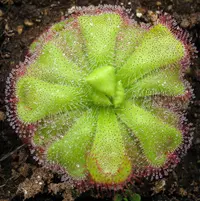
spoonleaf sundew Care (Drosera intermedia)

Also known as: oblong-leaved sundew, spatulate-leaved sundew, spoon-leaved sundew
spoonleaf sundew

About spoonleaf sundew

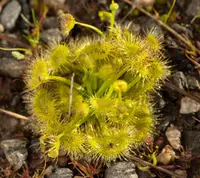
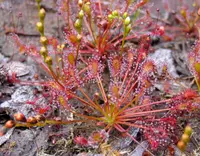
The spoonleaf sundew, Drosera intermedia, is a small carnivorous plant that traps insects with sticky, spoon-shaped leaves. It forms low rosettes that often develop red or pink tones in strong light.

In nature it grows in nutrient-poor bogs, fens, and wet sandy soils across parts of North America and Europe. The plant relies on captured insects for nutrients, which helps explain its need for very poor, acidic substrates.

It stays compact, which suits container culture, but demands consistently wet conditions and soft, low-mineral water. Bright light, high humidity, and undisturbed roots are key if you want to learn how to care for spoonleaf sundew successfully.

Main Plant Requirements

Care Difficulty

Moderate Care

Light Preference

Full Sun

Water Requirements

Aquatic

Temperature Preference

Cool Climate

Hardiness Zone

3–9

Soil Texture

Sandy, Peaty, Organic-rich

Soil pH

Strongly acidic (4.5–5.5)

Soil Drainage

Waterlogged tolerant

Fertilization

Minimal (feed rarely)

Get Personalized Care Plan

Scan your plant to receive care tips personalized for your specific plant

Available on iOS and Android

How to Care for the spoonleaf sundew

Drosera intermedia needs strong light to form healthy red traps and sticky dew.

  • Provide 6–10 hours of direct sun daily outdoors, with at least 4–6 hours of gentle morning sun; light afternoon shade prevents leaf scorch in hot climates.
  • Tolerates bright, very open partial shade, but plants grown with less than 4 hours of direct sun develop longer, weaker leaves and reduced dew.
  • In summer, protect from reflected heat and metal surfaces; in winter, position so the spoonleaf sundew receives maximum low-angle sun to maintain vigor.

This bog species requires consistently wet, mineral-free conditions around its roots.

  • Use rainwater, distilled, or reverse-osmosis water; avoid tap water with dissolved salts that can burn Drosera intermedia roots and reduce growth.
  • Stand pots or trays in 1–3 cm of water so the soil stays saturated; never allow more than the top 0.5 cm to dry, even briefly, during active growth.
  • In cooler fall–winter conditions, reduce water depth to 0.5–1 cm but do not let the medium dry; pale, limp leaves suggest underwatering, while sour odor and black roots suggest waterlogged, anaerobic soil.

This temperate sundew needs warm summers and a cool resting period to stay long-term healthy.

  • For active growth, aim for 70–85°F (21–29°C) days and 55–70°F (13–21°C) nights; short heat spikes to 90°F (32°C) are tolerated if roots stay wet.
  • In winter dormancy, many populations handle 32–45°F (0–7°C); light frosts down to about 25°F (-4°C) are usually survived if the crown is not exposed and the soil stays damp.
  • Avoid prolonged extremes above 95°F (35°C) or below 20°F (-7°C); in strong heat, increase water depth and provide light shade, and in severe cold, mulch or move containers to a sheltered, frost-protected spot.

This species prefers consistently moist air to maintain active dew production on its leaves.

  • Target 50–70% humidity; it tolerates brief drops but prolonged air below 40% reduces mucilage and trapping efficiency.
  • Low humidity stress shows as dry, matte leaf surfaces and reduced insect capture even when soil is wet.
  • Increase humidity with nearby water trays or grouped plants rather than enclosing spoonleaf sundew in stagnant, unventilated covers.

This wetland carnivore needs a nutrient-poor, acidic, airy medium that stays constantly moist yet not waterlogged.

  • Use a mix of 1:1 sphagnum peat moss and silica sand or perlite to create a loose, low-nutrient substrate.
  • Aim for acidic conditions around pH 4.0–5.5, avoiding any lime, compost, or standard potting soil that adds minerals or fertilizer.
  • Ensure the mix drains freely but remains evenly damp by using coarse sand or perlite to improve aeration around the roots.
  • Flush the pot occasionally with low-mineral water to prevent mineral buildup, which Drosera intermedia is highly sensitive to.

This species is very suitable for container cultivation, especially in trays or bog-style pots.

  • Choose a pot at least 8–10 cm deep so roots can access a stable, cool, moist zone below the surface.
  • Select plastic or glazed ceramic containers, which slow evaporation and help maintain the constant moisture this plant requires.
  • Set the pot in a shallow tray of low-mineral water to provide steady moisture without submerging the crown of the plant.

Drosera intermedia gains most nutrients from captured insects and should receive only very weak, occasional feeding in cultivation.

  • Use a very dilute orchid or carnivorous plant fertilizer at 1/8–1/4 strength, never standard houseplant food.
  • Apply to the tray water, not directly on leaves, at most every 4–6 weeks during active growth.
  • Give no fertilizer during winter dormancy; maintain only clean, low-mineral water.
  • Rely mainly on small insects for nutrition when caring for spoonleaf sundew.

Drosera intermedia needs only light, corrective pruning to maintain vigor and hygiene.

  • In late winter or early spring, remove dead or blackened leaves at the base to reduce mold risk.
  • Trim spent flower stalks once seeds have shed if unwanted, directing energy back to foliage.
  • Use small, sharp scissors or fine snips, disinfected with alcohol before and after use.
  • Avoid cutting healthy, dewy leaves, as this reduces the plant’s feeding surface and vigor.

Repotting or transplanting this carnivorous species is infrequent but useful to refresh the acidic, low-nutrient substrate.

  • Plan to repot Drosera intermedia every 1–2 years or when growth slows and peat looks compacted.
  • Carry out repotting in early spring just before strong new growth begins.
  • Use a gentle mix of 1:1 sphagnum peat and perlite or sand, thoroughly rinsed and free of added fertilizer.
  • Handle the root ball carefully, keeping it mildly moist, and minimize disturbance to avoid transplant shock.

This species is commonly propagated by seed and leaf cuttings under consistently moist, bright conditions.

  • Collect ripe seed and sow on the surface of damp peat-sand mix; do not cover, as seeds need light for germination.
  • Provide 60–75°F, bright indirect light, and constant moisture; germination usually occurs within several weeks.
  • Take healthy leaf cuttings in late spring or summer and lay them flat on wet long-fiber sphagnum.
  • Maintain high humidity with a clear cover and ventilate slightly to limit fungal growth while plantlets form.

This temperate sundew needs a cool dormancy and tolerates moderate frost when roots stay consistently damp.

  • In the ground, a light mulch of pine needles or coarse peat helps insulate the crown in colder regions.
  • Container plants in zones with prolonged freezes should be moved to a cold frame or unheated bright room.
  • Keep the medium just moist, not waterlogged, during dormancy to prevent rot in cold conditions.

Care Tips

Winter dormancy setup

In cold climates, move pots to an unheated but frost-free space (35–45°F) or bury the pot outdoors to rim level and mulch lightly so the plant can complete its natural winter dormancy without freezing solid.

Distilled tray refresh

Every 2–3 weeks, empty and rinse the water tray and saucer with clean distilled or rainwater to prevent mineral buildup and algae that can stress roots over time.

Insect feeding management

If natural prey is scarce, offer 1–2 small soft-bodied insects (like fruit flies) per month in the growing season, but avoid overfeeding and never use meat or fertilizer pellets, which rot and damage leaves.

Seedling density control

When volunteer seedlings crowd the pot, thin or gently transplant extras using long tweezers so each rosette has at least 1–2 cm of space, which improves light exposure and reduces fungal problems.

Bog container design

For growing spoonleaf sundew in containers, use a tall, undrained pot or bucket with a permanent 2–4 cm water reservoir at the bottom, which mimics a shallow bog and stabilizes moisture and temperature around the roots.

Common Pests and Diseases

Fungus gnats

These insects are attracted to constantly wet, peaty media and their larvae can feed on fine roots and organic matter around the crown. Symptoms include tiny black flies hovering over pots and reduced vigor in seedlings or small plants.

Solution

Allow only the surface of the medium to dry slightly between tray refills while keeping the root zone wet, then use yellow sticky traps to catch adults and a biological control such as Bacillus thuringiensis israelensis (BTI) in the water to target larvae. Rinse away algae buildup on the medium surface and avoid adding fertilizer, which increases organic growth that supports gnat populations.

Aphids

These insects may cluster on fresh growth, flower stalks, and undersides of leaves, sucking sap and distorting new traps. Symptoms include curled or stunted leaves, sticky honeydew, and sometimes sooty mold on older tissue.

Solution

Submerge foliage briefly in clean rainwater or distilled water to dislodge colonies, or gently rinse affected areas under a soft stream of water. For persistent infestations, apply a mild, carnivorous-plant-safe insecticidal soap only to affected parts, and repeat at short intervals while avoiding spraying during strong sunlight to prevent leaf burn.

Botrytis (grey mold)

This disease develops in cool, stagnant, very humid conditions, colonizing dead insects or old leaves and then spreading to healthy tissue. Symptoms include soft brown patches, fuzzy grey mold on leaves or flower stalks, and rapid collapse of affected parts.

Solution

Remove and discard any dead leaves, spent flower stalks, or moldy insects as soon as they appear, then improve air circulation and reduce overcrowding of pots. If needed, move the plant to a brighter, breezier position and use a fungicide labeled safe for carnivorous plants as a targeted spot treatment rather than a routine spray.

Spider mites

These pests may appear during hot, dry spells, especially under strong indoor lighting, feeding on leaf surfaces and reducing the plant’s ability to trap prey. Symptoms include dull, stippled leaves, fine webbing between leaves, and slow, weakened growth.

Solution

Increase ambient humidity around the plant while maintaining bright light, then rinse foliage thoroughly with a gentle stream of water, focusing on leaf undersides and crown areas. For heavier infestations, apply a miticide or insecticidal soap known to be safe for Drosera species, repeating as directed until new growth appears clean; this is a key part of good Drosera intermedia plant care.

Interesting Facts

Habitat water levels

This species often grows partly submerged at the edges of acidic ponds and bog pools, with its roots and even lower leaves standing in water for much of the growing season.

Seasonal growth strategy

In cooler climates it survives winter as a compact hibernaculum, a tight resting bud that protects the growth point from freezing and flooding.

Hybridization in the wild

In some North American bogs it naturally hybridizes with Drosera rotundifolia, forming the intermediate hybrid Drosera × beleziana where the two parent species grow together.

Botan icon

Did you know?

Drosera intermedia has one of the broadest natural ranges among temperate sundews, occurring across much of northern and central Europe, parts of Siberia, eastern North America, and even into the Caribbean, always tied to nutrient-poor, acidic wetland habitats.

FAQs about spoonleaf sundew

Brown tentacles or leaf tips usually come from strong sun, dry air, mineral buildup, or old age. Remove fully dead leaves, keep the soil constantly damp with low-mineral water, and avoid strong midday sun reflecting off glass.

Grow Healthy Plants with Botan Care

Keep your plants happy and healthy with plant identification, disease detection, and easy care guidance.

Botan plant care app — identify plants on mobile

Explore More Plants