Cool root management
Use a tall, insulated pot (at least 20–25 cm deep) and stand it in a tray with cool, clean water to keep the root zone stable and slightly cooler than the air, which supports this species’ long, sensitive taproot.

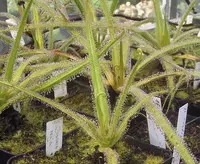
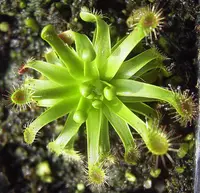
King sundew, Drosera regia, is a carnivorous plant that forms upright, narrow leaves covered in sticky glands that trap insects. It usually grows as a clumping rosette from a short stem or rhizome.
In nature, it occurs in cool, coastal mountain valleys of South Africa with mild temperatures and constant moisture. It relies on insect prey for extra nutrients, which helps it tolerate poor, sandy soils.
This species can be moderately challenging, as it dislikes extreme heat, drying out, or heavy, rich potting mixes. Understanding how to care for king sundew starts with providing bright light, pure water, and consistently damp, airy soil.

Care Difficulty
Hard Care

Light Preference
Full Sun

Water Requirements
Keep Soil Moist

Temperature Preference
Cool Climate

Hardiness Zone
9–11

Soil Texture
Sandy, Peaty, Organic-rich

Soil pH
Strongly acidic (4.5–5.5)

Soil Drainage
Waterlogged tolerant

Fertilization
Minimal (feed rarely)
Scan your plant to receive care tips personalized for your specific plant
Available on iOS and Android
This South African carnivorous species needs strong light to form tall, dewy leaves and robust traps.
This species prefers constantly moist, low-mineral conditions that mimic cool, seepage-fed habitats.
This highland species prefers cool to mild conditions with noticeable day–night temperature drops.
This species prefers consistently moist air and benefits from moderately high humidity.
Use a loose, low-nutrient, acidic mix that stays moist yet airy.
This species is well suited to container growing when given a deep, stable pot.
This species is adapted to nutrient-poor soils, so fertilizing king sundew must be done sparingly and indirectly.
Pruning Drosera regia focuses on hygiene and light maintenance rather than reshaping the plant.
Repotting is infrequent but important for long-term health of Drosera regia in containers.
Multiplying Drosera regia is possible but somewhat slow, mainly through cuttings and seed.
Winter care focuses on preventing freezing damage, as Drosera regia is not fully frost hardy.

Plant Health Check
Not sure what's wrong with your plant? Check your plant's health inside the app.
Genetic and morphological studies indicate that this species represents a very old lineage within sundews, likely tracing back to the ancient supercontinent Gondwana and diverging early from other Drosera groups.
Mature plants can form long, arching leaves that often exceed 30–40 cm, making it one of the largest sundew species and giving it an appearance closer to a small grass-like shrub than a typical rosette sundew.
In the wild it is restricted to a single valley in the Drakensberg region of South Africa, where it grows in cool, constantly moist soils along mountain streams and seeps with high year-round water availability.

This species produces unusually thick, woody rhizomes compared with most other sundews, allowing older plants to form a substantial subterranean structure that can re-sprout after above-ground damage and contributes to its reputation for being long-lived under stable conditions.
Flowering is reduced by low light, nutrient buildup from hard or fertilized water, or plants that are still immature. Ensure a cool winter rest, very pure water, and avoid feeding the roots. Flowers usually appear on strong, mature rosettes.
Keep your plants happy and healthy with plant identification, disease detection, and easy care guidance.