Use tall pots
Choose deep, narrow pots with many side and bottom holes so the long roots can run downward and the lower mix stays evenly moist without becoming stagnant.

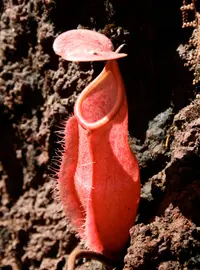
Nepenthes vieillardii is a tropical carnivorous vine-forming pitcher plant native to New Caledonia. It usually grows as a scrambling or climbing plant in humid, nutrient-poor habitats. The plant produces narrow leaves ending in colorful pitchers that trap insects, supplying nutrients that the soil lacks. Pitcher size and color can vary, but they are typically slender and elongated. In cultivation, it prefers consistently moist, airy substrate, high humidity, and bright filtered light. Its need for stable warmth, moisture, and good water quality makes it more suitable for growers ready to research how to care for Nepenthes vieillardii.

Care Difficulty
Hard Care

Light Preference
Partial Shade

Water Requirements
Keep Soil Moist

Temperature Preference
Tropical / Frost Sensitive

Hardiness Zone
11–12

Soil Texture
Peaty, Organic-rich, Sandy

Soil pH
Strongly acidic (4.5–5.5)

Soil Drainage
Moist but well-drained

Fertilization
Minimal (feed rarely)
Scan your plant to receive care tips personalized for your specific plant
Available on iOS and Android
This highland pitcher plant prefers bright, gentle light that mimics open, humid forest edges.
This species needs consistently moist, low-mineral conditions without staying stagnant or waterlogged.
This highland species grows best with mild days and noticeably cooler nights.
This highland pitcher plant needs consistently high humidity to form stable pitchers and foliage.
This species prefers a very airy, low-nutrient, fast-draining yet moisture-retentive mix that mimics mossy, organic forest substrates.
This species adapts well to container culture when the pot supports its vining, often top-heavy growth habit.
This species grows in nutrient-poor habitats and needs only very light feeding in cultivation.
Pruning is mainly used to manage size and remove nonfunctional growth on Nepenthes vieillardii.
Repotting focuses on preserving the airy, low-nutrient root environment this species requires.
Propagation of Nepenthes vieillardii is possible but slow and best for patient growers.
This tropical lowland species is highly frost-sensitive and needs warm, stable conditions in winter.

Plant Health Check
Not sure what's wrong with your plant? Check your plant's health inside the app.
This species is endemic to New Caledonia, where it is one of only a few native pitcher plants adapted to the island’s ultramafic and serpentine substrates, which are naturally poor in nutrients and often rich in heavy metals.
Unlike many climbing Nepenthes, this species typically forms low, scrambling or prostrate stems that weave through scrub vegetation, with pitchers produced close to the ground rather than high in the canopy.
In its native maquis shrubland, it tolerates exposed, seasonally dry, nutrient-poor conditions that are challenging for most carnivorous plants, showing a relatively high tolerance for sun and wind compared to many related species.

Field observations from New Caledonia note that its pitchers often host distinct communities of invertebrates, forming small, specialized aquatic microhabitats that differ from those found in co-occurring Nepenthes species on the island.
This species is slow growing. Expect only a few new leaves and pitchers per year under good conditions. Growth speeds up slightly in stable warmth, high humidity, and low-mineral water, but remains modest compared with many houseplants.
Keep your plants happy and healthy with plant identification, disease detection, and easy care guidance.