Seasonal rest setup
Provide a slightly cooler, brighter location and reduce tray water depth in late autumn to allow a mild winter rest, which supports denser spring rosettes and longer plant lifespan when growing Drosera scorpioides.

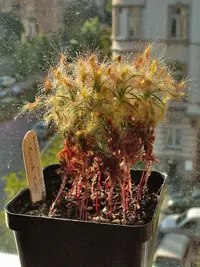
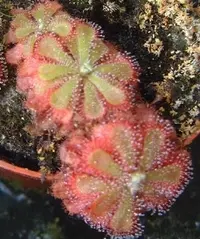
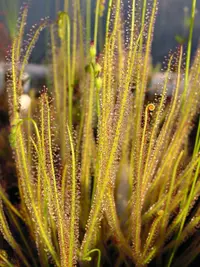
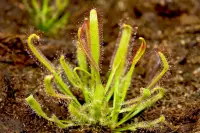
Drosera scorpioides, often called the pygmy sundew, is a small carnivorous plant that forms tight rosettes covered in glistening sticky hairs. These hairs trap tiny insects, which the plant digests to supplement nutrients that are scarce in its native sandy, nutrient-poor soils of southwestern Australia.
Plants stay compact and often grow in groups, creating dense, sparkling mats in suitable conditions. They can be moderately easy to grow if their need for constant moisture, strong light, and low-mineral substrate is respected.
Those learning how to care for Drosera scorpioides should understand that it does not tolerate drought, high mineral water, or heavy rich potting mixes, but adapts well to controlled indoor or greenhouse setups.

Care Difficulty
Moderate Care

Light Preference
Full Sun

Water Requirements
Keep Soil Moist

Temperature Preference
Warm Climate

Hardiness Zone
10–11

Soil Texture
Sandy, Peaty, Organic-rich

Soil pH
Strongly acidic (4.5–5.5)

Soil Drainage
Waterlogged tolerant

Fertilization
Minimal (feed rarely)
Scan your plant to receive care tips personalized for your specific plant
Available on iOS and Android
This pygmy sundew needs strong light to form compact rosettes and good red coloration.
This carnivorous plant prefers consistently moist, low-mineral conditions without drying out fully.
This pygmy sundew prefers mild conditions and does not tolerate hard frost.
This species benefits from moderately humid air that prevents dew from drying too fast.
This carnivorous species needs very nutrient-poor, moist, airy soil to avoid root damage.
This species is well suited to container culture when moisture and mineral buildup are controlled carefully.
This carnivorous species gains most nutrients from prey and usually does not benefit from conventional fertilization.
Pruning needs for Drosera scorpioides are minimal and focus on cleanliness rather than shaping.
Repotting is infrequent but important to maintain suitable, low-mineral media and a healthy root system.
This species is commonly propagated to maintain healthy colonies and renew aging plants.
Winter care focuses on maintaining cool, bright, frost-free conditions with stable moisture.

Plant Health Check
Not sure what's wrong with your plant? Check your plant's health inside the app.
Drosera scorpioides is one of the smallest rosetted sundews, typically forming compact cushions only about 1–2 cm tall, which allows it to occupy shallow, nutrient-poor soils between rocks in southwestern Australia.
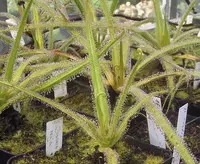
Older plants develop a short, woody stem that lifts the sticky carnivorous leaves above the soil surface, creating a miniature tower that can better intercept small flying and crawling insects.
This species produces tiny clonal bodies called gemmae at the center of the rosette, allowing it to spread rapidly across its habitat without relying only on seeds.

In its native southwestern Australian habitat, Drosera scorpioides is part of one of the world’s richest carnivorous plant floras, growing alongside many other Drosera species that often occupy slightly different microhabitats only a few meters apart.
Brown leaves usually come from old foliage dying back naturally, mineral buildup from tap water, or prolonged dryness. Use low-mineral water, keep the substrate evenly moist, and remove dead leaves so new growth receives light and airflow.
Keep your plants happy and healthy with plant identification, disease detection, and easy care guidance.