Echeveria Care (Echeveria 'Cubic Frost')

About Echeveria

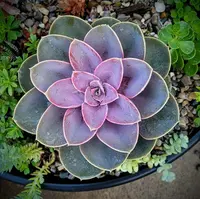
Echeveria 'Cubic Frost' is a compact succulent from the Crassulaceae family, valued for its sculptural rosettes and pastel coloring. It is a cultivated form, derived from species native to arid regions of Mexico and Central America. Leaves are thick, curled, and often dusty lavender or blue-gray, forming tight rosettes that stay low and slowly clump with age. Flower stalks may appear in warmer seasons, carrying small, bell-shaped blooms above the foliage. This plant suits indoor containers and bright patios, as long as it receives strong light, fast-draining soil, and infrequent watering. Its drought tolerance and slow growth habit make it a practical choice for those learning how to care for Echeveria.

Main Plant Requirements

Care Difficulty

Easy Care

Light Preference

Full Sun

Water Requirements

Low Water

Temperature Preference

Tropical / Frost Sensitive

Hardiness Zone

10–11

Soil Texture

Sandy, Loamy, Rocky

Soil pH

Slightly acidic (6.5–7.0), Neutral (7.0)

Soil Drainage

Well-drained

Fertilization

Minimal (feed rarely)

Get Personalized Care Plan

Scan your plant to receive care tips personalized for your specific plant

Available on iOS and Android

How to Care for the Echeveria

This succulent needs strong light to keep its compact, sculpted rosettes and cool tones.

  • Provide 6–8 hours of bright light daily, ideally with direct morning sun and bright, filtered light or light shade in the hot afternoon.
  • Outdoors, position Echeveria 'Cubic Frost' where it gets east or southeast exposure; indoors, place near a south- or west-facing window without heavy obstruction.
  • Watch for stretching, fading color, or weak leaves as signs of too little light, and for crisped leaf tips or bleached patches as sunburn from intense midday sun.

Watering should be infrequent and deep, allowing the roots to dry between soakings.

  • Water only when the top 3–5 cm of soil are completely dry, then drench the root zone and let excess drain fully away from the rosette and crown.
  • In spring and summer, this may mean watering every 7–14 days in fast-draining soil; in cool, low-light seasons the interval often stretches to 3–4 weeks.
  • Use a gritty, sharply draining mix to prevent root rot; soft, translucent, or easily detached leaves indicate overwatering, while wrinkled, flattened leaves signal that Echeveria 'Cubic Frost' is too dry.

Stable, warm conditions support dense rosette growth and reduce stress-related leaf loss.

  • Aim for 65–80°F (18–27°C) during active growth, with good air movement to prevent fungal problems on thick succulent leaves.
  • Protect from frost and hard freezes; short dips to 30–32°F (-1–0°C) may damage tissue, so move plants or cover them before temperatures drop below 35°F (2°C).
  • In hot spells above 90°F (32°C), give light afternoon shade and avoid reflected heat from walls or pavement to limit leaf scorch and stress.

This succulent prefers relatively dry air and does not need elevated humidity.

  • Target 30–50% humidity, similar to average indoor air in heated or air-conditioned homes.
  • Dry air is well tolerated; problems arise more from excess moisture on leaves than from low ambient humidity.
  • If air is extremely dry and leaf tips shrivel, place the pot near other plants or on a pebble tray, keeping leaves dry.

Use a very fast-draining, mineral-based mix that prevents water from sitting around the roots.

  • Choose a gritty, sandy mix such as cactus/succulent substrate with extra mineral content for structure and aeration.
  • Combine roughly 50–70% inorganic materials (perlite, pumice, coarse sand, small gravel) with 30–50% lean potting mix or composted bark.
  • Aim for slightly acidic to neutral pH around 6.0–7.0, which supports nutrient availability without stressing roots.
  • Avoid dense, peat-heavy or water-retentive soils; if water lingers on the surface for more than a few minutes, lighten the mix with more coarse particles.

This species is well suited to container growing when excess moisture is controlled carefully.

  • Choose a wide, shallow pot that matches the shallow root system, leaving about 2–3 cm around the rosette for air flow and drying.
  • Use unglazed terracotta if extra evaporation is needed, as it pulls moisture from the mix and reduces rot risk.
  • Keep the container slightly elevated on pot feet or stones so drainage holes stay clear and water cannot pool under the base.

Light feeding supports compact growth and clean leaf color in this succulent.

  • Use a balanced liquid fertilizer (around 10-10-10 or 20-20-20) diluted to 25–50% strength for caring for Echeveria.
  • Feed once a month during spring–summer, only when the soil is slightly moist.
  • Skip compost-heavy products; choose a low-organic, cactus or succulent formula instead.
  • Stop feeding in fall–winter to avoid weak, stretched growth during its semi-dormant period.

Pruning needs for Echeveria 'Cubic Frost' are minimal and focus on cleanliness and shape.

  • Best time for light pruning is in spring or early summer when growth is active.
  • Remove dead, yellowing, or damaged leaves at the base to reduce rot and pest risks.
  • Trim stretched, leggy stems with clean, sharp scissors to keep a compact rosette form.
  • Cut spent flower stalks near the base after blooming to redirect energy to foliage.

Repotting helps maintain healthy roots and firm rosettes in Echeveria 'Cubic Frost'.

  • Repot every 2–3 years or when roots circle the pot, growth slows, or soil stays wet too long.
  • Choose late spring as the preferred time so the plant can recover in warm, bright conditions.
  • Use a slightly wider, shallow pot with fast-draining cactus mix to limit moisture around roots.
  • Handle the rosette gently, loosen roots lightly, and keep soil just barely moist for 1–2 weeks after repotting.

New plants of Echeveria 'Cubic Frost' are commonly grown from offsets and leaf cuttings.

  • Take offsets or healthy leaves in late spring–summer when growth and rooting are strongest.
  • Let cut surfaces callus for 1–3 days in a dry, shaded place to reduce rot risk.
  • Place callused pieces on well-draining, barely moist cactus mix under bright, indirect light.
  • Keep humidity low, water very sparingly, and wait for new roots and small rosettes to form.

Cool, dry conditions are important for safe overwintering of Echeveria 'Cubic Frost'.

  • This plant is frost sensitive and should be kept above 35–40°F, ideally around 45–55°F in winter.
  • Move container plants indoors or into a cold greenhouse before nights drop near freezing.
  • Provide as much light as possible and water lightly only when soil is completely dry.
  • Avoid overhead watering and cold drafts to prevent leaf damage and rot.

Care Tips

Offset management

Remove and replant offsets only when they are at least 2.5–3 cm across and have visible roots, as this timing reduces stress on the mother rosette and gives the pup a higher survival rate.

Prevent stem etiolating

If the stem starts elongating and leaves space out, use a clean knife to behead the rosette above a healthy leaf node, let the cut end callus for 2–3 days, then re-root in dry, gritty mix to restore a compact form.

Controlled leaf propagation

Select only firm, undamaged lower leaves, twist them off cleanly at the base, allow them to callus for 2–5 days, then place on top of dry substrate and mist the substrate edge lightly every few days until roots and tiny rosettes form.

Winter rest adjustment

During short winter days, reduce handling and repotting, keep the plant slightly cooler and drier, and only resume active adjustments such as propagation or pruning once new growth is visible in spring.

Pest scouting routine

Inspect the tight leaf bases and underside of leaves every 1–2 weeks with a flashlight, and if mealybugs or scale are spotted, isolate the plant and treat promptly with cotton swabs dipped in isopropyl alcohol before caring for Echeveria in the rest of a collection.

Common Pests and Diseases

Mealybugs

This pest feeds on leaf sap and hides in tight leaf clusters, leaving white cottony patches and causing distorted, slowed growth.

Solution

Isolate the plant, then dab visible insects with cotton swabs dipped in 70% isopropyl alcohol and repeat weekly until clear; for dense rosettes typical of Echeveria 'Cubic Frost', gently spread leaves to reach the crown and consider a systemic insecticide labeled for succulents if the infestation is heavy.

Aphids

These insects cluster on young rosette centers and flower stalks, sucking sap and leaving sticky honeydew that can attract sooty mold.

Solution

Rinse the plant thoroughly with a firm stream of water to remove colonies, then apply an insecticidal soap or neem oil spray to the rosette center and undersides of leaves, repeating every 5–7 days until no new aphids appear.

Fungus gnats

This pest develops in consistently damp, organic-rich potting mixes and adult flies hover around the plant surface while larvae damage fine roots.

Solution

Allow the soil to dry more deeply between waterings, switch to a very gritty cactus mix, and use yellow sticky traps for adults; for the larval stage, a biological control such as Bacillus thuringiensis israelensis (BTI) in the water can be used until populations decline.

Powdery mildew

This disease appears as white, dusty patches on the waxy leaves, especially where rosettes stay humid and air circulation is poor, and can dull the plant’s gray-lilac color.

Solution

Improve airflow, avoid overhead watering, and remove heavily affected leaves; for persistent cases, apply a sulfur-based or potassium bicarbonate fungicide labeled for ornamentals in the evening to avoid sunburn on the glaucous leaf surface.

Edema

Symptoms include small translucent or corky raised spots on lower leaves caused by overwatering and rapid water uptake in cool, low-light conditions.

Solution

Reduce watering frequency, use a fast-draining succulent mix, and provide more light and warmer conditions; damaged spots do not heal, but new growth will be normal once watering and environment are adjusted according to standard Echeveria 'Cubic Frost' care instructions.

Interesting Facts

Spiraled, twisted rosettes

This cultivar forms compact rosettes with strongly twisting, upturned leaves that give a cubic, sculptural appearance, unlike the flatter rosettes of most wild Echeveria species.

Color shifts with stress

Its thick, pastel lavender leaves can intensify to pinkish or peach tones when exposed to high light and mild drought stress, an effect linked to increased production of protective pigments called anthocyanins.

Nursery-selected hybrid origin

This plant is a nursery-created hybrid, not a naturally occurring species, selected specifically for its unusually thick, contorted foliage and strong powdery coating compared with typical Echeveria.

Botan icon

Did you know?

Under high light and cool, dry conditions, the dense white bloom (epicuticular wax) on its leaves becomes especially noticeable, helping reduce water loss and sun damage while also giving the rosette a soft, frosted, almost porcelain-like appearance that is unusual even among ornamental Echeveria hybrids.

FAQs about Echeveria

Leggy, stretched growth usually results from insufficient light, especially indoors. The rosette elongates toward the light source, leaves space out, and color fades. Rotate the pot and gradually increase light intensity to improve future growth.

Grow Healthy Plants with Botan Care

Keep your plants happy and healthy with plant identification, disease detection, and easy care guidance.

Botan plant care app — identify plants on mobile

Explore More Plants