

Rotate for symmetry
Turn the pot 90° every 1–2 weeks so the rosette develops evenly and does not lean or stretch toward a single light source.

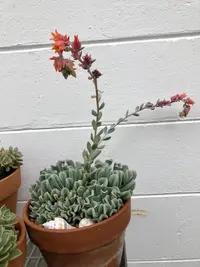
Echeveria runyonii 'Topsy Turvy' is a compact succulent from Mexico, valued for its distinctive twisted, downward-curving leaves. It forms tight rosettes that can slowly spread into small clusters over time.
Leaves are thick, powdery blue-gray and often look slightly folded, giving the plant a sculptural appearance. In the right conditions, it produces arching flower stalks with small, warm-toned blooms.
This species is adapted to bright, dry habitats and stores water in its leaves, which makes it relatively forgiving for beginners learning how to care for Echeveria. It prefers strong light, minimal excess moisture, and a very well-draining, gritty soil mix.

Care Difficulty
Easy Care

Light Preference
Full Sun

Water Requirements
Low Water

Temperature Preference
Tropical / Frost Sensitive

Hardiness Zone
9–11

Soil Texture
Sandy, Loamy, Rocky

Soil pH
Slightly acidic (6.5–7.0), Neutral (7.0)

Soil Drainage
Well-drained

Fertilization
Minimal (feed rarely)
Scan your plant to receive care tips personalized for your specific plant
Available on iOS and Android
This succulent needs bright, mostly direct light to stay compact and maintain its blue-gray rosette form.
Water is stored in the thick leaves, so the main goal is to avoid prolonged wetness around the roots.
This species prefers warm, dry conditions and is sensitive to prolonged cold and frost.
This succulent prefers dry indoor air and does not need added humidity.
This species needs a very fast-draining, mineral-rich mix that dries quickly between waterings.
This species is very suitable for container growing when excess water can drain away quickly.
This succulent needs only light feeding to support compact rosette growth and healthy leaf color.
Echeveria runyonii 'Topsy Turvy' needs only light, targeted pruning to stay tidy and healthy.
This species prefers tight pots and only needs infrequent repotting in well-draining soil.
This plant is commonly propagated from offsets, leaf cuttings, and stem cuttings in warm, bright conditions.
This succulent is frost sensitive and needs controlled conditions during cold weather, especially in cooler climates.

Plant Health Check
Not sure what's wrong with your plant? Check your plant's health inside the app.
The leaves curve inward and backward around the rosette, a growth form called contortion that results from uneven expansion of leaf tissues along the upper and lower surfaces.
This cultivar originated as a horticultural sport of Echeveria runyonii and is now considered stable, meaning its distinctive twisted rosettes are reliably passed on through vegetative propagation.
In suitable climates it typically sends up slender inflorescences in late summer to fall, producing small orange to coral, bell-shaped flowers that contrast strongly with the blue-gray foliage.
Leggy, stretched rosettes form when light is too weak or too distant, especially indoors. The plant elongates toward the light, leaves widen their spacing, and color may fade. Rotate and gradually improve light to prevent further stretch.
Keep your plants happy and healthy with plant identification, disease detection, and easy care guidance.

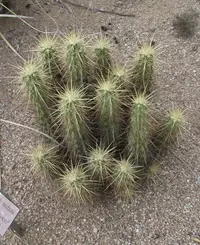
Nichol's hedgehog cactus
Echinocereus nicholii
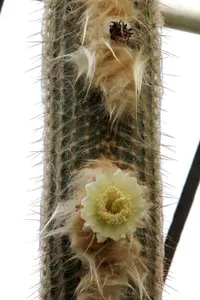
Espostoa melanostele
Espostoa melanostele

cottontop cactus
Echinocactus polycephalus
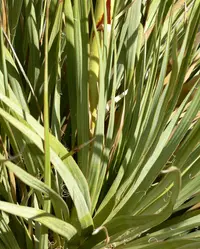
Bigelow's nolina
Nolina bigelovii
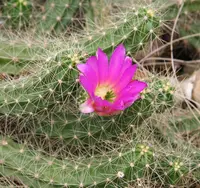
Echinocereus cinerascens
Echinocereus cinerascens
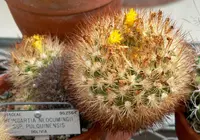
Cuming crown cactus
Rebutia neocumingii
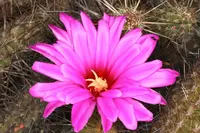
Brandegee's Hedgehog Cactus
Echinocereus brandegeei
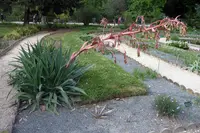
Beschorneria yuccoides
Beschorneria yuccoides