Deep pot selection
Use a deep, heavy clay pot with ample drain holes to stabilize the top‑heavy body and allow the strong taproot to anchor and develop properly.

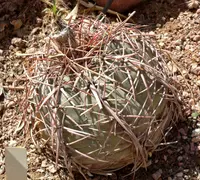
Echinocactus horizonthalonius, commonly called turk's head cactus, is a small, slow-growing desert cactus with a rounded, ribbed body and a woolly crown. Mature plants often stay solitary and form a dense cluster of spines that protect the stem from sun and herbivores.
This species is native to arid regions of northern Mexico and the southwestern United States, where it grows on rocky, limestone-rich slopes. Its slow growth, sensitivity to excess moisture, and need for high light make it more challenging than many common cacti.
Those factors mean gardeners should learn how to care for turk's head cactus before buying one, especially regarding drainage, watering restraint, and strong light exposure.

Care Difficulty
Hard Care

Light Preference
Full Sun

Water Requirements
Low Water

Temperature Preference
Warm Climate

Hardiness Zone
8–10

Soil Texture
Sandy, Rocky, Loamy

Soil pH
Slightly acidic (6.5–7.0), Neutral (7.0)

Soil Drainage
Well-drained

Fertilization
Minimal (feed rarely)
Scan your plant to receive care tips personalized for your specific plant
Available on iOS and Android
This desert cactus needs intense sun but benefits from gradual exposure to prevent scorch.
This species prefers deep but infrequent watering with thorough drying between soakings.
This cactus is adapted to hot, arid conditions but needs protection from hard frost.
This cactus thrives in dry air and rarely needs humidity adjustment indoors.
This species needs a very fast-draining, mineral-heavy substrate that mimics desert rocky soils.
This species is well suited to container growing when the pot is chosen to manage its slow, deep-rooting habit.
This slow-growing desert cactus needs only light feeding to stay healthy in cultivation.
Echinocactus horizonthalonius almost never needs structural pruning and is usually left to maintain its natural form.
This species grows slowly and prefers infrequent disturbance, so repotting is only needed every few years.
This cactus is mainly propagated from seed, as offsets are uncommon and removal can damage the plant.
This desert cactus benefits from a cool, very dry winter rest, with attention to temperature limits and moisture control.

Plant Health Check
Not sure what's wrong with your plant? Check your plant's health inside the app.
This cactus may take more than a decade to reach just a few inches across, reflecting its adaptation to nutrient-poor, arid limestone habitats in Texas and northern Mexico.
It naturally occurs on gypsum- and limestone-rich soils and rocky slopes, where high mineral content and sharp drainage limit competition from faster-growing plants.
The stem has broad, strongly defined ribs that run more horizontally than in many related barrel cacti, which helps the plant expand and contract with water storage while reducing surface stress in harsh sun.

In parts of its native range, this species has declined due to habitat disturbance and illegal collection, and some local populations are considered threatened, making responsible, cultivated sources important for Echinocactus horizonthalonius plant care.
This species grows very slowly, often adding only a few millimeters in diameter per year. In cultivation it may take 5–10 years to become noticeably larger, so minimal visible change over several seasons is normal.
Keep your plants happy and healthy with plant identification, disease detection, and easy care guidance.