


Encourage compact growth
Rotate the pot 90° every 2–3 weeks during active growth so the plant receives even light from all sides and develops a symmetric, compact body that supports heavy flowers better.

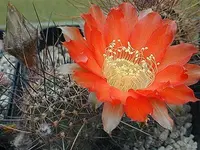
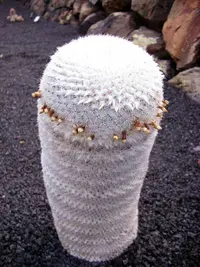
Echinopsis haematantha is a small, globular cactus known for its striking, brightly colored funnel-shaped flowers that often appear larger than the body of the plant. Plants usually stay compact, with dense spines that can vary in color and length between forms.
This species is native to high-altitude regions of Argentina and Bolivia, where it grows in rocky, well-drained habitats with strong light and cool, dry air. Its slow growth, drought tolerance, and compact size make it suitable for containers, though it dislikes prolonged dampness and poorly drained soil.
Understanding how to care for Echinopsis haematantha mainly involves providing strong light, very free-draining mineral-rich soil, and careful watering that allows the roots to dry between waterings.

Care Difficulty
Moderate Care

Light Preference
Full Sun

Water Requirements
Low Water

Temperature Preference
Warm Climate

Hardiness Zone
9–11

Soil Texture
Sandy, Loamy, Rocky

Soil pH
Slightly acidic (6.5–7.0), Neutral (7.0)

Soil Drainage
Well-drained

Fertilization
Minimal (feed rarely)
Scan your plant to receive care tips personalized for your specific plant
Available on iOS and Android
This compact cactus prefers strong light that mimics high-altitude sun but needs some protection from extremes.
Watering should imitate brief mountain rains followed by thorough drying.
This species prefers warm days with cooler nights and has some cold tolerance if kept completely dry.
This cactus prefers dry indoor air and rarely suffers from humidity issues.
This species needs a very free-draining, mineral-rich soil to prevent root rot.
This species is well suited to container growing when moisture is carefully controlled.
This compact cactus benefits from light feeding during its warm growing season but remains sensitive to excess salts.
This species needs only minimal pruning focused on hygiene rather than shaping.
This slow-growing cactus tolerates being slightly rootbound and only needs infrequent repotting.
New plants are most often produced from offsets, with seed used mainly for larger-scale or specialist growing.
This cactus needs a cool, very dry winter rest and is not suited to prolonged freezing outdoors in most climates.

Plant Health Check
Not sure what's wrong with your plant? Check your plant's health inside the app.
This species is native to rocky slopes of the central Andean region of Argentina and Bolivia, where it often grows above 3,000 m in intense sun, low humidity, and wide temperature swings between day and night.
Populations show strong natural variation in flower color, ranging from deep red and orange to yellow and even bicolored forms, which has led to the description of several local forms and varieties within the species.
It develops a pronounced tuberous taproot that stores water and nutrients, allowing the small above-ground stem to survive drought, cold nights, and high-radiation conditions in its native habitat.

In the wild, this cactus often grows tightly wedged among rocks or gravel scree, where the stem can remain partly buried and only the spines and flower buds are exposed, an adaptation that reduces heat stress and limits damage from wind and blowing debris.
This species usually blooms in late spring to summer, often producing several flushes in one warm season. Each flowering cycle is brief, but healthy, mature plants can repeat-bloom annually under stable, bright, dry conditions.
Keep your plants happy and healthy with plant identification, disease detection, and easy care guidance.

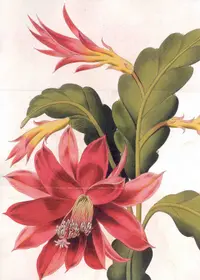
Disocactus ackermannii
Disocactus ackermannii
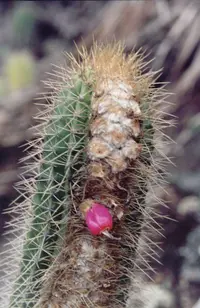
Coleocephalocereus fluminensis
Coleocephalocereus fluminensis
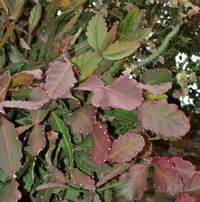
Rhipsalis pachyptera
Rhipsalis pachyptera
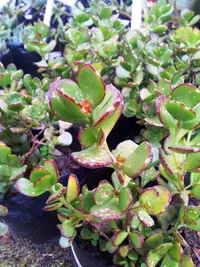
Cotyledon woodii
Cotyledon woodii
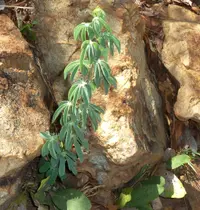 POPULAR
Blue leaf elephant foot
Adenia glauca
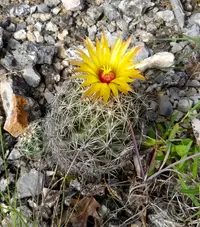
Pineapple Cactus
Coryphantha sulcata
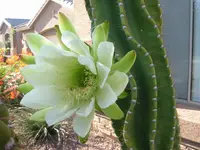
lady of the night cactus
Cereus hexagonus
Mammillaria albilanata
Mammillaria albilanata