


Rotate for symmetry
Rotate the pot 1/4 turn every 2–3 weeks so the stem and offset clusters develop evenly and do not lean toward the light source.

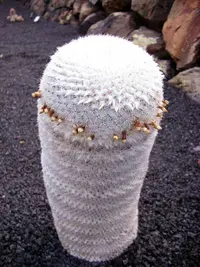
Mammillaria albilanata is a small, slow-growing cactus species known for its dense white spines that give the plant a softly frosted look. It usually stays compact and forms a single stem or a small clump over time.
This species is native to arid regions of Mexico, where it grows on rocky slopes with strong light and very sharp drainage. Its drought tolerance and modest size make it suitable for windowsills and small indoor collections.
Mammillaria albilanata is generally considered easy to grow if overwatering is avoided and the plant receives plenty of light and a gritty, fast-draining soil mix. Understanding how to care for Mammillaria albilanata mainly means respecting its desert origins and sensitivity to excess moisture.

Care Difficulty
Easy Care

Light Preference
Full Sun

Water Requirements
Low Water

Temperature Preference
Tropical / Frost Sensitive

Hardiness Zone
10–11

Soil Texture
Sandy, Loamy, Rocky

Soil pH
Slightly acidic (6.5–7.0), Neutral (7.0)

Soil Drainage
Well-drained

Fertilization
Minimal (feed rarely)
Scan your plant to receive care tips personalized for your specific plant
Available on iOS and Android
This small cactus prefers bright, direct light that mimics an open, arid habitat.
Watering should mimic brief desert rains followed by thorough drying.
This species prefers warm, dry conditions with a cooler, drier rest period.
This cactus prefers dry air and rarely suffers from low household humidity.
Use a very fast-draining, mineral-based mix to protect Mammillaria albilanata from root rot.
This species is well suited to container growing due to its compact, shallow-rooting habit.
Light feeding supports compact, healthy growth in Mammillaria albilanata without forcing soft, weak tissue.
Mammillaria albilanata needs minimal pruning, focused on cleanliness rather than reshaping the plant.
This cactus prefers being slightly root-bound and needs repotting only occasionally to refresh the substrate.
New plants of Mammillaria albilanata are commonly produced from offsets and seeds under warm, dry conditions.
Winter care focuses on keeping this cactus cool, very dry, and above freezing.

Plant Health Check
Not sure what's wrong with your plant? Check your plant's health inside the app.
This species develops a distinctive, dense white wool at the crown that often forms a sharply defined ring around the top of the stem, contrasting with the green body and pale spines. The wool helps protect the growing point from intense sun and reduces water loss in its native arid habitats.
It tends to offset freely from the base, forming tight, rounded clusters of many heads over time rather than remaining solitary. In mature specimens, these cushions can become quite broad, providing a large surface for flowering across many stems at once.
The radial spines are numerous, fine, and whitish, creating a soft-looking, snow-dusted appearance despite being firm to the touch. This gives the plant its characteristic pale body color that distinguishes it from many darker-spined Mammillaria relatives.
This species usually blooms in late winter to late spring, forming a ring of small, funnel-shaped pink to whitish flowers near the stem top. Flowers are followed by elongated red fruits containing tiny black seeds.
Keep your plants happy and healthy with plant identification, disease detection, and easy care guidance.

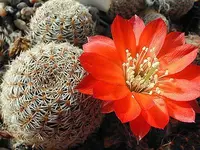
Aylostera albopectinata
Aylostera albopectinata
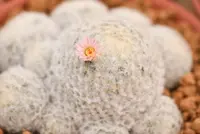
Powderpuff cactus
Mammillaria bocasana
 POPULAR
Blue leaf elephant foot
Adenia glauca
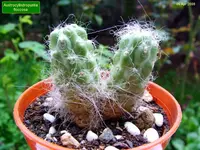
waraqu
Austrocylindropuntia floccosa
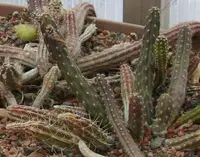
Austrocactus spiniflorus
Austrocactus spiniflorus
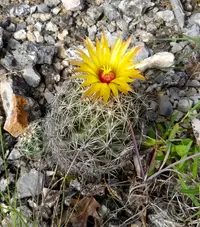
Pineapple Cactus
Coryphantha sulcata
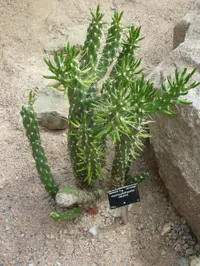
Eve's needle cactus
Austrocylindropuntia subulata
Cotyledon woodii
Cotyledon woodii