Deep pot choice
Use a deep, heavy clay pot with ample drainage holes so the long taproot can develop fully and the plant is less likely to tip over in strong sun or outdoor winds.

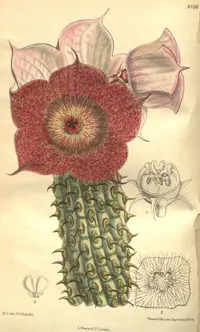
Namib hoodia (Hoodia currorii) is a leafless succulent from arid regions of Namibia and Angola, adapted to intense sun and very low rainfall. It forms upright, cactus-like stems with small spines and a clumping habit as it matures.
In suitable conditions, it may produce large, star-shaped flowers that are often dull-colored and sometimes strongly scented. The plant grows slowly and is sensitive to excess moisture, which makes it more challenging than typical houseplants.
Successful care for Namib Hoodia relies on strong light, excellent drainage, and careful watering that mimics its desert habitat.

Care Difficulty
Moderate Care

Light Preference
Full Sun

Water Requirements
Low Water

Temperature Preference
Tropical / Frost Sensitive

Hardiness Zone
10–11

Soil Texture
Sandy, Rocky, Loamy

Soil pH
Slightly acidic (6.5–7.0), Neutral (7.0)

Soil Drainage
Well-drained

Fertilization
Minimal (feed rarely)
Scan your plant to receive care tips personalized for your specific plant
Available on iOS and Android
This desert succulent needs intense light to develop compact, healthy stems.
This plant is highly drought-adapted and must dry thoroughly between waterings.
This succulent prefers hot, dry conditions with mild winters and is highly sensitive to frost.
This desert succulent tolerates very low humidity and rarely needs special humidity management indoors.
Hoodia currorii requires a very fast-draining, mineral-rich substrate that mimics rocky desert soil.
This species is suitable for container growing when the pot and drainage are chosen to keep roots dry and stable.
This desert succulent needs only minimal feeding to stay healthy in cultivation.
Hoodia currorii needs very light pruning focused on health and safety rather than shaping.
This slow-growing succulent prefers infrequent repotting and a stable root environment.
Propagation of Hoodia currorii is possible but slow, with seeds generally more reliable than stem cuttings.
This species is highly sensitive to cold and needs strict protection from freezing conditions.

Plant Health Check
Not sure what's wrong with your plant? Check your plant's health inside the app.
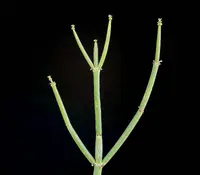
This species develops thick, columnar, gray‑green stems with a hard, corky surface that helps reflect intense desert sun while storing water for long dry periods.
In its native range in Namibia and Angola, it often grows wedged among rocks on arid slopes, where fissures provide slight shade, cooler root zones, and improved drainage.
The star‑shaped, often dull‑colored flowers emit a faint carrion‑like scent that attracts flies, which serve as the main pollinators in its native desert ecosystems.

Hoodia currorii is one of the more robust hoodia species and in habitat can form impressive clumps of many upright stems, which makes it a conspicuous structural element in otherwise sparse desert vegetation.
Growth is slow. Seedlings often take several years to form noticeable clumps, and stems usually extend only a few centimeters per year. Healthy plants focus energy on root and stem thickening more than rapid vertical growth.
Keep your plants happy and healthy with plant identification, disease detection, and easy care guidance.