Wind exposure management
Site the plant where it receives steady light wind but is protected from extreme, drying gusts, for example behind a slatted fence, to keep canes upright and reduce mechanical stress on the root system.

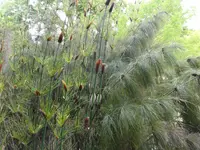
Broom reed (Elegia capensis) is a reed-like restio from South Africa’s Cape region, where it grows in windy, coastal and fynbos habitats. It forms upright, tufted clumps with slender, jointed green stems and fine side-branches that give a soft, feathery texture.
Mature plants can develop an architectural, fountain-like shape that suits modern and naturalistic gardens. The plant is adapted to nutrient-poor, sandy soils and seasonal rainfall, which influences how to care for Broom reed in cultivation.
It generally prefers full sun, regular moisture without waterlogging, and sharply drained, acidic to neutral soil to stay healthy and long-lived.

Care Difficulty
Moderate Care

Light Preference
Full Sun

Water Requirements
Keep Soil Moist

Temperature Preference
Warm Climate

Hardiness Zone
9–11

Soil Texture
Sandy, Loamy, Organic-rich

Soil pH
Acidic (5.5–6.5), Slightly acidic (6.5–7.0)

Soil Drainage
Moist but well-drained

Fertilization
Minimal (feed rarely)
Scan your plant to receive care tips personalized for your specific plant
Available on iOS and Android
This restio prefers bright, open conditions that mimic its South African fynbos habitat.
This species is adapted to moist, seasonally wet soils and dislikes long dry periods at the root zone.
This restio prefers mild, maritime-type climates with cool, moist winters and warm but not extreme summers.
This restio prefers consistently moist air but adapts to average home humidity if soil moisture is stable.
Elegia capensis needs a moist, airy medium that drains freely yet never dries out completely.
This species can grow successfully in containers outdoors if moisture and stability are managed carefully.
Elegia capensis prefers lean, sandy soil and only light feeding when grown in containers or poor ground.
Pruning Elegia capensis focuses on removing old material and keeping the clump open and upright.
Elegia capensis is usually grown in the ground, but container plants or young clumps sometimes need transplanting.
Propagation of Elegia capensis is possible but slower than many ornamental grasses and requires patience.
Elegia capensis tolerates only light frost, so winter care is important in colder climates.

Plant Health Check
Not sure what's wrong with your plant? Check your plant's health inside the app.
This species is native to the Western Cape of South Africa, where it grows in fynbos, a fire-prone shrubland with nutrient-poor, sandy soils and a strongly Mediterranean climate.
It belongs to the Restionaceae, a family of reed-like plants that replace grasses in many South African fynbos habitats, forming stiff, jointed culms and fine branchlets that create its characteristic broom-like appearance.
In its native range it is part of a fire-adapted plant community, where populations regenerate after periodic wildfires that clear competing vegetation and release nutrients into the soil.

Elegia capensis is widely used in South African and international floristry as a long-lasting, textural foliage element, with its durable, broom-like stems often harvested and dried for arrangements and ornamental landscaping.
Browning usually comes from inconsistent moisture, hard tap water, or excessive fertilizer salts. Wind scorch and low humidity can also dry leaf tips. Flush the soil occasionally, maintain even moisture, and remove worst-affected foliage to improve appearance.
Keep your plants happy and healthy with plant identification, disease detection, and easy care guidance.