Use host debris
Place well-rotted leaf litter and small twigs from broadleaf trees over the cultivation area, as this mimics the natural woodland habitat and encourages the fungus to colonize the upper soil layer.

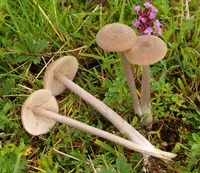
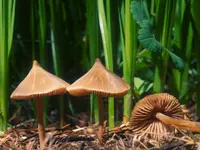
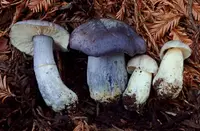
The felted pinkgill, Entoloma griseocyaneum, is a small woodland mushroom, not a leafy houseplant. It forms slender stems topped with conical to bell-shaped caps in gray-blue to brown tones, often with a slightly velvety surface.
This fungus typically appears in grasslands, meadows, and light woodland in temperate regions, often in autumn. It usually grows scattered or in small groups rather than dense clusters.
Because it is a mycorrhizal fungus, living in association with surrounding plants and soil life, it is not practical to cultivate indoors or in pots. For those curious about how to care for felted pinkgill, it is best appreciated in its natural habitat rather than as a managed garden or indoor species.

Care Difficulty
Hard Care

Light Preference
Partial Shade

Water Requirements
Regular Water

Temperature Preference
Cool Climate

Hardiness Zone
Unknown

Soil Texture
Loamy, Silty, Organic-rich

Soil pH
Strongly acidic (4.5–5.5), Acidic (5.5–6.5)

Soil Drainage
Moist but well-drained

Fertilization
Minimal (feed rarely)
Scan your plant to receive care tips personalized for your specific plant
Available on iOS and Android
This small woodland mushroom prefers cool, soft light similar to that of a shaded forest floor.
This fungus relies on consistently moist, but not waterlogged, soil to form healthy fruiting bodies.
This species prefers cool to mild conditions and is sensitive to both hard frost and strong heat.
This fungus forms fruiting bodies best in consistently moist, cool air rather than dry indoor conditions.
This woodland fungus depends on naturally structured, moist but well-drained soil rather than a potting-style mix.
This species is generally unsuitable for container growing, as it relies on complex soil and ecological interactions that containers cannot replicate reliably.
Entoloma griseocyaneum is a wild, soil-dwelling fungus that does not benefit from conventional fertilization in gardens or containers.
Entoloma griseocyaneum does not require pruning, since mushroom fruiting bodies are temporary structures, not permanent stems or branches.
This fungus is not suited to normal pot culture, so repotting or transplanting focuses on preserving its native soil community.
Intentional propagation of Entoloma griseocyaneum is rarely attempted and is technically demanding outside scientific or specialized cultivation setups.
In its natural range this fungus is cold hardy and needs no special winter care in gardens or lawns.

Plant Health Check
Not sure what's wrong with your plant? Check your plant's health inside the app.
The cap is bluish grey when moist but fades to a much paler grey as it dries, a trait known as hygrophany that helps field mycologists separate it from similar brownish Entoloma species.
Its spores are distinctly angular and pink in spore print, a combination typical of Entoloma but with a small, sharply polygonal shape that is important for reliable microscopic identification.
It typically fruits in short flushes in unimproved grassland and mossy lawns, with individual mushrooms persisting only a few days, which contributes to how easily this species can be overlooked in the field.
This species is considered inedible and potentially poisonous due to the harmful compounds typical of the Entoloma genus. It must not be eaten or taste-tested, and it should never be used as a substitute for edible mushrooms.
Keep your plants happy and healthy with plant identification, disease detection, and easy care guidance.