

Substrate pre-conditioning
Before inoculation, moisten and pasteurize hardwood sawdust or a sawdust–straw mix at 160–170°F for 1–2 hours to reduce competing fungi and bacteria while preserving beneficial microbes that help the mycelium establish.

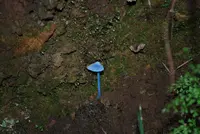
Skyblue pinkgill, Entoloma virescens, is a small, delicate mushroom rather than a leafy plant. It is recognized by its soft blue to blue‑green cap and pale gills that often develop a pinkish tint as the spores mature.
This species typically appears on soil or among leaf litter in woodland or grassland habitats, depending on local conditions. It has a modest, low‑growing habit and usually fruits in scattered groups rather than dense clusters.
Because it is a wild fungus with specific ecological partners and microclimate needs, it is not an easy subject for home cultivation. Attempts to care for skyblue pinkgill should focus on maintaining a stable, cool, moist environment and undisturbed, organic‑rich ground.

Care Difficulty
Hard Care

Light Preference
Partial Shade

Water Requirements
Keep Soil Moist

Temperature Preference
Warm Climate

Hardiness Zone
Unknown

Soil Texture
Loamy, Organic-rich, Peaty

Soil pH
Acidic (5.5–6.5), Slightly acidic (6.5–7.0)

Soil Drainage
Moist but well-drained

Fertilization
Minimal (feed rarely)
Scan your plant to receive care tips personalized for your specific plant
Available on iOS and Android
Entoloma virescens is a woodland fungus that fruits best in soft, indirect light rather than open sun.
This fungus relies on consistently moist, not saturated, soil to produce healthy fruiting bodies.
This species prefers cool to mild conditions, similar to a shaded woodland floor.
This fungus requires consistently high ambient humidity to form and maintain healthy fruiting bodies.
Entoloma virescens fruits best in moist, loose, organic-rich ground with reliable drainage.
This species is generally unsuitable for container growing beyond short experimental cultivation.
Entoloma virescens is a woodland fungus that relies on natural soil nutrients rather than added fertilizer, so routine feeding is not recommended for skyblue pinkgill.
Entoloma virescens does not require pruning, as individual mushrooms are seasonal fruiting bodies rather than long-lived stems or branches.
This fungus is not suited to typical repotting or transplanting, since it depends on complex soil and microbial relationships in the ground.
Reproducing Entoloma virescens is challenging for home growers and is generally left to natural spore dispersal in suitable habitats.
Outdoor populations of Entoloma virescens normally need no special winter care, as the mycelium remains in the soil while fruiting bodies disappear.

Plant Health Check
Not sure what's wrong with your plant? Check your plant's health inside the app.
The cap and gills often develop a greenish to bluish staining as the fruiting body ages or is bruised, which helps distinguish this species from other pink-spored mushrooms.
Despite its greenish tones on the cap, the fungus produces a distinctly pink spore print, a key diagnostic feature used by mycologists to separate it from visually similar green-capped species.
This species grows on soil and among leaf litter, where it contributes to breaking down organic matter and recycling nutrients in forest and woodland ecosystems.
This species is considered inedible and potentially poisonous. Identification within Entoloma is difficult, and some related species are seriously toxic. It is safest to treat all similar blue entolomas as non-edible and avoid consumption entirely.
Keep your plants happy and healthy with plant identification, disease detection, and easy care guidance.

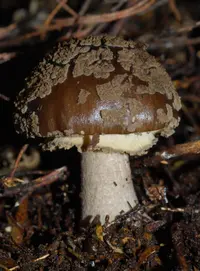
Southern Beech Amanita
Amanita nothofagi
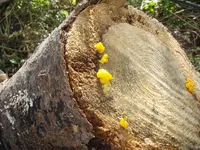
Orange Jelly Spot
Dacrymyces chrysospermus
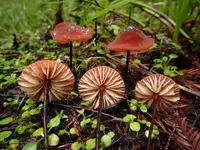
red pinwheel
Marasmius plicatulus
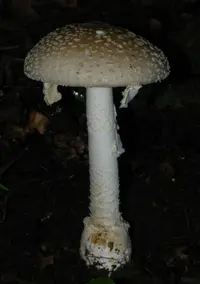
Small Funnel-Veil Amanita
Amanita multisquamosa
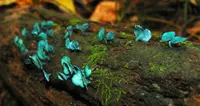
Green Wood Cup
Chlorociboria aeruginascens
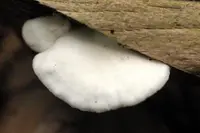
Peeling Oysterling
Crepidotus mollis
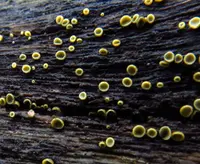
Chlorosplenium chlora
Chlorosplenium chlora
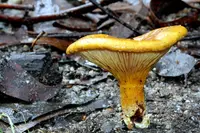
Austropaxillus infundibuliformis
Austropaxillus infundibuliformis